Unprecedented flooding is quickly becoming a fact of life in some Southern California coastal communities.
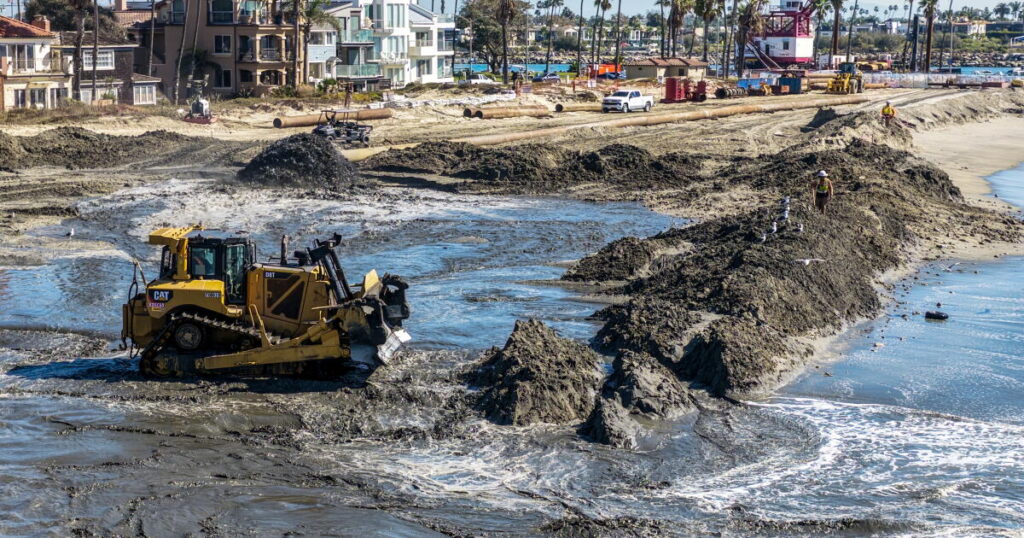
On Monday morning, high tide brought water pouring into business districts in Newport Beach and flooded part of Pacific Coast Highway in Sunset Beach. Sea water levels reached an all-time record high in San Pedro, topping 8 feet. Conditions are expected to get worse Tuesday.
What’s going on? After all, Southern California has endured El Niños before, as well as unusually high tides.
The difference, scientists say, comes to how hot the ocean waters have been. Hot water takes up more room than colder water, causing sea levels to rise. This week — even without any former hurricanes in the Pacific Ocean to send swells to the California coast — maximum sea levels recorded at high tide are now nearly 2 feet higher than what would be expected from just astronomical forces that bring us high tides.
“The waters along the immediate coast of California are actually at record warm levels for the time of year, all the way from about the Farallon Islands south to Baja California,” UC Agricultural and Natural Resources climate scientist Daniel Swain said in an interview Monday.
Because hot water raises sea levels, “the thermal expansion right now is comparable to, or even greater than, [what] we’ve really ever seen before of the seawater,” Swain said. “That’s starting to be a pretty significant elevation of sea level that has both direct and indirect contributions from El Niño, plus the background warming of the ocean.”
An analysis of data posted to the website CyclonicWx shows that sea surface temperatures are at record-high levels off the California coast, as well as off the coast of the Baja California peninsula and a wide swath of the eastern Pacific Ocean. That record dates back to 1982.
There are several reasons why we’re seeing what appears to be an unprecedented onslaught of coastal flooding these last few months.
Part of the issue is how intensely strong this El Niño is. El Niño is a climate pattern that occurs when temperatures in the central and eastern tropical Pacific Ocean — essentially west of Peru — become warmer than normal. And sea surface temperatures are intensely hotter than normal.
“I call it El Niño Macho,” said Josh Willis, a NASA climate scientist. “It’s probably going to be be similar to or bigger than the 1997 one, which was, you know, like trillions of dollars of damage worldwide. It was a massive global event, and we’re on track to be that big or bigger.
“Now we’ve also had 20 years of climate change since then, right? So sea levels are higher,” Willis said.
Seawater levels have risen by about 1 foot off the California coast over the last 125 years.
And temperatures are hitting eye-popping figures.
“It’s more than 9 degrees warmer off of South America right now,” Reinhard Flick, a researcher at the Scripps Institution of Oceanography at UC San Diego, said in an interview. And that’s what’s fueling what is shaping up to be an extraordinarily strong El Niño.
At Scripps Pier in La Jolla, the sea surface temperature Monday was 73.8 degrees, significantly above the average for the calendar day, which is 64.7 degrees. That’s 9.1 degrees above average.
“The water was warm all year off of Southern California, but the El Niño is now enhancing that and keeping it warm, where naturally it would drop,” Flick said.
At the Los Angeles Harbor in San Pedro on Monday, the sea level hit 8.02 feet above the baseline, which is defined as the average daily lowest-water level observed between 1983 and 2001. That broke the previous record set during another El Niño, on Jan. 10, 2005, when the sea level hit 7.93 feet.
The 8.02-feet reading came in 1.42 feet higher than what would be predicted by the position of the moon, Earth and sun alone, with the difference being “caused by a combination of thermal expansion due to the warmer waters off our coast and Kelvin wave contribution, on top of the baseline very high astronomical high tide,” said David Gomberg, meteorologist with the National Weather Service office in Oxnard.
On Monday, streets flooded from Newport Beach to Long Beach. As high tide peaked Monday morning, water surged from Newport Harbor onto the streets of the Balboa Peninsula, flooding some businesses in the Balboa Fun Zone. Crews worked to pump out the knee-high water and reinforce sandbags along the harbor side of the peninsula.
In Long Beach, residents reported flooding along Bayshore Beach, Naples and the peninsula. Nancy Pinckert, a resident of Naples, recorded video showing water leaking through the base of a seawall onto a walkway. “The Naples seawalls are undergoing profound stress during these current high tides,” Pinckert said, who worries that the city hasn’t done enough to replace the aging seawalls for her neighborhood. She said she’s worried the November and December king tides “will breach the seawalls for the first time ever.”
A Kelvin wave earlier this month passed off the California coast. It isn’t a wave that is obviously visible at the sea surface and can’t be surfed, and moves at only 6 mph, but it does move warmer water from the equatorial Pacific Ocean up and down the coast of the Americas, and along the California coast. Its arrival earlier in October, combined with the effects of the swells from Tropical Storm Rachel, contributed to dramatic flooding of homes on the Long Beach Peninsula and the streets of Newport Beach earlier this month.
Some Californians have noted how unnaturally warm the ocean has felt, and scientists agree. “Absolutely, it’s highly unnatural, and it’s bad for the ecology,” Flick said. Sports fishermen might celebrate the arrival of unusual fish, but “if it persists, it’s a serious event for the birds and for the plankton.”
“A lot of the California coast is 5 to 9 degrees Fahrenheit warmer than average in terms of water temperature. … That really is enormous,” Swain said. It’s about 9 degrees hotter than average on the Central Coast, and 5 degrees warmer elsewhere off of Southern California and around the Farallon Islands west of San Francisco, he said.
A second reason is that we’re near the peaks of some of the highest tides California ever sees over the course of the century — what’s known as the 18.6-year lunar node and 4.4-year lunar perigee tidal cycles. They arise from small changes in the orbit of the moon and affect tide-generating forces, according to Flick.
That cycle is expected to cause even higher tides around the Thanksgiving, Christmas and Martin Luther King Jr. Day holidays. Should a strong storm arrive during those time periods, that could cause even more severe coastal flooding.
Something like that happened during the historic storm of late January 1983, which occurred during one of the strongest El Niños on record and battered the coast up and down California, damaging many piers. A strong storm arrived at precisely a time of the month when the tides were very high, according to Flick.
While the pace of coastal flooding may feel unbelievable to some, it was predicted months ago, during a town hall where Mark Merrifield, director of UC San Diego’s Center for Climate Change Impacts and Adaptation, warned that he expected “likely the highest sea levels ever recorded on the California coast associated with this event,” referring to the strengthening El Niño. ““Flooding … along the Southern California coast is likely to be a major issue for the winter season.”
If anything, the flooding arrived even earlier than that prediction. An unusually active hurricane season in the eastern Pacific Ocean — something expected during an El Niño — materialized, and remnants of former Hurricane Marie over Labor Day weekend sent seawater flooding homes on the Long Beach Peninsula and along Beach Road in Dana Point. A sinkhole opened up in the driveway of actor Nicolas Cage’s Malibu home, forcing evacuation orders for dozens of nearby homes.
The post The California coast’s great enemy: Record-hot ocean temperatures from El Niño appeared first on Los Angeles Times.