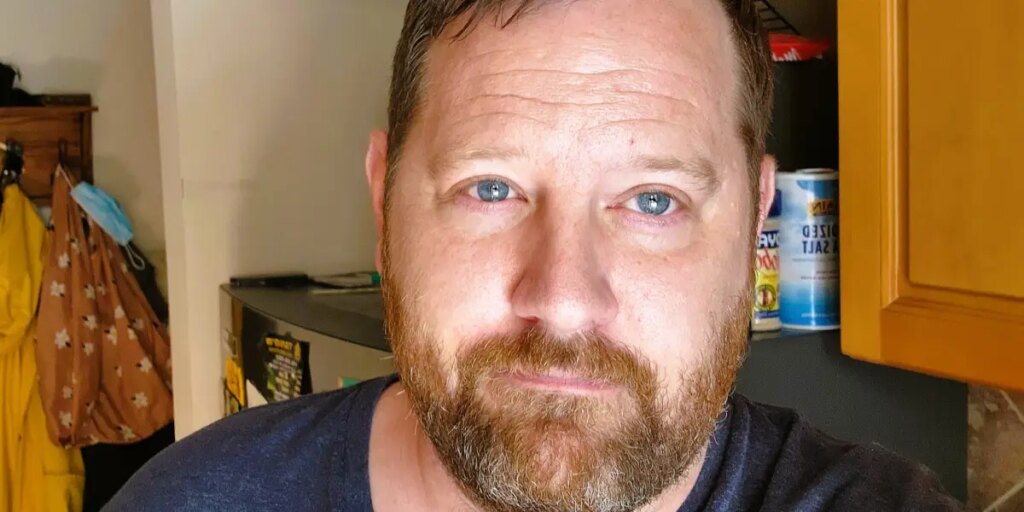
Fredrik (Freddie) deBoer met three mothers who told him they had spent years keeping their adult children, all with severe schizophrenia, alive and out of institutions. He spent about two hours with them while recording a podcast, and what stuck with him was their exhaustion. He said they were thankful for his controversial statements because, as they put it, “we’re not allowed to weigh in on this stuff.”
“It just offended me so deeply,” deBoer told Fortune from his home office in Connecticut.
That conversation led to a 2022 essay, “The Gentrification of Disability,” and that has turned into a book, “All in Your Head: Illness as Identity, Trauma as Fashion, and the Desire to be Disordered,” which comes out Oct. 27 from Simon & Schuster. It attacks the anti-psychiatry movement, trauma culture and the casual use of disability and diagnosis labels, while also tracing how deinstitutionalization left the most severely ill to homelessness and jail. “I did this to pick this fight because I really, really am deeply offended by that,” deBoer said.
He should know because he’s “part of the gentry,” he said. “I have a mental illness and I’ve been through the system.” DeBoer has bipolar disorder and was first hospitalized for a psychotic episode in 2002, as he has often written and talked about. In August 2017, after stopping his medication, he had what was diagnosed as an “acute psychotic episode due to bipolar mania,” during which he made a false public accusation against another writer and harassed people online. “My false accusation was a terrible crime against him, and I am and will remain terribly sorry,” deBoer wrote in a 2021 Substack post, insisting that his illness didn’t excuse his conduct: “I am responsible.”
There was a steep professional cost. He was teaching at Brooklyn College and “my relationship to the school or my supervisors was never the same,” he said. He left in 2020. He also deleted his social media accounts and largely stopped freelancing, with his income ultimately dropping more than a third. He has since rebuilt his career through his newsletter and books that bear his pugnacious, intelligent tone, including “The Cult of Smart” in 2020 and “How Elites Ate the Social Justice Movement.”
“It’s probably very predictable,” deBoer told Fortune when asked about how his latest will land. Mainstream liberals will mostly hate it. Right-leaning dissidents and some on the dissident left will like it, while he predicted the parents and relatives of people with severe autism will embrace it. They feel “very silenced and disrespected by the whole neurodiversity thing,” he explained, getting to his book’s thesis, that disability as a condition and disability as an identity have become decoupled.
Liberals will drift toward their “safe space,” he said: being against his book and being against him in general, driven less by conviction than by who’s in their out-group.
The leftist who fights with liberals
DeBoer has spent much of his life deep inside the liberal bubble. A faculty brat, he grew up on the campus of Wesleyan University in Middletown, Conn. The 1994 campus comedy PCU, starring Jeremy Piven and a young Jon Favreau in a Gen X update of Animal House in the era of political correctness, was based on his hometown. (He said one of the screenwriters, Zak Penn, was a student of his father’s.) “It’s a parody, but it’s not an exaggeration,” he said.
His central claim is that mental health culture has created a situation where over time, the people who are least afflicted get the most attention. In the book, an advance copy of which was reviewed by Fortune, he returns to his gentrification metaphor: disability used to be the poor part of town, then “a new kind of person has moved in, more privileged, less burdened, becoming the loudest residents.” He offered the example of an affluent, educated person with anxiety and depression who blogs about what mental illness is like, whereas, as he writes, “catatonic schizophrenics do not make TikToks.”
“Disabilities are things that decent people know not to make fun of,” deBoer insisted. The reason he wrote his essay and then this book, he added, is because calling yourself autistic or having ADHD, rather than a statement about a condition, increasingly amounts to saying, “here is a presentation of myself you are not allowed to make fun of.” He said it’s “all very human” and he understands why it’s happening, “but I’m trying to be the one to talk about why it’s destructive as well.”
The author cited his support group experience as an example. “Now it’s all trauma.” The assumption is that any psychiatric condition traces back to a single event, like a case of OCD explained by something that happened at age 4. That’s not just wrong, he said, but actually offensive in light of the very strong evidence of genetic influence on many psychiatric conditions. And it matters because it shapes treatment. PTSD once described soldiers recovering from firefights or survivors of torture, but now people go online to say “I experienced trauma when I didn’t get into Brown.” He described trauma as “just this big floating nothing” that is becoming a worthless contradiction. We are entering a world where “there cannot be a single human being who has not experienced trauma,” and yet “they also want trauma to be meaning-bearing and to have consequences.”
This is not just an intra-left fight. “Everyone knows this is unsustainable and doesn’t work, but everyone in charge just says, ‘Just don’t get sued.’” Elite colleges are making a mockery of actual disability, he said, citing a December 2025 Atlantic analysis that found over 20% of undergraduates at Harvard and Brown are registered as disabled, while Amherst has 34% and Stanford close to 40%.
The bigger cost in K-12 schools, he said. “To the degree that there’s a fiscal crisis in American public schools, it’s a special ed crisis.” He passed along stories from teachers, including one whose class had half its students on individualized education plans, another had 10 students entitled to sit at the front of the room.
The internet is making things worse, deBoer said, a creature of the internet himself. The damage he sees comes less from traditional social media than gated spaces such as Reddit, Discord and group chats, citing a TikTok trend in which teenage girls are claiming to have dissociative identity disorder. In another age, “someone would have said, ‘Hey, knock it off, you weirdo.’”
DeBoer rejected the label of “contrarian,” saying he follows a “pretty traditional lefty point of view” and placing himself in the company of Eric Hobsbawm, Michael Parenti, Todd Gitlin, Barbara Ehrenreich and Adolph Reed. (Ehrenreich’s classic “Nickel and Dimed” was visible on his bookshelf over his right shoulder.) “I’m more woke than 90% of the population,” he insisted, challenging critics to name a single issue where he’s right wing. “Palestine, abortion, food stamps, imperialism,” he reeled off issues where he feels certain he’s staked out a left-wing ground.
The issue is about his discourse. “Principle comes before association,” he said. “Unfortunately, the only thing people care about right now is association.” People with disabilities need more than that, is his point.
The post ‘I’m more woke than 90% of the population’: Freddie deBoer knows his new book about psychiatry and disability will piss you off—and welcomes it appeared first on Fortune.