Ted Baker felt a heaviness in his chest, then collapsed near his kitchen. His wife, fearing her 76-year-old husband was having a heart attack, called 911. But she knew the ambulance would never reach their doorstep.
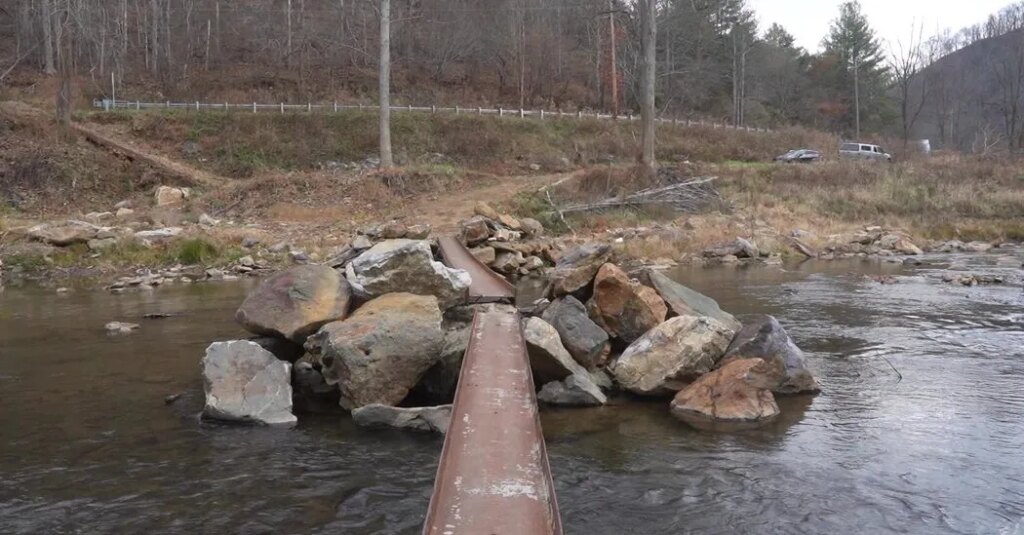
Their private bridge, the only way to cross the Cane River to their home in Burnsville, N.C., had been swept away by Hurricane Helene in 2024. They had applied for a state program to get it fixed. Now months had passed without progress, and an emergency crew was on the other side of the river, trying to figure out how to reach Mr. Baker.
The medics inched along a steel beam that the Bakers had been using as a makeshift crossing. Evelyn Baker watched them through the living room window as she held her husband. “Please hurry,” she thought.
The Bakers are among the hundreds of households across western North Carolina still missing a private bridge two years after Helene devastated the region. That is despite a $175 million state recovery program to rebuild such private bridges and roads, which are prevalent across a mountainous region carved by creeks and rivers.
A document obtained by The New York Times shows the state program had rebuilt only 44 private bridges as of Sept. 15. Hundreds of sites are still in need of private bridge assistance, and some estimate that number could near 1,000.
Living without a bridge here is dangerous and lonely. Emergency crews can’t reach houses, making house fires and medical scares more hazardous. Friends rarely come over because driving through a shallow creek is difficult and damages vehicles. Older residents worry about another winter walking on steel beams prone to icing.
“They want to help us,” Ms. Baker said, referring to the state. “But they get tied up in all that red tape.”
More than a dozen contractors, recovery leaders, and former and current state officials said in interviews that stringent new requirements on contractors, bridge plans and nonprofits imposed by the state had led to ballooning costs and long delays.
“There’s a lot of hurdles to jump over,” said Marquis Ferguson, whose construction company, WMF Land Services, worked with the state to rebuild private bridges in the past. “They’ve slowed down even more now.”
North Carolina officials say the program is prioritizing making new bridges more resilient so they will outlast the next disaster.
Justin Graney, a spokesman for North Carolina Emergency Management, which is overseen by the governor’s office, said in a statement that “there is always room for improvement, and each process undergoes continuous review for ways to streamline — all with the survivor in mind.”
He added that the program “strives to improve daily with faster results, safe repairs, and ensuring the best use of the funding provided.”
Frustrations about the program have unfolded during pivotal midterm races in the state. North Carolina Democrats have highlighted the Trump administration’s deficiencies with Helene recovery as they seek to flip a Senate seat and a congressional district that encompasses the state’s western region.
Gov. Josh Stein, a Democrat, has also made Helene recovery a top priority of his administration.
He recently criticized President Trump’s joke about withholding Helene funding if Michael Whatley, his chosen candidate for Senate, does not win.
But anger over the program’s progress could further erode the Democratic Party’s standing in conservative-leaning western counties still struggling to recover from the deadliest storm in state history. More than 100 people were killed; officials estimate the storm caused nearly $60 billion in damages. And the destruction to private bridges in particular was unlike that in any natural diaster in memory.
“They just forgot about us,” said Heidi Hawkins, 65, whose bridge was damaged during Helene. “They’re treating this with no level of urgency. It’s abysmal.”
Ms. Hawkins still drives across her cratering bridge because her back pain is too severe to carry groceries. The steel is warped, and it appears on the brink of collapse, but her $900-a-month income cannot cover costs for a new one. On a recent drive out, she crossed her fingers and felt the 15-foot bridge rumble and creak.
About five miles south, Annemarie Van Gyn stood on her steel beam and saw the river swirl below her. She was about 20 feet in the air, with no rail to hold on to. Lugging dog food, she looked up at the sky to stave off vertigo.
“I don’t get my hopes up anymore,” Ms. Van Gyn said. “We feel abandoned.”
Mr. Stein said in a statement that people in western North Carolina deserved a government that moves with urgency. “We are constantly taking a hard look at every program, including this one, to find any way to move faster,” he said.
For generations, families settled near bodies of water across North Carolina’s mountains, building 15- to 75-foot bridges, often made from locust logs and steel, that had survived decades before Helene. Nowadays, the price of new private bridges can range from around $50,000 to hundreds of thousands of dollars — steep costs in a largely poor region.
That is why people were hopeful about the state’s private road and bridge program. (The Federal Emergency Management Agency is of little help with private bridge repairs because its individual assistance grants for all types of property damage are capped at around $40,000.)
But recovery efforts faced challenges right away, several local leaders said, because of a decision by the Stein administration to disband a program that had rapidly repaired private bridges destroyed during a 2021 storm. Many in deeply conservative and government-wary communities still praise that program, which used a small team to find and pay trusted local contractors to make the repairs following county regulations.
With only $15 million, the program completed hundreds of private road and bridge projects about a year after the storm. It is unclear why that program or its tactics were not used for Helene recovery.
Under the current program, the projected price of rebuilds and repairs appears to have grown significantly over time. Last fall, the state estimated that it would cost half a billion dollars to complete the 3,700 projects on the program’s list, according to a document obtained by The Times. Officials now assert the $150 million allocated to the program would cover only 371 projects, far fewer than anticipated.
Some residents impatient with the state took on debt, drained retirement savings or continued to wait and hope that nonprofits would eventually rebuild their bridges.
Mr. Graney, the spokesman for Emergency Management, said “the scale and complexity of repairing private roads and bridges” was “very different” for Helene compared with Tropical Storm Fred in 2021. Chris Werner, the first director of the Helene program, said comparing the two programs was akin to “apples and oranges.” He added that he was proud of completing about 50 projects during his 11-month tenure.
The Helene program got off to a slow start last year because only a certain type of contractor with a “highway classification” could build private bridges. That had largely not been the case before Helene. The rule was clarified and enforced only last year.
Those specialized contractors typically bid on expensive public infrastructure projects — not private bridges. The rule prevented nearly all local contractors from working on private bridges, as they had for decades, halting construction for months. Many moved on to other jobs amid confusion.
Among them was Michael Allen, a contractor in Buncombe County, N.C. Mr. Allen said he had several private bridge projects lined up, but the rule meant he could not complete them.
“How is it fair to have people dreading to leave and get back home?” he asked.
The highway classification rule was fixed in December after blowback. Mr. Graney said the state had worked to get the rule changed. By then, hardly any bridges had been completed, records and interviews show.
Engineering plans mocked up under the state program are also making private bridges quadruple and quintuple the typical price, up to more than $1 million per project, according to contractors, nonprofit builders and engineers who have reviewed them.
The state says the costs are tied to resiliency improvements and, in some instances, changes to topography after Helene. But builders say they could construct those same bridges for much cheaper.
Under the old program, the state built like-for-like private bridges that were enhanced up to code only if needed.
Bridge-building nonprofits once considered critical partners are no longer working with the state. Emergency Management has $10 million to reimburse nonprofits for private roads and bridges, but none of it has been spent. The reason is that the state is demanding nonprofits pay all costs upfront, using its strict and expensive engineering stipulations.
“It’s completely untenable,” said Josh Hensley, executive director of A Bridge Home. “This is directly causing fewer families to get help.”
In response to questions from The Times, Mr. Graney said the program “is being revised to serve a wider group of nonprofits going forward.”
On that June afternoon, medics made their way to Mr. Baker. They hoisted him onto a rescue stretcher for rough terrain and raced back across the long steel beam to the ambulance. He survived.
The Bakers have been told by a state program official that their bridge won’t be finished until next year. They are grateful for the help, they say, and relieved to still have a home.
Still, the numbers weigh heavily in Mr. Baker’s mind: Five heart bypasses, three heart stents, one pacemaker and who knows how many more days without a bridge.
Allison Joyce contributed reporting. Kitty Bennett and Kirsten Noyes contributed research.
The post The Storm Wrecked Their Bridges. ‘All That Red Tape’ Left Them Stranded. appeared first on New York Times.