California’s conservative Central Valley is not where you’d expect Senator Bernie Sanders, the Vermont progressive, to hold a campaign rally ahead of the midterms.
But this working-class region of grape farmers and cattle ranchers, parched by 100-degree autumn heat, was Mr. Sanders’s destination one recent October evening as he strove to usher in the wave of left-wing populism that he has dreamed of for decades.
The left’s incursion this year into Republican turf, far from the liberal cities that have long served as its base of support, shows either how many gains progressives have made this election season or how wrong they are about what everyday Americans think of left-wing politics.
The answer will arrive on Nov. 3.
All year, Mr. Sanders and his allies have promised that their liberal candidates, backing ambitious goals including taxing billionaires and passing “Medicare for all,” would prove more popular with voters than centrist Democrats and their more cautious rhetoric. Left-wing candidates embracing such policies scored a raft of wins in Democratic primaries, not only in deep-blue cities but also in competitive races where Democrats have traditionally picked moderates to face Republican opponents.
But the left has insisted that its working-class focus and bold agenda are resonating even among moderates and Republicans in the general election, and in battleground districts such as the Central Valley. It’s a bet with potentially huge consequences, given how crucial these districts are to Democrats’ hopes of winning control of Congress.
If progressive candidates win big, they will most likely claim a mandate from the electorate to push left-wing policies in Congress next year. Failure, however, would allow the Democratic establishment to continue to argue that moderate and independent voters prefer centrist politicians — which will inform which types of candidates the party will encourage as it seeks to expand the map of places it can compete in. And midterm losses would also most likely set back progressives seeking to play a role in the Democratic presidential nomination in 2028.
Aware of the stakes, Mr. Sanders has embarked on a final-stretch campaign swing across the country to shore up his progressive protégés. In the Central Valley, he rallied in Bakersfield in support of Randy Villegas, the left-wing challenger to Representative David Valadao, a tenacious Republican who has resisted past challengers but has been made newly vulnerable by redistricting.
In an interview there, Mr. Sanders said he was focused primarily on campaigning for progressive Democrats in four competitive Senate races: Michigan, Maine, Minnesota and Florida. He said Lt. Gov. Peggy Flanagan in Minnesota faces “a tougher race than some people think,” while in Florida, he believed Angie Nixon could pull off an upset victory, “and I would not be shocked if she won.”
“I am doing everything I can to see that Democrats regain control of the House and the Senate,” Mr. Sanders said.
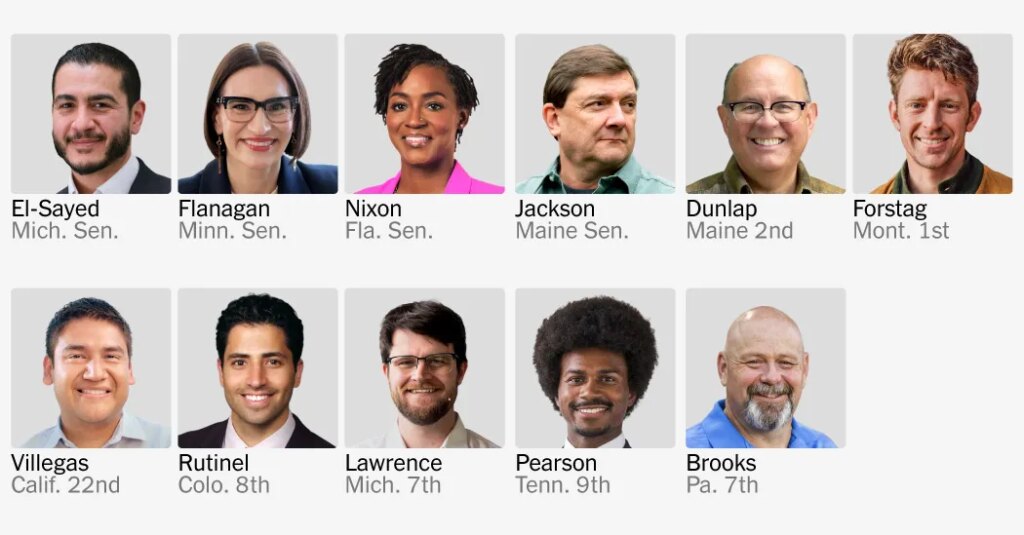
Self-described progressive or populist candidates are running for office all over the map. We examined roughly a dozen races that are being closely watched as tests of the viability of the progressive movement. Here is a look at how the left-leaning candidates could perform on Election Day, based on the current ratings of each of these races by The Cook Political Report, a nonpartisan prognosticator.
Races where Democrats are favored
In several races, progressive candidates with strong polling numbers are running in districts that currently tilt toward Democrats. They are considered slight favorites to defeat their Republican opponents.
-
Peggy Flanagan, the lieutenant governor in Minnesota, is running for the U.S. Senate. She is favored in a state that Vice President Kamala Harris won in 2024 by four percentage points, but she has been dragged down by a major fraud scandal. Michele Tafoya, her Republican opponent and a former N.F.L. broadcaster, has worked to portray herself as a moderate, in contrast with Ms. Flanagan’s vocal support for Medicare for all and other left-wing positions.
-
Bob Brooks, a retired firefighter and union leader, is considered a slight favorite in his bid for Pennsylvania’s Seventh District. A progressive who attracted early endorsements from across the political spectrum, including Mr. Sanders and Gov. Josh Shapiro of Pennsylvania, Mr. Brooks faces Representative Ryan Mackenzie, a Republican, in a battleground district in the Lehigh Valley.
-
Manny Rutinel, a former state legislator in Colorado, is trying to oust Representative Gabe Evans, a Republican, in Colorado’s Eighth District, a suburban area north of Denver. Mr. Evans is considered vulnerable, but Mr. Rutinel, after beating a moderate Democrat in the primary, has faced attacks for his left-wing background. A former animal-rights activist, he has more recently distanced himself from past comments criticizing the consumption of meat and dairy products. He even ate a carne asada taco in front of reporters to prove his change of heart.
Races rated as tossups
Some progressive candidates are running in races that are considered true tossups.
-
Randy Villegas is no “Valleycrat” — the kind of moderate-to-conservative Central Valley Democrat the party typically runs in California’s 22nd District. Mr. Villegas defeated a moderate in the primary, and has spoken openly about his alliance with Mr. Sanders and his desire for Medicare for all. He is betting that his populist policies will resonate in one of California’s more impoverished regions, while Republicans are trying to paint him as far too liberal. Last year’s Democratic redrawing of the district could help push Mr. Villegas over the finish line against Mr. Valadao, the Republican incumbent.
-
Sam Forstag, a former labor leader and smokejumper — a specialized type of firefighter — is trying to flip Montana’s First District, an open seat in the western part of the state. He embraced his progressive roots in the primary, often mentioning in his speeches that he appeared at a rally for Mr. Sanders and campaigning with Representative Alexandria Ocasio-Cortez. For the general election in a ruby-red state, Mr. Forstag has scrubbed his website of those endorsements as he faces Aaron Flint, an Army veteran and conservative radio show host.
-
William Lawrence, a co-founder of the progressive Sunrise Movement, angered the Democratic establishment with some of his past comments, and there was skepticism over whether the party would boost his candidacy in Michigan’s Seventh District after he toppled two centrist candidates in the primary. But Democrats are indeed spending on his behalf as Mr. Lawrence tries to oust Representative Tom Barrett, a Republican.
-
Troy Jackson, the former president of Maine’s State Senate, replaced Graham Platner — another progressive — on the ballot for the U.S. Senate in Maine in July. Senator Susan Collins, his Republican opponent, is a formidable incumbent. She’s also a moderate running against a populist candidate who has the backing of Mr. Sanders, a contrast Republicans have highlighted as they strain to hold on to the seat in a heavily Democratic state.
-
Dr. Abdul El-Sayed, a former county health director, is perhaps the highest-profile progressive on this list, and his success or failure may be viewed as a proxy for the broader movement. Dr. El-Sayed, running for the U.S. Senate in Michigan, overcame tens of millions of dollars in outside spending during a primary that pitted him against a moderate opponent. Now, centrist Democrats are terrified that his left-wing views — he is a vocal critic of Israel — could help Mike Rogers, his Republican opponent, and cost the party a crucial seat. Progressives including Mr. Sanders and Ms. Ocasio-Cortez have campaigned with him.
Races where Republicans are favored
Some progressive candidates are running in redder areas, and Republicans are currently favored in those races.
-
Matt Dunlap, the Maine state auditor and former Maine secretary of state, is backed by Our Revolution, the left-wing organization founded by alumni of Mr. Sanders’s campaigns. He’s trying to maintain Democratic control of Maine’s Second District, a rural region currently represented by Representative Jared Golden, a far more moderate politician who is retiring and seems like a more natural fit with the district. Analysts have given Mr. Dunlap’s Republican opponent, former Gov. Paul LePage, the edge.
-
Angie Nixon is running for the U.S. Senate in Florida, a state President Trump won by 13 points in 2024. A member of the Democratic Socialists of America, Ms. Nixon shocked her party’s establishment with an upset win in the primary, and some prognosticators think there’s a chance she could do the same against Senator Ashley Moody, the Republican incumbent, in November. Mr. Sanders and Ms. Ocasio-Cortez have campaigned for her, too, but Ms. Moody remains heavily favored.
-
Justin Pearson, a state lawmaker in Tennessee, rose to political fame when he was briefly expelled from the State Legislature in 2023 after participating in a gun control protest on the House floor. With the support of progressive groups like Justice Democrats, he mounted a challenge to Representative Steve Cohen, a Democrat, in a safely Democratic seat in Memphis. But a Republican-led redistricting effort redrew Tennessee’s Ninth District into one that is considered a safe Republican pickup and prompted Mr. Cohen to announce his retirement. Despite Mr. Pearson’s underdog status against Brent Taylor, a Republican state legislator, Democrats are bullish on their candidate’s chances, and Ms. Ocasio-Cortez has campaigned with him.
Taylor Robinson contributed reporting.
The post The 11 Midterm Races That Could Shape the Progressive Movement’s Future appeared first on New York Times.