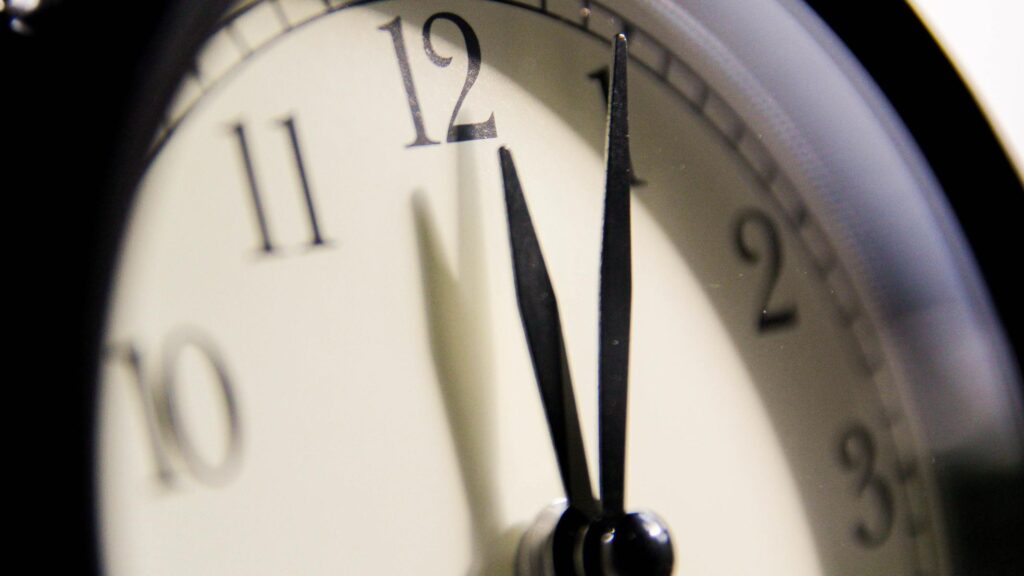
The clocks in most of the U.S. will fall back an hour this weekend as Daylight Saving Time once again comes to an end.
Early Sunday morning, most of the country will switch back to observing Standard Time, resulting in earlier sunrises and earlier sunsets. The looming clock change comes as some lawmakers, with the backing of President Donald Trump, have been trying to push a bill through Congress that would make Daylight Saving Time permanent and end the biannual time change. But the bill has been met with pushback from other lawmakers and sleep experts.
Here’s everything you need to know about the clock change this fall, and the state of the bill that’s trying to put a stop to the cycle of changing the clocks twice a year.
When do the clocks fall back in 2026?
Daylight Saving Time will end on Nov. 1 at 2 a.m. local time. At that time, the clocks will fall back an hour, to 1 a.m. local time.
How can I prepare for the clock change?
Dr. Alex Dimitriu, a psychiatrist and sleep medicine physician, likens the practice of changing the clocks twice a year to “an hour of jet lag,” adding that it can be an adjustment for many people. But the transition to Standard Time also means that people will gain an extra hour of sleep.
“Typically, moving to Standard Time is actually in sync with our circadian rhythm,” says Dr. Andrea Matsumura, a sleep medicine physician and spokesperson for the American Academy of Sleep Medicine. “Most people have a fairly easy transition into Standard Time; it’s the Daylight Saving Time that you have to do a lot more work to adjust [to] losing an hour of sleep.”
In the days leading up to the start of Daylight Saving Time—which will happen next March—Matsumura typically advises that people start going to bed a little earlier to help make the time change “a little less painful.” But there’s less preparation needed in the days leading up to Standard Time; in fact, Matsumura recommends that people simply stick to their regular sleep schedule ahead of Nov. 1.
Matsumura does suggest that people continue to take steps that normally help improve sleep, such as getting some daylight when they wake up in the morning and not drinking caffeine too late in the afternoon. Similarly, Dimitriu recommends that people do some physical movement in the morning, such as going for a walk, and avoid eating food too late in the evening.
What’s the status of the bill that would make Daylight Saving Time permanent?
Most states in the U.S. change their clocks twice a year: once in March as Daylight Saving Time begins, and again in November for Standard Time. Under the current federal law, states are permitted to opt out of Daylight Saving Time and remain in Standard Time year-round. Hawaii and most of Arizona have chosen that option, and so observe Standard Time throughout the year. Federal law does not, though, allow states to remain in Daylight Saving Time year-round.
A bill known as the Sunshine Protection Act, if passed by Congress and signed into law by the President, would change that. The measure would result in the country observing Daylight Saving Time year-round, though individual states could choose to forgo that path and instead stay in Standard Time permanently.
The Sunshine Protection Act passed the House with bipartisan support in July. But the measure is facing an uncertain fate in the Senate. Earlier this month, Senate Majority Leader John Thune told POLITICO that “there’s no clear path forward or consensus” on the bill yet.
Some lawmakers in the upper chamber, such as Sen. Tom Cotton of Arkansas, have criticized the proposal. Critics have argued that permanent Daylight Saving Time would mean much later sunrises in some parts of the country, resulting in people going to school and work in the dark.
Sleep experts, including the American Academy of Sleep Medicine, have also objected to the bill because they say that Standard Time aligns better with people’s circadian rhythms.
Still, Trump has slammed critics of the Sunshine Protection Act and continued to push for the bill. At the beginning of October, he accused Cotton of “holding up” the bill, and urged his followers on Truth Social to “call Tom on his cellphone” to express support for the Sunshine Protection Act.
The post Daylight Saving Time Ends This Week. Here’s How to Best Prepare Yourself for the Time Change appeared first on TIME.