Voters in Serbia choose a new Parliament on Sunday, in an election that will test whether nearly two years of student-led protests against the political establishment reflect wider public opinion or just youthful anger out of sync with the majority.
The vote pits the governing party of Aleksandar Vucic, Serbia’s dominant political figure since 2012, against a slate of candidates selected by activists in the vanguard of the protests, which began in November 2024.
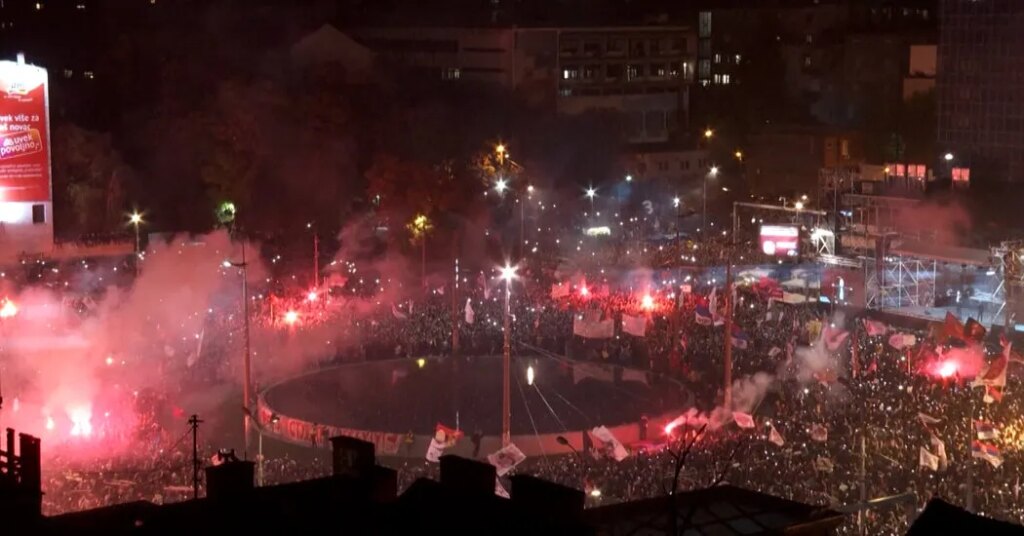
The demonstrations have raged on and off since then, attracting hundreds of thousands of people in cities across the country. Some polls indicate that Mr. Vucic’s main opposition, a new political grouping called “Student List-Students Win,” could get as many votes as the governing party, or even more.
Opinion polls in Serbia, however, are notoriously unreliable, heavily biased in favor of whoever commissions them.
Still, the vote is being seen as Serbia’s most competitive in years, a pivotal moment akin to the 2000 presidential election narrowly lost by Slobodan Milosevic, Serbia’s authoritarian nationalist leader during the Balkan wars of the 1990s. Preliminary official results are expected to be released late Sunday or early Monday.
The election comes just six months after voters in neighboring Hungary rejected their longtime leader Viktor Orban, a close ally of Mr. Vucic’s who, like the Serbian leader, championed populist nationalist politics.
What is at stake?
Serbia has the largest territory, population and economy of the seven countries that emerged from the ruins of Yugoslavia, and it is the linchpin of the region’s stability.
Since Mr. Milosevic’s fall, it has been stuck in limbo between Russia, its traditional protector with a shared Orthodox Christian faith, and the European Union, which Serbia applied to join in 2009. That process has largely stalled under Mr. Vucic, who resigned as president last month to seek the post of prime minister, which he has held twice before.
President Vladimir V. Putin of Russia has effectively endorsed Mr. Vucic, saying at a conference in early October that he hoped the Serbian leader would return as prime minister. But Russia, like the European bloc, has at times been exasperated by Serbia’s refusal to clearly pick a side. Mr. Vucic frames his policy, which he calls “two stools,” as a skillful balancing act between East and West, but others deride it as indecisive and opportunistic.
He has infuriated the European Union by refusing to impose sanctions on Russia over the war in Ukraine. But he has also angered Russia by turning a blind eye to the sale, through middlemen, of large quantities of Serbian weapons and ammunition to Ukraine.
Mocking Mr. Vucic’s mixed messaging before he stepped down as president, Maria Zakharova, the Russian foreign ministry’s spokeswoman, asked: “Is there really only one President Vucic?”
The Student List has also avoided taking clear-cut positions on foreign policy, reflecting the wide diversity of opinion in its ranks. Its candidates, nearly all political novices drawn from academia, sports, trade unions and the professions, include pro-European liberals, Russia-friendly nationalists and others in between.
It has, like Mr. Vucic, balked at insistent demands from the European bloc that Serbia join sanctions on Russia, announcing recently that it opposed doing so. But some analysts see that as a pre-election gambit to avoid alienating voters sympathetic to Russia, and many in the opposition are eager to unblock the logjam preventing entry to the European Union.
The Student List has not promised to accelerate that process, but an opposition victory would remove one important obstacle: alarm in Brussels over democratic backsliding since Mr. Vucic’s Serbian Progressive Party came to power in 2012.
Whatever government is formed after the election, it will struggle to resolve the most rancorous issue poisoning Serbia’s relations with many countries in the Balkans and beyond: the status of Kosovo, which declared independence from Serbia in 2008. Mr. Vucic and many Student List candidates insist that Kosovo remains Serbian territory.
What are the main issues?
Mr. Vucic and his party, which has been rebranded for the election as Aleksandar Vucic — United Serbia, have campaigned on a twin message: nationalism and economic success. They have cast their opponents as traitors in cahoots with Croatia and Serbia’s other enemies in the 1990s, when the multiethnic state of Yugoslavia to which they had all belonged disintegrated in war.
Like Mr. Vucic, who was Mr. Milosevic’s information minister, Student List candidates have at times embraced nationalist themes. But they have struggled to shake off the “anti-Serb” label applied to their movement by a vast and often outrageously mendacious media machine controlled by the governing party.
“It is terrible what their propaganda is capable of,” said Rasa Nedeljkov, a program director at the Center for Research, Transparency and Accountability, a research group in Belgrade, the capital, that is often critical of the government. “It has absolutely no limits.”
The governing party has also boasted of its success in building new highways and attracting foreign investment from Europe as well as China, which has built large factories in Serbia and helped rescue a huge steel mill from bankruptcy.
The economy could grow this year by nearly 4 percent — far more than in most of Europe and twice the pace in Hungary, where economic troubles and widespread corruption eroded support for Mr. Orban.
The Student List, like the protest movement from which it emerged, has hammered the government over corruption, the same issue Mr. Orban’s opponents put at the center of their successful campaign.
Corruption in Serbia has grown steadily worse since Mr. Vucic first became prime minister in 2014, according to Transparency International, which last year for the first time ranked it as the most corrupt in the region.
The student-led protests began in 2024 after 16 people were killed by falling concrete at a newly renovated railway station in the city of Novi Sad. Many blamed the deaths on inspectors on the take and corrupt deals between officials and construction contractors.
Will the election be fair?
The playing field is titled heavily in favor of the governing party, which controls the national electoral commission; most media outlets, including all television stations with national reach; and also state-owned companies, whose managers owe their jobs to Mr. Vucic and can easily pressure employees over how to vote.
In a report on the last election for Parliament in 2023, an arm of the Organization for Security and Cooperation in Europe said the vote had been “technically well-administered” but “was marred by harsh rhetoric, bias in the media, pressure on public sector employees and misuse of public resources.” The governing party’s “systemic advantages” and the dominant role of then-President Vucic in a legislative election “created unjust conditions for contestants,” the report said.
The same organization reported in July that the government had since addressed some, but not its most important concerns.
The electoral commission has put the total number of registered voters at 6,450,523 — a figure that raised eyebrows, given that Serbia’s total population, including children, is only around 6.5 million. Members of the commission associated with the opposition called the number suspiciously high, but pro-Vucic members, who form a majority, prevailed.
If the race is as tight as many expect, the final result could hinge on the votes of more than 100,000 Serbian citizens who live abroad, a demographic that in many countries leans toward the opposition. In what Mr. Vucic’s opponents see as an effort to reduce overseas turnout, the electoral commission changed the rules this year and tied voting to the time in Serbia.
That means voters in Australia, which is home to a large Serbian diaspora, will have to vote at night. The window for casting ballots in Chicago, another place with a large Serbian community, will open at 1 a.m.
Milan Protic, a former Serbian ambassador to Washington, said Mr. Vucic was “trying to play every card he has left because, for the first time, he is not in full control.” He added: “Maybe, just maybe, his time is up.”
Alisa Dogramadzieva contributed reporting.
The post What to Know as Serbia Votes for a New Parliament appeared first on New York Times.