To reach Tristan, roughly halfway between Africa and South America, Kelly Green crossed 1,738 miles of the South Atlantic from Cape Town aboard the M.V. Edinburgh, a 205-foot lobster boat. She had never been to sea before, and she worried about seasickness, but it never came.
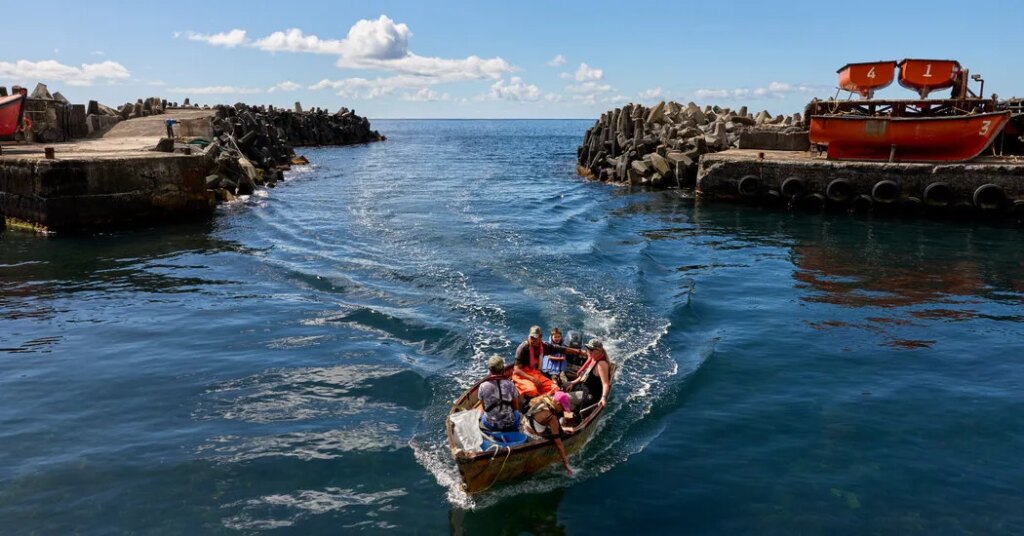
After a week at sea, the ship dropped anchor off Calshot Harbour, in front of Tristan da Cunha’s only settlement — Edinburgh of the Seven Seas. Its two small piers, jutting into the water, looked to Kelly like arms reaching out to welcome her.
Kelly could see most of the island’s residents (then 264 people) waving, including her mother and father, Marina and Sean Burns. Her father had been sent to the island, a British Overseas Territory, to serve as its administrator. He persuaded his reluctant 22-year-old daughter to visit, though Kelly, living in Britain, was more interested in clubs than remote islands. Kelly remembers him saying: “You have to come out, because you’ll never get the chance again.”
Among the men who helped carry her bags off the boat was Shane Green, 21. They met again that night at the island’s only pub. They danced.
Kelly went home after six weeks. The first night back in Cape Town, South Africa, where most ships leaving Tristan travel to, her hotel phone rang. It was Shane. They talked every night for months.
That was in 2012. Two years and several visits later, Kelly made the decision that would change her life: She moved to Tristan and became the first woman in over a century to settle there for good. The last had been three Irish sisters, in 1908.
Tristan was first sighted in 1506 by Tristão da Cunha, a Portuguese naval commander. Britain annexed the island in 1816 and set up a garrison for a year. A Scottish corporal stayed behind with his wife, their two children and two English stonemasons. That was the beginning of the community that lives there today.
Only 220 people now call it home, down from a peak of 300 in 1993. In the past three years, there have been 21 deaths and only six births. A few islanders have emigrated over the years.
Before settling on Tristan, Kelly’s life had been defined by travel. As a diplomat’s daughter, she had moved every few years — Antigua, Bangladesh, Senegal, Kenya — then became a flight attendant. Shane had never lived anywhere but Tristan. Where Kelly could describe the color of the sand on a beach in Mombasa, Shane knew every cove and gulch of his island and could explain, in great detail, the safest way from Green Hill to the beach called Down-Where-The-Minister-Landed-His-Things.
Part of what made it easier was that she and Shane, despite their very different lives, grew up watching the same British TV shows, which Kelly’s father had taped and brought to the island.
Living on an isolated island requires residents to be rather social — to pitch in for the common good, wear multiple hats, work long days and make their own fun.
Before Kelly moved in with Shane, he took her to dig potatoes, clean tripe and gut fish. He was impressed by how quickly she adapted. She said, “If I didn’t want to get my fingernails dirty, we wouldn’t have worked out.”
The couple married soon after and have a daughter, Savanna, 12, and a son, Seren, 5.
On Tristan, directions come in the form of “Up by Martha’s” or “Past Ricky’s.” Kelly and Shane’s home, which Shane built as an addition onto his grandparents’ cottage, sits at the top of the village.
When Kelly steps outside to hang laundry, she can see the vast expanse of the ocean stretch out before her. To her right lie the remnants of the 1961 volcanic eruption, a vast lava wall nearly 300 feet high that hems in Edinburgh, which residents call “the Settlement,” on its eastern side. Behind her, a giant cliff face closes off the sky above.
There is little of the ambient hum that fills most inhabited places — no traffic or electrical thrum. Even the diesel generators that power much of the Settlement are only audible up close. At times it is quiet enough to hear the rush of wind under an albatross’s wings, or the echo of a tumbling rock kicked loose by grazing sheep.
When winter storms hit, the only sounds are the roar of the wind and the window-rattling boom of waves exploding against the cliffs. Salt spray fills the air and eventually streaks everything with rust.
Most mornings, Kelly bakes bread and packs lunches before leaving by half past eight for her job as the island’s Head of Tourism.
At work, she might deal with a private yacht mooring offshore, sending her on a run of chores and errands — arranging tours, ferrying grateful guests to and from showers and washing their clothes. The next day might be spent fielding media questions, writing posts for the island’s social media accounts, or, on Wednesdays, serving lunch for a small group of expatriates.
Cruise season, from November to April, is her busiest time, when ships drop hundreds of ebullient and emotional passengers ashore if the harbor is calm enough to let them land. Some have waited years to visit. When a ship arrives, Kelly is down at the harbor, welcoming visitors with a clipboard and a walkie-talkie, making sure the islanders who’ve signed up as taxi drivers for the day, Shane among them, are ready, and the volcano walking tour sets off on time.
Shane works as a carpenter for the Public Works Department. He also fishes out of one of the bright orange lobster boats, the Verkenner, which he operates with his fishing partner, Steve Swain — part of the small fleet owned by the single company permitted to operate in Tristan’s waters.
On fishing days, Shane is at his boat before dawn with Steve, tying frozen bait to traps by the light of their headlamps. They’ll stay out all day and return around six in the evening, to find their daughters waiting with a cooler of homemade mutton pies and cans of soda.
Tristanian children have unusually free rein on the island. In summer, Savanna spends a lot of time at the community pool across the road from the pub, running around with school friends, or dancing in the same hall where Kelly and Shane first danced, and their parents before them.
Seren is more interested in helping his dad with the sheep and hammering nails into bits of wood with his friend Alfie. Seren and his sister both love the island’s black sand beaches, and ducking in to see their grandparents, whose doors, like most on Tristan, are always left unlocked.
One of the island’s few predictable moments of excitement is the arrival of a supply ship — they call about 10 times a year — bringing returning islanders, new cars, the odd visitor and the Christmas presents Kelly ordered months in advance. For a few precious days, Kelly can find Tristan’s supermarket shelves stocked with plums, grapes and heads of iceberg lettuce. She has to be quick, though, because the appearance of fresh produce triggers something like a doorbuster-sale.
The farthest Kelly and Shane travel regularly is to the Patches, a cluster of small stone-walled plots two and a half miles west of the Settlement, where Tristanians have grown potatoes, pumpkins and cabbages for more than a hundred years.
The family’s 24 “patches” sit inside a mosaic of low volcanic stone walls and wire fencing, built to keep the island’s cows out. Antarctic terns nest in the cracks of the walls and divebomb anyone who strays too close.
Shane is proud of his potatoes, varieties with names like White Blossoms, Smooth Skins and Americans. In a good year, the family digs up more than they know what to do with, the children sorting the harvest by size into old shopping baskets as their grandparents look on.
The couple uses their nearby camping hut, the closest thing to a summer cabin on the island, for a weekend getaway from the Settlement’s hustle and bustle. There is no internet and no electricity beyond a few solar bulbs. The ocean is just a few minutes’ walk away.
Leaving Tristan is difficult, and getting back is even harder. The two ships that call regularly carry just twelve berths each, with priority given to government officials and islanders needing medical treatment. Only the SA Agulhas II, a South African research vessel, which calls at Tristan once a year, has more spaces, but those fill up quickly too.
A vacation abroad is nearly impossible: Kelly’s family alone would take four of those spaces. The only other chance is a passing cruise ship, and those cabins cost more than most islanders can afford.
Kelly last left the island in 2023, for her father’s funeral. Sean had suffered a series of strokes while serving an unexpected third term as administrator on the island. No ship was close enough to reach Tristan quickly, so the RV Meteor, a German research vessel working in the region, was dispatched. It took several days to arrive.
Sean was carried aboard, and the ship immediately turned for Cape Town. Although his wife, Marina, was able to accompany him, there was not enough room for Kelly.
Sean died during the crossing, somewhere in the South Atlantic. Kelly has the exact coordinates tattooed on her left arm.
After her father’s funeral, Kelly returned to Tristan. But she worried that her mother felt lost without him. Marina and Sean had spent 40 years together, moving from posting to posting, and Marina had worked as a teacher at each of them. So, when a position opened at St. Mary’s School in 2025, Kelly suggested that Marina take it. She did.
For Kelly, memories of Sean are everywhere: She keeps some of his ashes in a small wooden canoe he brought from a trip to Senegal; the community named a traditional longboat “Sean B.” in his honor; her children go to school opposite the Residency where her father lived; and islanders still stop Kelly to tell her what a popular administrator he was.
“Raising a family here is amazing,” Kelly said, but she always reminds Savanna and Seren that there is also a world beyond Tristan. “There is life to experience before you decide what you want to do.”
Shane wants his children to study off the island if they choose to, but he is just as intent on teaching them to splice rope, plant potatoes, or catch fish from the beach — skills they can fall back on if they decide to stay.
The post Far, Far Away appeared first on New York Times.