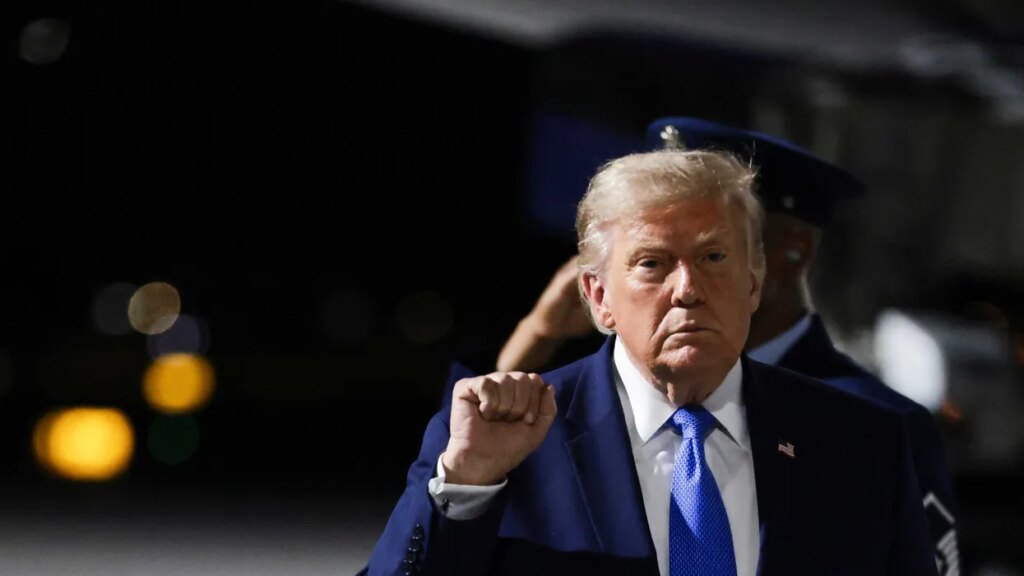
President Donald Trump has a problem he’s seen before, filing a lawsuit that makes headlines, claiming hundreds of millions or more — but being forced to duck out when he faces a risky situation regarding his public persona.
But he’s never seen one this dangerous.
He filed his defamation suit against the BBC in December of 2025, claiming a documentary about January 6th damaged him to a precious degree. We often hear the old maxim that the truth is the ultimate defense. Never more so than in a libel suit.
And that’s a Trumpian problem.
The BBC seems perfectly comfortable proving the factual foundation (they admitted editing some of the speech that may have been an angle of some kind) on what it covered regarding that awful day. Trump does not seem perfectly comfortable. And yet his entire case relies on proving that the BBC lied. The case presents yet another situation where Trump does not want to face what he did regarding plans formed prior to that day, and certainly not on January 6th and thereafter, especially as described by people under oath.
The whole thing is all but as laughable as it is inevitable, given he filed this suit a year ago knowing, knowing, that he would eventually have to testify. One should just try to imagine — since Trump can certainly imagine — the devastating evidence the BBC discovered in its investigation? Trump sued himself into a mini-civil Jack Smith case.
Indeed, it’s possible Jack Smith will also be deposed, because, well, who knows more about the truth about that day than Jack Smith? No one, other than people whose last name is “Trump,” and even that’s despairingly doubtful. The judge has not yet ruled on whether the DOJ has to sign off on whether Smith testifies, but that’s not Trump’s immediate problem.
Now, depositions alone are often sealed until shortly before trial, and those sections that are publicly available are often only made so through summary judgment references, not the entire transcript (or video). It depends on the type of case involved.
But what kind of case could be less likely to have portions of the transcript published in summary judgment motions than the ones most associated with Trump’s alleged lies? So, yes, as often happens, should the judge rule that facts cited in those motions, facts from the depositions, be unsealed, whoa, look out as to what the BBC has to say … and perhaps Jack Smith. Because when “the truth is the ultimate defense,” keep an eye open for that responsive summary judgment motion. The most gooey facts pertaining to “the truth” shall surely appear in that brief.
The judge does not have to allow those portions to be released; it can keep them under seal, but Trump has a couple of problems with even that because the standard involves whether there is a public interest to be served in the portions mentioned in the motions. Trump could claim that those revelations are too damaging to him and do not serve the public interest, but wow, is that ever a tough hill to die on — not literally, but way too close.
His problems don’t stop there. Because it won’t be just the defense arguing that the portions should be published. The media will surely intervene as a third party with an interest in the case and argue they should be able to see the facts as attached to those summary judgment motions. And that — right there — might be Trump’s biggest problem, coming up the pike awfully fast in political dog years.
To prevent the media or public from seeing these facts, a party like Trump, especially a plaintiff like Trump, must prove an overriding interest in stamping those facts down, keeping them secret — such as exposing trade secrets or severely compromising personal safety. Those aren’t going to save him regarding the Jan. 6th documentary, and it gets even worse. Trump, as the plaintiff in this case, is the one who decided to seek a $10 billion check from the BBC, knowing all this beforehand and ploughing ahead anyway. Officially or not, courts are more likely to spill on a guy who is supposedly trying to set the record straight regarding the BBC $10 billion lie versus what he considers the truth.
After all, he’s claiming a documentary — made for the public — is wrong. How does the public not have an interest in allowing summary judgment facts to air out, so to speak? His argument leads to a very old legal maxim; He is using the court as a sword but now desperately wants to use it as a shield. Additionally, the BBC has a reputation to maintain, too, and losing $10 billion over a claimed lie would certainly impact its future, presuming it’s protected by the truth.
The media may also have a similar argument. ABC and CBS Paramount settled Trump’s suits against them, though largely seen more akin to a “payoff” than an admission of any wrongdoing; at least that’s a widely held suspicion. Multiple media organizations may have published similar facts, and if the BBC reported the truth, it helps improve and protect the reputations of other entities that reported similar facts.
We haven’t even touched on Trump’s finances. He has to prove harm, meaning it impacted his reputation (he was elected president; imagine a tougher argument to overcome as to harm), and generally you have to prove you lost money due to the defamation, thus putting his finances into play in the summary judgment. The judge has already ordered that Trump turn over Mar-a-Lago membership numbers.
Summary of the decision to file the complaint, the summary judgment, and just plain summary of all above, Trump surely filed suit wanting coverage of him screaming, “They intentionally lied! So much so, I want $10B dollars to make me okay again.” He has worked so hard to keep the DOJ and Jack Smith’s records from becoming public; using this lawsuit as a sword was never a good idea if what he really needed was a shield. Not that this would be the first time Trump ever failed to follow through on the eventual folly.
He has about six weeks to decide whether to voluntarily dismiss the case before the second deposition date runs, and precious few after that if the judge believes that the Iran war or something required him to be in the White House that day. The judge could order sanctions if it believes that the BBC got played (again). And Trump has only February until the matter is set for trial, though trial dates can often be moved back.
In other words, this is coming down the pike: real trouble, testifying, settling for some nominal amount to save just a little face, or dropping the matter. Presuming that Trump cannot possibly win at trial (it is the vaunted BBC), those aren’t appealing options.
He will, again, look like a loser. And if we know anything, it is that Trump hates looking like a loser.
Jason Miciak is a Raw Story columnist, former editor of Occupy Democrats, author, attorney, consultant and single parent girldad. Please follow on Bluesky, and he can be reached at [email protected]
The post Trump’s BBC vendetta backed him into a corner — with only weeks to avoid a killing blow appeared first on Raw Story.