Jamie Fly is the CEO of Freedom House, where Jennifer Brody is the deputy director of policy and advocacy for technology and democracy.
The Iranian regime doesn’t like Starlink, and it’s little wonder why. As Mohammad Hafez Hakami, a deputy technology minister, said on Sept. 30: The spread of Elon Musk’s satellite network drives the “final nail in the coffin” of Tehran’s ability to control cyberspace. “If this trend continues,” Hakami added, “we will be forced to cut electricity in the next crisis.”
Iranian authorities have long relied on centralized control of the country’s internet infrastructure to throttle connections and impose sweeping shutdowns during protests. Satellite internet breaks that model. A rooftop terminal doesn’t route through state-controlled networks and therefore can’t be switched off whenever the regime pleases.
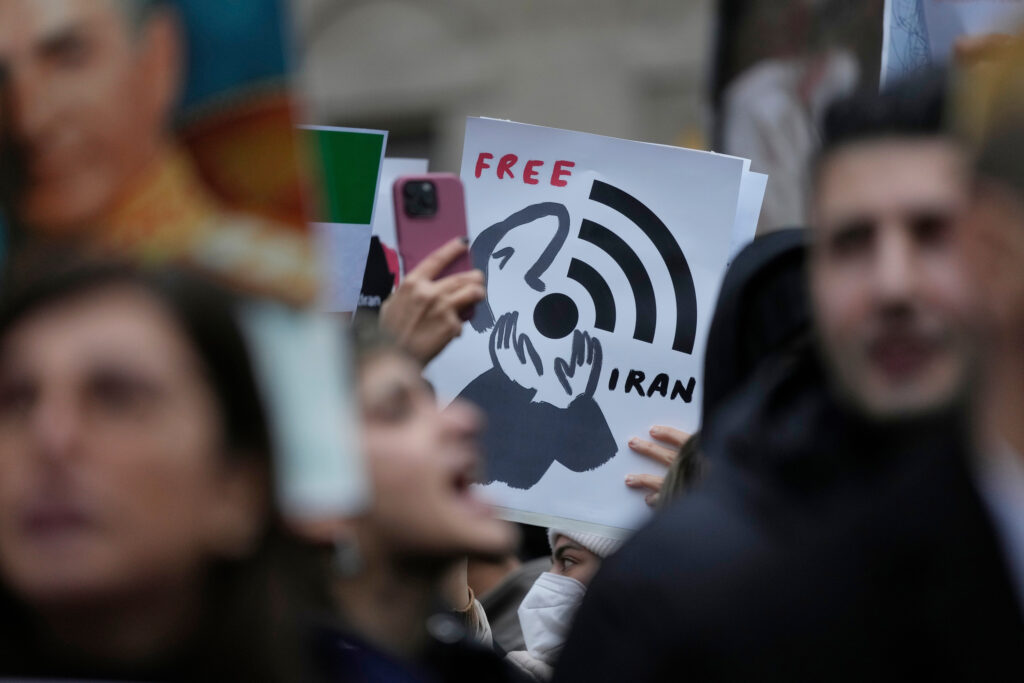
The tech is put to marvelous use. Access to a free and open internet is how Iranians can organize and document their government’s human-rights abuses. It gives life to free expression and assembly. When the state’s rulers cut internet access — as they did for nearly three months this spring — both of those evaporate and repression unfolds in the dark.
That recent event, the longest nationwide blackout in history, contributed to Iran’s tying China and Myanmar as the world’s worst environments for internet freedom in the latest edition of Freedom House’s “Freedom on the Net,” published last week. As the report notes, the authorities reconfigured the internet into a “two-tiered system” in which only a privileged few were able to freely connect to the web.
Not content with that, however, Tehran is also trying to stifle signals via diplomatic means. At the International Telecommunication Union — the U.N. body tasked with facilitating “international connectivity in communication networks” — Iran has championed efforts that cloak censorship in the language of the rule of law. In 2023, Tehran and its partners in Moscow succeeded in getting the body to consider an agenda item regarding “unauthorized” satellite operations. The goal is to assert “spectrum sovereignty,” or to control which satellites can operate within their borders, while the regimes work on building their own equivalent tech.
Their measure is still under consideration and will likely be discussed at a fall 2027 ITU Radiocommunication Conference in Shanghai, where participants will review the international treaty overseeing spectrum and satellite governance. It is thus an important venue where democratic governments can resist the authoritarians’ gambit and advocate for a humanitarian carveout for people living through internet shutdowns and armed conflict.
But blocking Moscow and Tehran at the ITU is only a partial solution. There are at least three things Washington could do to assist those who are living behind digital iron curtains.
First, invest in direct-to-cell satellite technologies. Modern cellphones are now able to connect to satellites without conspicuous terminals that need to be smuggled or hidden. The United States ought to build a government-sponsored system that could be deployed in crises to counter internet outages and ensure the free flow of information. Foreign citizens have their phones; we provide the satellites.
Second, fund the deployment of existing satellite internet capabilities. At roughly $600 per terminal, standard Starlink equipment is prohibitively expensive for most people living under repressive governments. Congress could appropriate funds to help defray costs and increase ordinary citizens’ access to these critical technologies. Increasing funding for the Iran Internet Freedom Grant Program — which can assist civil society in creating secure communications channels and anti-censorship tools — is a good place to start.
Third, put safety first. Iranian authorities reportedly detained and killed Hesam Alaeddin, 40, after he was discovered using Starlink to bypass the internet blackout. Any effort to expand access must include safe distribution channels for terminals and technical protections against government surveillance.
The future of space-based connectivity will be shaped by governments that want to either connect or control people. Iran’s leaders have told the world what they seek. Democracies should take them at their word and act accordingly.
The post The autocrats waging war on Starlink appeared first on Washington Post.