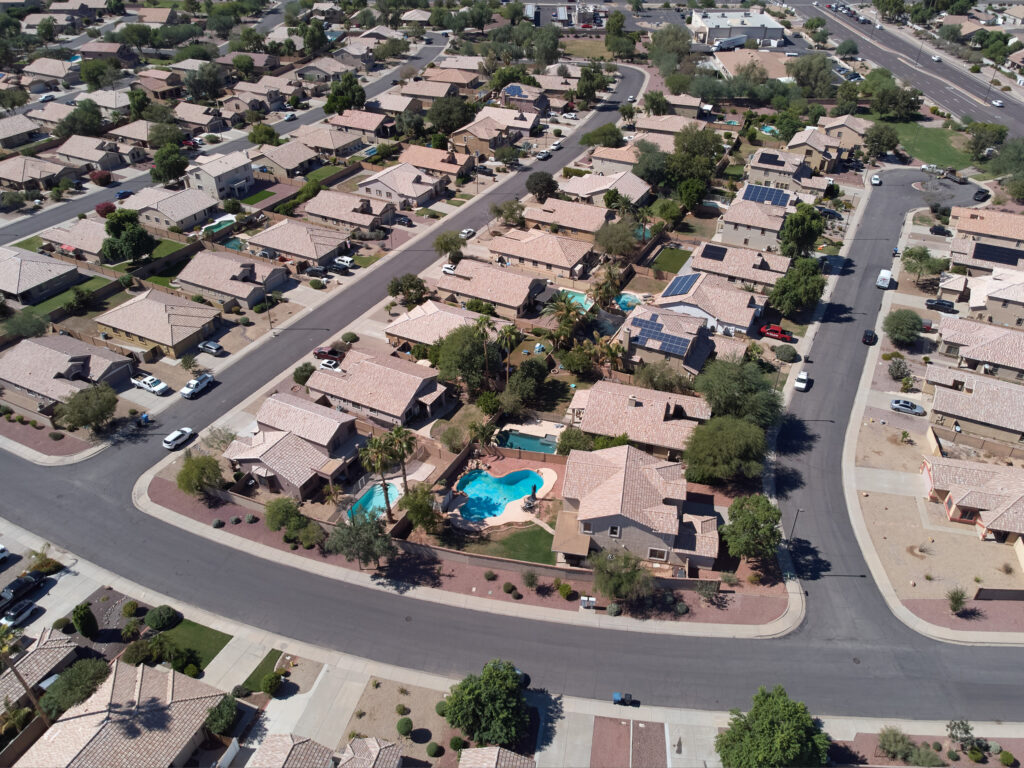
QUEEN CREEK, Ariz. — Ron Rios treasures his backyard pool that makes Arizona’s triple-digit summer heat more tolerable. So he was furious to learn that his Phoenix suburb might hike his water bill: from $130 to, eventually, more than $500 a month.
City leaders said it was necessary to fund sweeping investments that would secure their water supply for the next 100 years. The Colorado River was shrinking, they said, and they had to adapt.
But Rios, the 52-year-old owner of an artificial turf company, didn’t want to get water bills on par with the monthly payments on his Suburban.
“People can’t afford that,” he said. “Give me a break.”
Queen Creek, one of America’s fastest-growing cities, shows the challenges facing communities around the Southwest as the Colorado River dwindles and the remaining water gets more expensive. Rios uses an unusual amount of water, and his bill is an outlier. But it reflects a broader reality.
Marc Skocypec, Queen Creek’s utility director, put it this way at a recent town meeting: “Cheap water is over.”
To officials, Queen Creek is a model of how to confront the Southwest’s water woes head-on. The city expects to ultimately spend $730 million to tap into faraway groundwater, insulating themselves from drought for decades to come.
But a proposed “water resource fee” to fund the project has brought furious pushback from the highest water users in town, in a conservative place where leaders pride themselves on lowering taxes. It’s also renewed long-standing tensions over whether Queen Creek is expanding too fast for its resources, as city officials say they expect their population to nearly double by around 2050.
Other Southwest metropolises are facing similar questions about how to keep growing in arid places where water is scarce and getting more so. Arizona’s desert cities are in an especially tough position because they hold more junior water rights than other cities that draw on the Colorado River, such as Los Angeles, Las Vegas and San Diego.
Arizona has extensive groundwater reserves to fall back on, but they are considered nonrenewable and carefully guarded. Tapping into new water sources will require more expensive investments — and more debates like the one playing out in Queen Creek.
“The really difficult thing I think that we face is having the political will and consensus around investing for future generations,” said Sarah Porter, director of the Kyl Center for Water Policy at Arizona State University.
Queen Creek officials were worried the cost of their water would keep going up as the Colorado River grew unreliable. So they borrowed money to buy a hundred-year supply of groundwater from the Harquahala Basin to their west and carry it through an existing canal.
To pay off the debt, officials proposed charging residents an extra fee for each 1,000 gallons they used, starting at $3.07 and escalating to an estimated $10.74 after several years.
They say the plan will pay off in the long term by locking in the city’s water expenses. Other Arizona communities are now looking at buying water from the same basin — at quadruple the rate that Queen Creek negotiated when it struck its deal several years ago.
“Everybody is chasing water,” Skocypec said.
Basins like Harquahala have their limits and can only be part of the solution.
“The solutions to the Colorado River crisis are going to be piecemeal ones that are cobbled together,” said Kathryn Sorensen, director of research at the Kyl Center for Water Policy. “There’s just frankly not one big replacement source out there.”
The Queen Creek town council will vote on the first phase of their water fee in November. In the meantime, officials are trying to sell the plan to residents.
The average single-family home would pay an extra $57 or $138 a month once the water fee is fully phased in, officials said, depending on the details of their usage.
At the town meeting this month, one man grumbled that the costs could balloon and speculated without evidence that someone was getting “kickbacks.” He whispered to the man seated behind him: “It’s a complete sham!”
Rios walked out of the meeting frustrated.
“It just makes me mad,” said his wife, Holly Rios, as they left.
Despite their complaints, Rios stood to gain as Arizonans cut back on water, because of his synthetic turf company. He’d already installed fake grass in most of his backyard, near a sign that read “Welcome to our Pool Patio — where the neighbors listen to good music whether they want to or not.”
But Rios still had some real lawn and citrus trees, and he said he uses more than 30,000 gallons of water a month, triple the average household.
Rios didn’t understand why the city couldn’t just tap into the groundwater below them (it’s strictly regulated by the state), and he was considering spending tens of thousands of dollars to drill his own well.
He wondered if Queen Creek could backtrack and sell the water it just purchased at a markup.
“Sell it to Cave Creek,” Rios said, thinking of a tiny town particularly reliant on the Colorado River. “They’re panicking. Sell it to them for three times what we bought it for, and walk away.”
The biggest pushback to the water fee came last month, at a city council meeting. Some people had orchards and horses, and they used flood irrigation, a water-intensive technique common in farming. They were panicking.
By the time the fee was fully phased in, they would be paying tens of thousands a year; some would pay six figures. One woman said her water bill would be more than her property tax bill. A man said he might not be able to retire.
“The cumulative cost for all six years is over $83,000 — I’m going to have to sell both my kidneys at that point,” said Gary Ehlers, 63, who grows pecan, orange, lime, plum and pomegranate trees on his lot.
Mayor Julia Wheatley said she didn’t take the changes lightly.
“It is the first thing I think about when my eyes pop open in the morning,” she said. “It is the last thing I think about when I go to bed at night.”
A little over two weeks ago, city officials presented a solution for the “irrigators” with orchards and animals who would be hardest-hit. The city would transfer flood irrigation to another water provider, meaning it wouldn’t be subject to the new fee. The town would still be able to cover its costs; its water would just go further.
But tensions lingered over Queen Creek’s broader trajectory.
Incorporated in 1989 as an agricultural community of just a couple thousand people, the city’s population has grown to about 90,000, and the water issue stoked doubts among some longtime residents that the rapid change was good for them and the town.
“At what point does the town, or any town, turn around and say — particularly in the Southwest and in the desert, where water is gold — at what point are you going to turn around and say ‘We can’t grow anymore?’” said Eric Kerr, 65, who was born and raised in the area.
All the growth is “maybe putting the cart before the horse,” echoed his son-in-law, Elias Slover.
Queen Creek officials are quick to emphasize that longtime residents won’t be subsidizing newcomers. New developments will pay additional one-time water fees. Yet the water issue hangs over the town plans.
New home building in Queen Creek was held up in recent years because of more stringent requirements to show the area has sufficient water. And when a developer recently sought to turn a dirt lot into a 150-unit gated community, residents pushed back.
“Water security must come before continued expansion of residential development,” one man said at a council meeting.
The Queen Creek planning commission had unanimously recommended approval of the project. The lot sat empty for years.
But council members said they struggled to approve the plans over so much opposition from constituents. They voted it down.
Officials said people have flocked to Queen Creek for much-needed affordable housing. Wheatley said in an interview that the city has plenty of water to keep growing with their big investment, and that officials make sure that “growth pays for growth” through fees on new developments.
Arizona has reduced its water use even as it’s grown, she added.
“Even as residential comes in, we’re using far less than agriculture did,” she said.
At the town meeting, someone suggested rising water costs might turn people away from the city.
Officials had a simple reply: Queen Creek wouldn’t be the only place raising its bills.
The post ‘Cheap water is over’: A $500 bill shows a Southwest suburb’s dilemma appeared first on Washington Post.