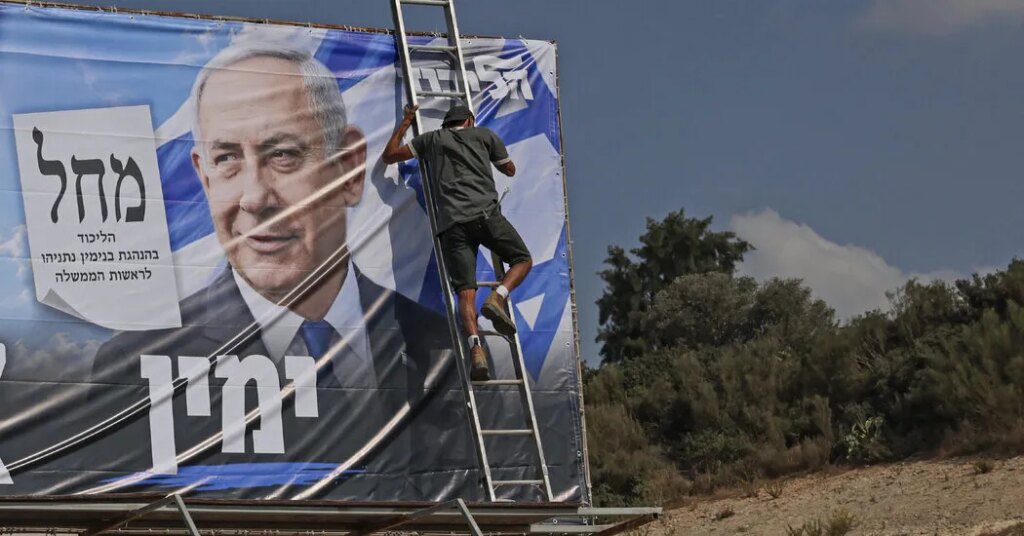
The Israeli election on Tuesday is being touted as one of the most consequential in Israel’s history, not just for Israelis but also for large parts of the world. Yet despite the wars and turmoil Israelis have both undergone and unleashed since the Hamas attacks of Oct. 7, 2023, the electoral landscape has barely changed. The atmosphere in the streets exudes resignation and disillusionment, undergirded by dread.
That’s not to say the country has stood still. These past three years have brought displacement of Israeli communities, the hostage crisis, weeks of heavy missile and drone fire, constant interruptions to the school year, disruptions to international air travel and endless war, including current threats of another round of war with Iran that could interfere with the election itself.
An International Criminal Court arrest warrant against Israel’s prime minister, Benjamin Netanyahu, for alleged war crimes and crimes against humanity, remains outstanding, and the International Court of Justice is adjudicating claims of genocide. European countries have levied sanctions, and American public opinion has shifted strikingly against Israel.
Small wonder that over a quarter of a million Israelis have left the country over the last few years, and that thousands living abroad are flying back to Israel just to vote.
For both Israelis and observers around the world, this election is still largely about whether voters will finally end Mr. Netanyahu’s political career. It is bound to be viewed by many as a referendum on his open-ended wars and occupation of parts of Gaza, Syria and Lebanon, as well as his government’s unabashed land grabs and emboldening of settler militias attacking Palestinians, journalists, government officials and diplomats in the West Bank. (On Friday, Israel started an offensive in a part of the West Bank where the army said Palestinian gunmen killed two Israeli soldiers.) If Mr. Netanyahu remains in power, it will send a clear message that a large swath of Jewish Israeli society broadly supports these policies.
Still, for many Jewish Israelis, the core electoral questions remain largely domestic: For one, will the most far-right government in Israel’s history receive a mandate to continue chipping away at the independent judiciary, the only check on power in a country without a constitution? And would it remain committed to exempting the ultra-Orthodox from conscription, a divisive issue in a country embroiled in constant war? For Palestinian citizens of Israel, the most urgent concern is the continued threat to their personal safety, a result of unchecked organized crime and the politicization of the police.
Despite all this, consistent polling of Israelis has shown a remarkably persistent two-camp structure: the Netanyahu-settler-religious bloc and the anti-Netanyahu bloc, each commanding roughly half of the Jewish electorate, with changes occurring largely within camps rather than between them.
The four Palestinian Arab parties, three running together as the Joint List, and Raam, all of which oppose Mr. Netanyahu, remain a significant factor that could break the deadlock, as Palestinian Israeli voters make up about 20 percent of Israel’s population. In most polls, the parties together would receive about 12 to 15 seats, which could make them the third-largest bloc after Lt. Gen. Gadi Eisenkot’s Yashar party and Mr. Netanyahu’s Likud party. In that sense Palestinian-led parties would be kingmakers. But leading politicians in both blocs have indicated they do not intend to form governments with them. This is merely because they are Palestinian.
Shifts in public opinion have been hard to come by. The 12-day war in June 2025, when Israel launched a surprise attack on Iran’s nuclear and military facilities, did not boost Mr. Netanyahu’s public support, despite widely being considered a success. If success didn’t ultimately move the needle, neither has failure: Public opinion remained consistent after the arguably botched war between the United States, Israel and Iran this year. Furthermore, accusations by senior Israeli security officials that Mr. Netanyahu ignored warnings before Oct. 7 (which he has denied) and that he curated quotes from official meetings leading to that day to deflect blame from himself have not seemed to hurt his chances of retaining the prime minister’s seat.
Indeed, the noteworthy change in public opinion was in response to the government’s move to overhaul the judiciary. A majority of Israelis, including nearly half of Likud voters, opposed the legislation. Only this — not the glaring failure to protect Israelis on Oct. 7 or its ferocious response — initially diminished the Netanyahu coalition’s popularity.
This political stagnation can be traced to several sources. First, Israel is a tribal society where many have long voted with their own narrow interest groups and remain loyal to specific parties. Further, there is no significant divide between right and left in Israel when it comes to the Palestinians, but rather many shades of right across the political spectrum. Even the new Yashar party, the leading contender to replace Likud, is filled with right-wingers. Mr. Eisenkot has not charted a significantly different path here than Mr. Netanyahu; he, too, has said he rejects Palestinian statehood.
This has left a group of opposition leaders devoid of an alternative or coherent vision for the Israeli-Palestinian conflict, incapable of conjuring excitement among voters. The political stalemate also derives from a technical issue in Israel’s parliamentary system: Too many small parties compete for the same slices of specific interests. Several of those small parties hover dangerously close to the minimum threshold of 3.25 percent of the total vote. Any votes cast for a party that does not reach that threshold are lost and do not make it into parliament.
The decisive factor in an Israeli election is not party size but the party leader who can put together a coalition. According to the polls, a clear majority of Israelis wish to oust Mr. Netanyahu and his far-right messianic partners. Consistent polling shows the anti-Netanyahu bloc, when Jewish and Palestinian Arab parties are taken together, has well over the 61 seats needed for a majority.
And yet, the anti-Palestinian, antidemocratic and, frankly, anti-strategic decision by almost all opposition parties to refuse a coalition with Arab parties means they are almost as unlikely to form a government as the Netanyahu bloc. They have even ruled out the prospect of relying on support from Arab parties in the Knesset, without inviting them into the coalition. Such a relationship would help a minority government pass legislation and advance policies, a path Prime Minister Yitzhak Rabin took in the early 1990s. Thus the opposition has effectively excluded Palestinian citizens as legitimate partners in the political process. If the opposition ultimately reneges on this promise, it will still have ridden to success on the same populist, right-wing wave that its political rivals have long surfed, further cementing divides between Israeli citizens by ethnic, rather than political and civic, lines.
The combination of these factors — political stagnation, the ability of numerous small parties to sway an election, the exclusion of Palestinian parties, along with Mr. Netanyahu’s longtime shaping of Israeli discourse — makes it possible that Mr. Netanyahu will remain in power despite majority opposition.
Even if a bloc led by Mr. Eisenkot were to succeed in forming a government, actually remaining in power, and then changing policy, could remain elusive. The monolithically anti-Palestinian stance that dominates Israeli politics makes meaningful change on the most critical issue unlikely. That is why elections deemed so important may not make much of a difference. But they are nonetheless momentous.
Mairav Zonszein, a contributing writer in Opinion, is the senior Israel analyst with the International Crisis Group, a nonprofit think tank dedicated to conflict prevention.
The Times is committed to publishing a diversity of letters to the editor. We’d like to hear what you think about this or any of our articles. Here are some tips. And here’s our email: [email protected].
Follow the New York Times Opinion section on Facebook, Instagram, TikTok, Bluesky, WhatsApp and Threads.
The post What the Israeli Election Won’t Change appeared first on New York Times.