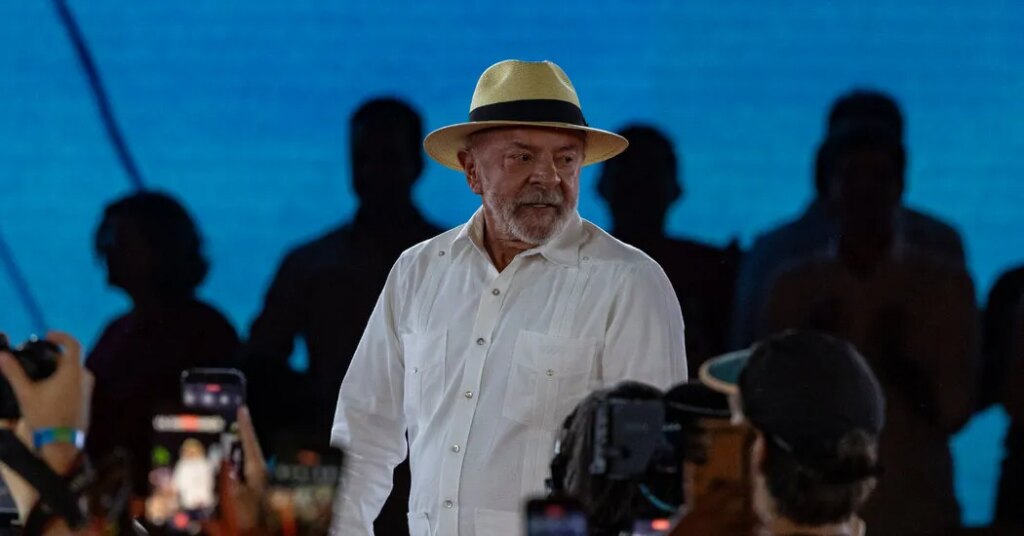
No politician has made a bigger mark on Brazil than President Luiz Inácio Lula da Silva.
Over three terms in office, he helped lift millions out of poverty, fought for workers’ rights and became, for a time, the face of a powerful leftist tide sweeping Latin America.
But the political currents have changed drastically and Mr. Lula, the region’s most influential statesman, is now facing a tough battle as he seeks another term. If he is defeated on Sunday, as polls suggest he might be, it would be the biggest win yet for the right-wing surge barreling through Latin America.
Right-wing candidates, aligned with President Trump on fighting drug gangs and waging culture wars, have won seven straight Latin American elections in the past 18 months.
As the region’s largest country, Brazil represents a major prize. A victory for Flávio Bolsonaro would tighten the right’s claim on Latin America, leaving Mexico the last big country controlled by the left.
Mr. Lula has offered a rare example of resistance to Washington’s strategy to project military and economic might in the region, pushing back against Mr. Trump as he has tried to squeeze Brazil with tariffs and sanctions.
By contrast, Mr. Lula’s right-wing opponent, Mr. Bolsonaro, has promised to join a U.S.-led regional security alliance and has offered Brazil’s vast critical mineral deposits as a way to lessen American reliance on China.
Mr. Lula, 80, is heading into Sunday’s race as the underdog, having drawn fewer voters than Mr. Bolsonaro in a first round of elections this month. Yet the margin between the two leading candidates was the smallest in Brazil’s history, with polls suggesting a narrowing race for the presidency.
In the final stretch of campaigning, Mr. Lula and his allies have worked to mobilize millions of Brazilians, on social media and on the streets.
Mr. Lula has also challenged Mr. Bolsonaro to open up his financial statements and phone records to public scrutiny, vowing to do the same. Mr. Bolsonaro has said he will oblige only after reviewing Mr. Lula’s records, which the leftist offered to electoral authorities this week.
What has become clear is that Mr. Bolsonaro’s promises to tackle organized crime, high grocery bills and a sluggish economy have resonated with millions of working-class Brazilians who in the past may have cast a ballot for Mr. Lula.
“It’s really about this profound sense of fatigue,” said Camila Rocha, a political scientist who studies the rise of the Brazilian right, said of Mr. Lula. “It’s the feeling that this leader, this project, has already run its course — alongside a deep desire for renewal.”
On the campaign trail, Mr. Lula has pointed to his economic achievements over the last four years, while also warning that restoring the Bolsonaro family to power poses a risk to Brazil’s democracy. Mr. Bolsonaro’s father, former president Jair Bolsonaro, is serving a 27-year-sentence for attempting a coup after losing the last election to Mr. Lula.
Mr. Lula has also defended his broader political legacy, built on decades of social programs that relieved widespread hunger, expanded education opportunities and reduced deep inequality in the last nation in the Americas to abolish slavery.
“Inequality and underdevelopment are the result of policy choices,” Mr. Lula told the United Nations General Assembly in September. “It is possible to include the poor in the budget and make the rich pay their fair share.”
Yet the leftist leader, whom former President Barack Obama once called the “most popular politician on Earth,” has struggled to stir excitement among Brazilian voters whose electoral priorities appear to have shifted.
Even though in the past four years Brazil’s economy has grown modestly and unemployment has fallen to its lowest rates on record, rising household debt and an affordability crisis have left many ordinary Brazilians feeling worse off.
Some of Mr. Bolsonaro’s libertarian ideas, like a hands-off state, lower taxes and cutting red tape for the self-employed, have also appealed to a growing portion of the working class that is migrating to the gig economy.
“There is a new kind of working class in Brazil,” said Rosana Pinheiro-Machado, a professor at University College Dublin who studies Brazil’s populist movements. “And it has a new way of viewing prosperity.”
If Mr. Lula is to secure a victory on Sunday, he will have to win over some of the millions of Brazilians who in the first round stayed home, voted for other losing candidates or annulled their ballots.
In an effort to lift his approval rating heading into the elections, Mr. Lula has increased how much people receive under the government’s signature welfare program and granted temporary fuel subsidies to ease the pain of rising prices because of the war in Iran.
He also expanded a government program to relieve indebted Brazilians facing billions of dollars in consumer loans. And just days before the first round of voting, he banned online betting, which has accelerated Brazil’s spiraling personal debt crisis.
This is not the first time Mr. Lula faces an uphill climb. Less than a decade ago, he was sitting in a prison cell, serving a 12-year sentence over a corruption scandal that appeared to have ended his political career.
But his convictions were annulled by the Supreme Court in 2021 amid evidence that the judge, prosecutors and the police had colluded to put him behind bars. This freed Mr. Lula to run against the elder Mr. Bolsonaro in 2022, a race he won in a huge political comeback.
Mr. Lula emerged on the political stage in the 1970s, making his name as a union leader on the outskirts of São Paulo. As president between 2003 and 2010, Mr. Lula, a former metalworker with a fifth-grade education, created generous social programs that helped some 20 million Brazilians climb out of poverty.
On the world stage, he has elevated Brazil to a leader on issues such as poverty, hunger and climate change, in part through his efforts to protect the Amazon rainforest. A skilled diplomat, Mr. Lula has also cemented Brazil’s reputation abroad as an important emerging power in the Global South.
When he left office in 2010, Mr. Lula’s approval ratings topped 80 percent. But the scandal that landed him in prison tarnished his reputation with a large slice of Brazil’s population, who still link him and his political party to corruption. Even after returning to the presidency, Mr. Lula has struggled to regain the trust of many voters.
Now, a new corruption scandal embroiling much of Brazil’s political and judicial elite, including Mr. Bolsonaro himself, is adding to the fatigue many Brazilians feel toward their political leaders. With the crisis unfolding on Mr. Lula’s watch, it has further dampened enthusiasm around his candidacy.
Ultimately, Brazilians will have to decide whether they still share his vision for Brazil’s future.
And, even if Mr. Lula is able to secure another victory, he will face the daunting task of governing a bitterly divided nation and navigating a legislative branch that has swung sharply to the right.
“Even if President Lula wins,” said Ms. Rocha, the political scientist, “it still marks, in a sense, the decline of a certain kind of leftism, of his Workers’ Party, and of Lula himself.”
The post Could Latin America’s Most Famous Leftist Be on the Brink of Defeat? appeared first on New York Times.