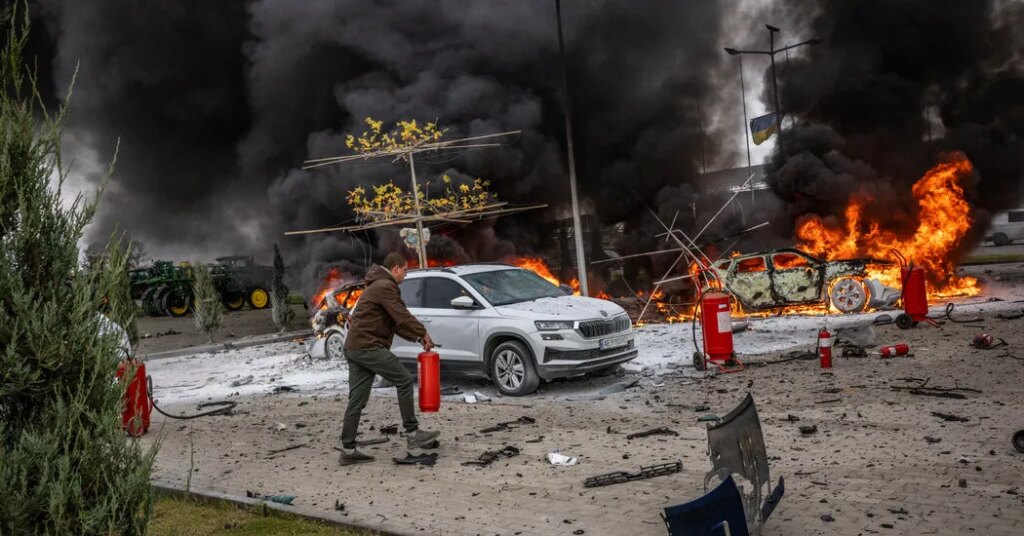
On the same day President Trump told reporters that Russia “has been fine on Ukraine,” President Volodymyr Zelensky shared a photo taken moments after a Russian drone struck a Ukrainian playground.
The image showed 14-month-old Angelina, bundled up in a red jumper, her shoelaces tied in perfect bows, slumped, lifeless, in a stroller. Her face was blurred. A sprinkling of dust and debris was the only hint of her violent end.
“Her mother’s name was Inna,” Mr. Zelensky wrote. “She died in the hospital.”
The statements hours apart from the two leaders hammered home a reality: Never has the chasm between Mr. Trump’s view of the war and Ukrainians’ experience of it seemed so vast.
Mr. Trump continues to periodically lament the huge numbers of lives lost in the fighting, calling it a waste. He is trying to restart peace talks. But he has begun blaming Ukraine for his domestic political problems, and turning to Russia, the country that started the blood-soaked conflict, for a helping hand.
Ukrainians over the years have grown largely numb to Mr. Trump’s parroting of Russian talking points, and Kyiv has adapted after he ended donations of U.S. weaponry. But to many, Mr. Trump has crossed an irrevocable line by buying Russian diesel and suspending sanctions in what energy experts call a futile effort to bring down fuel prices before the midterm elections.
Mr. Trump, who has cut U.S. aid to Ukraine by 99 percent, is sending American money to the Kremlin — and therefore to a Russian war machine that the United Nations says is killing Ukrainian civilians at a “new horrifying level.”
With that has come a profound sense of moral whiplash for Ukraine nearly five years into its wartime roller-coaster ride with America.
Not long ago, under a different U.S. president, Joseph R. Biden Jr., the United States’ message to Ukraine was that its fight was the front line in a global battle for freedom. By holding firm, he said, Ukrainians were defending the democratic world itself.
Families buried their dead believing that, whatever the cost, they were not dying alone or in vain. At funerals and on the front, in cafes and in parks, soldiers and civilians alike often talked about fighting for a cause greater than their own self-interest.
Now, Ukrainians say, they feel betrayed. Mr. Trump does not talk about the war as a matter of right and wrong. He talks about it in starkly transactional terms.
“We’ve given a lot to Ukraine. They’ve given nothing to us,” Mr. Trump said last week. “Remember that.”
Chief Sgt. Pavlo Kazarin, a writer now serving in Ukraine’s Unmanned Systems Forces, said in an interview that Ukrainians were “watching Donald Trump destroy all the reputational capital that his predecessors accumulated over recent decades, when the United States supported democracy, when the United States declared that it supported freedom, and when the United States invested in soft power to support its allies around the world.”
Mr. Trump has at times boiled the war down to a conflict between two leaders who “don’t like each other” and just need to make a deal. He has falsely blamed Mr. Zelensky for starting the war, and he recently suggested that the Ukrainian leader wanted it to continue so he could enrich himself.
What Mr. Trump does not understand, Sergeant Kazarin said, is that Russia’s goal is Ukraine’s erasure as a nation. Without this understanding, the Trump administration’s peace efforts will fail, he added.
“For Ukrainians, this war is a war for existence,” Sergeant Kazarin said.
The feeling of a world turned upside down was crystallized for many Ukrainians this past week when Mr. Trump’s peace envoy, Steve Witkoff, traveled to St. Petersburg, Russia. Mr. Witkoff praised President Vladimir V. Putin as a “humanitarian” for releasing an American prisoner the U.S. government had deemed wrongfully detained.
A few hours later, Russia launched a salvo of 21 ballistic missiles at Kyiv, the Ukrainian capital. Three carried cluster munitions designed to detonate in the air as they approached their targets, spreading destruction across hundreds of yards, Mr. Zelensky said.
The use of cluster munitions in a city of three million people was met with silence from the White House.
“Overnight, Kyiv residents heard what Russian ‘humanism’ truly sounds like: a brutal attack with dozens of ballistic missiles striking energy infrastructure, medical facilities, shopping centers, and residential areas,” Ukraine’s foreign minister, Andrii Sybiha, wrote on social media. “Appeasement, servility, and flattery will not stop this war,” he added.
Oleksandra Matviichuk, a Ukrainian who won the Nobel Peace Prize in 2022 for her work at the Center for Civil Liberties, a nonprofit organization, noted that civilian casualties had only increased as Mr. Trump had tried for nearly two years to reach an agreement to end the war.
“This is not what you expect from the peace negotiation,” she said. “It’s a clear indicator that something is going wrong.”
By focusing on Russia’s territorial claims, mineral rights in Ukraine for the United States and other business deals, with scant mention of attacks directed at civilians, the Trump administration is sending a signal to Moscow that “people have no meaning and they can do whatever they want,” Ms. Matviichuk said.
“Trump’s peace negotiations have already gone down in history as the deadliest years for Ukraine’s civilian population since the start of the full-scale invasion,” she said.
In 2025, injuries and deaths among civilians in Ukraine rose 31 percent, according to the United Nations. In the first half of 2026, civilian casualties climbed another 37 percent. In September, at least 328 civilians were killed and 2,105 injured — an 85 percent jump over the previous September. October is on pace to be deadlier still.
Ms. Matviichuk said she feared even worse bloodshed as Mr. Trump openly sides with Russia, with Ukraine reporting sudden speed restrictions with a Pentagon-controlled satellite internet system, gaps in the sharing of U.S. military intelligence and delays in deliveries of interceptor missiles.
Mr. Trump has also demanded that Ukraine stop striking oil refineries, Kyiv’s best way to choke off funding for Russian attacks. While Mr. Trump has claimed that the strikes have raised diesel prices in the United States, energy experts say that the U.S.-Israeli war in Iran has played a larger role.
“When you take the resources that the defending side needs for its defense, you’re not stopping the war,” Ms. Matviichuk said.
While Mr. Trump accuses Mr. Zelensky of not wanting peace, Ukrainians say the question of why they are still fighting is as absurd as it is obvious: They have no choice.
Russia invaded Ukraine. Kyiv has agreed to Trump administration proposals to lower the violence, from a total cease-fire to limited truces on land, in the air and at sea. Moscow has agreed to none of any substance.
The Russian military is stockpiling hundreds of ballistic missiles, thousands of cruise missiles and tens of thousands of drones for a winter campaign aimed at rendering Ukrainian cities unlivable, according to Ukrainian intelligence. Russia’s economy remains centered on war, and Mr. Putin has never backed down from his maximalist demands.
After witnessing the well-documented atrocities committed by Russian forces in Bucha, digging up the mass graves in Izium and uncovering torture chambers in Kherson and other liberated towns and villages, Ukrainians believe that surrender will not bring peace.
“Russian occupation is not just changing one state flag to another,” Ms. Matviichuk said.
“If we stop resisting,” she added, “we will cease to exist. We will disappear as a nation.”
Liubov Sholudko contributed reporting.
The post Ukraine’s Feeling of Moral Whiplash at the Hands of Trump appeared first on New York Times.