When actor Christina Applegate, who has spoken publicly about having multiple sclerosis, revealed this week that she had been misdiagnosed, I sat with the news awhile. Mostly because I had been there, too.
I won’t pretend to know exactly what Applegate is going through. I didn’t experience a misdiagnosis in the same way she did. But I know what it feels like to have debilitating symptoms and search endlessly for an answer, yet have no way to easily take a test to get a concrete answer.
There is a kind of authority in finally knowing what is wrong with you, a relief that comes from having some of the unknowns patched up. It is unfortunate that it can often take so long to get there, but there is immense value in knowing what you’re dealing with rather than having no clue at all.
I waited almost two years to learn that I had neuromyelitis optica spectrum disorder, or NMOSD (formerly known as Devic’s disease), a rare autoimmune disorder of the central nervous system that can damage the optic nerves, spinal cord and other parts of the brain. A 2024 study estimated that only about 22,000 Americans were living with NMOSD in 2022.
Before I received that diagnosis, I spent months hearing that I probably had another autoimmune disorder: multiple sclerosis.
Searching for answers for two years
The first time I heard of multiple sclerosis was in a neurology office in Bethesda, Maryland. My neurologist muttered several possibilities, but the ones he said loudly were: multiple sclerosis, Lyme disease and NMOSD, a string of letters I had never heard before. A painful heaviness in my right eye and blurred vision had brought me there.
My symptoms began two weeks before I went to my college’s run-down urgent care, where I was diagnosed with a corneal abrasion. Over the next few days, my vision continued to deteriorate. I went to a top-rated ophthalmologist I found through Google. After a couple of lengthy vision tests that showed a severe loss of visual sensitivity, I was diagnosed with optic neuritis, inflammation of the optic nerve. The ophthalmologist explained that it could be a sign of a larger problem and referred me to a neurologist.
It was in that first appointment that I learned about MS, NMOSD and some other things that could explain my symptoms. An MRI and bloodwork came back negative for both. As I learned, though, these types of autoimmune conditions are so difficult to diagnose in part because there’s no one test that can confirm them. Instead, they require considering a constellation of symptoms, clinical signs and test results to piece the puzzle together, rule out other conditions and land on a diagnosis.
My doctor prescribed me steroids to help in the short-term and ordered more tests to hopefully find signs of one of these conditions or something else to explain my symptoms.
In the meantime, over the next few days I lost vision completely in my right eye. I could no longer see color or light — no matter how bright — or movement. Additionally, I had trouble swallowing, and my throat became sore. I called my neurologist, who advised me to go to the emergency room.
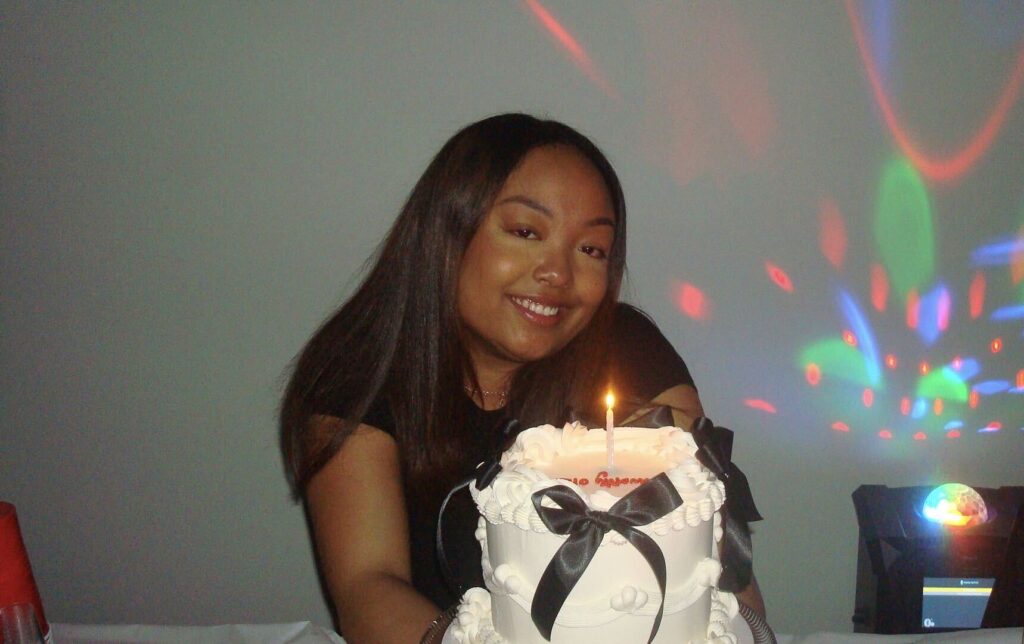
At the hospital, I was given an intravenous steroid for two days to help restore my vision. After that, I was discharged and started on the oral steroids my neurologist prescribed. A few days later, I spent my 21st birthday with friends who bought me a beautiful cake and danced with me all night, but I didn’t drink a drop of alcohol on my milestone birthday because I was taking 26 prednisone pills a day.
About a month later, my vision was back to normal, but my doctors still didn’t have answers about what caused the optic neuritis in the first place. My doctor ordered more MRIs, on a quest for evidence of MS or NMOSD. Again, the tests came back negative. It felt no more like an answer than the corneal abrasion I had been diagnosed with at urgent care.
In the beginning, MS was my care team’s leading theory because it made the most sense. My symptoms mirrored the disease, and with no other clear explanation, my doctors kept returning to it. The scans and tests were meant, in part, to confirm what seemed like the most likely answer. But they couldn’t. My neurologist kept searching for an explanation, considering everything including my ethnic background to try to get to the bottom of things.
Getting a diagnosis I didn’t expect
About a year and a half after I experienced those first symptoms, I went into one of my final appointments with my neurologist, who planned to retire before my next visit. A blood test looking for antibodies specific to NMOSD — which my doctor had begun to focus on more after repeated scans and bloodwork failed to diagnose MS — came back positive. After nearly two years of uncertainty, I was diagnosed with NMOSD.
Sebastian Lopez, a neurologist at Mayo Clinic in Florida, said the overlapping symptoms of inflammatory neurological conditions — such as MS and NMOSD — can make distinguishing them difficult. Optic neuritis, for instance, can occur in both. But the two diseases have different underlying mechanisms and require different treatments, which is why a proper diagnosis is so important.
The consequences of a missed diagnosis can be severe. Each NMOSD attack can cause irreversible neurological dysfunction, making it important to identify the disease and begin treatment quickly. Some medications used to treat MS may also worsen NMOSD, Lopez said.
Since NMOSD is so rare and can often resemble other neurological diseases, clinicians may not consider it until others are ruled out. “Most people who think they might have it probably don’t, but it does happen, and the doctor has to be on the lookout for it when they recognize a core symptom,” said Ilya Kister, a neurologist at NYU Langone Health who specializes in MS but has a special interest in NMOSD. “The hardest part is to think of it. Once you think of it, then you can check to see if it’s NMOSD.”
While the antibody test I had can’t diagnose NMOSD on its own, it can help providers land on a diagnosis when combined with a few key clinical signs, including optic neuritis and myelitis, or inflammation of the spinal cord, Kister said. MRI scans of the brain and spinal cord also can help distinguish between MS and NMOSD, but in my case, the antibody test was what finally completed the puzzle.
Living with NMOSD
For me, NMOSD is a quiet disrupter. I’ve skipped dates because I’d had an attack, when my leg felt dead with pain, and the only way to feel better was to slow down. I’ve missed dinners with friends because fatigue overtook me. I’ve joined support groups on Reddit and Facebook in hopes of better understanding my symptoms. The pain sometimes is unbearable.
But once again, there is value in a diagnosis. Mine gave me a path toward treatment, and according to my doctor, it was urgent that I began immediately. I drive from Washington to Maryland every six months to sit in a chair for three hours as my medication is infused. A representative from the treatment’s support program checks in every few months to see how I’m doing. I have a mother and grandmother who pray for me, and a team of doctors who want things to get better.
Lopez said that based on the available data, certain NMOSD medications can decrease the risk of attacks by more than 96 percent. While I still experience symptoms — including tingling and numbness in my toes, legs and arms in the morning, back pain and fatigue — so far, after two infusions, I’ve been able to avoid bigger attacks and trips to the emergency room.
Kister left me with something I hadn’t heard in those early days of scrolling through NMOSD threads and questioning my mortality: “NMOSD is one of the great triumphs of neurology,” he said. “When I give talks on NMOSD, I always challenge the audience to find me another neurologic disease where we have had as much success as with NMOSD.”
It was strange to think of my disease as a triumph. I spent nearly two years trying to figure out what was happening to me, and even now, a diagnosis doesn’t mean I can stop thinking about it. I still have to make time for infusions after fighting insurance to cover the expensive drug, log my symptoms and live with the uncertainty of a condition that can cause lasting neurological damage.
While treatment has come a long way, there’s still much further to go. “Right now, we can manage this condition extremely well compared to several years ago, but we cannot cure it yet,” Lopez said. “It’s been really amazing to see the transformation from a disease that was not known, a disease that was considered a severe variant of multiple sclerosis, to the condition that we now know a lot more about.”
The post Doctors thought I had MS. It turned out to be this rare disorder instead. appeared first on Washington Post.