In what one environmental law expert described as “a dangerous ultimatum,” the Trump administration said it would strip California of its authority to protect its coastline unless state regulators agreed to more than a dozen “corrective actions” that would benefit close allies of the White House, according to the draft findings of a controversial federal review.
Citing “a pattern of jurisdictional and regulatory overreach,” the 92-page review said California coastal authorities have demonstrated “unjustified hostility and political bias against offshore drilling opportunities, oil and gas projects broadly, and SpaceX’s launch activities.”
The document, which The Times obtained through a public records request, said future federal funding for the state’s coastal management program has been suspended “unless and until the identified deficiencies are satisfactorily addressed.”
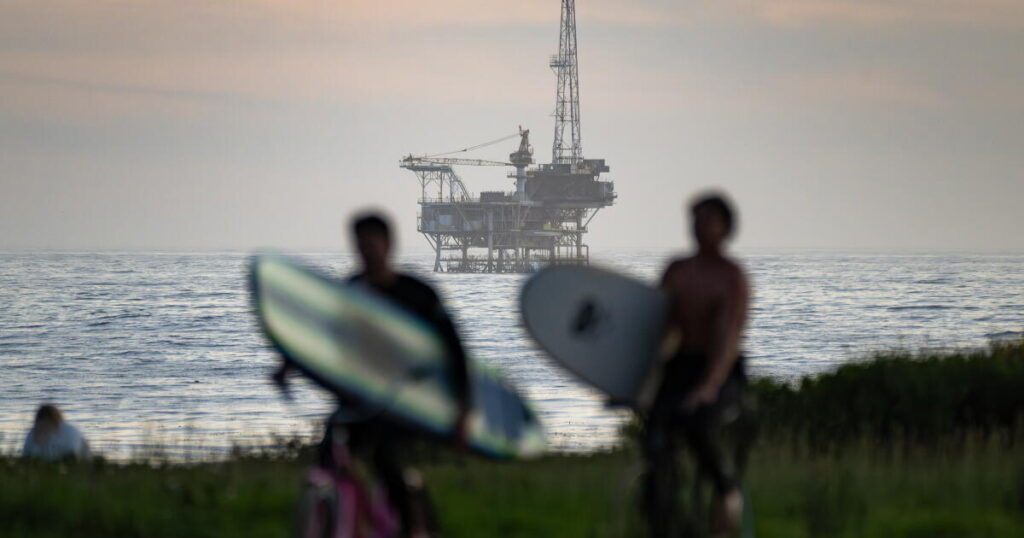
At the top of the list of corrective actions are demands that the California Coastal Commission meet with SpaceX and “discuss any outstanding concerns about political bias and … productive next steps moving forward.” It also directed coastal authorities to discuss “any outstanding concerns about regulatory burden and overreach” with Sable Offshore Corp., a Texas-based oil company that has sought President Trump’s influence to bypass state oversight and restart a once-dormant offshore operation off the Santa Barbara coast.
The state’s leading coastal agency must also issue an official statement by January pledging that California “will not categorically oppose initiatives led by certain entities, or relating to certain industries, such as oil and gas, or involving certain activities, such as offshore drilling,” according to the preliminary findings by the National Oceanic and Atmospheric Administration’s Office for Coastal Management.
Legal experts who reviewed the draft document said they were troubled by the Trump administration’s politicized use of a longstanding federal law known as the Coastal Zone Management Act, or CZMA.
Never before, they said, has the federal government attempted to strip a coastal state of its rights in this way, and the consequences could be far-reaching if the draft findings become final. The action also comes as the president has sought to dismantle clean air policies, endangered species protections and other landmark environmental regulations that have long drawn the ire of industry and fossil fuel producers.
“This audit is an attack on states’ rights…. What is cloaked as a serious review is a dangerous ultimatum that strikes at the heart of California’s democracy,” said Meg Caldwell, who directed Stanford’s Environmental and Natural Resources Law and Policy Program for more than two decades. “The audit contains a lot of puffery and grievance, but the real goal is to commandeer California’s ocean and coastal governmental system for the Trump administration’s agenda. …The conspicuous questions now are: Where does this stop? Which state is next?”
The three California agencies charged with implementing the CZMA — the Coastal Commission, the California State Coastal Conservancy and the San Francisco Bay Conservation and Development Commission — have until Nov. 16 to respond to the preliminary findings and corrective actions.
The Coastal Commission — which has been inundated in recent weeks with media questions and emergency permit requests amid record-breaking flooding from El Niño and tropical storms — is reviewing the draft findings. Spokesperson Joshua Smith declined to say at this time whether the commission would accept the list of corrective actions laid out by the Trump administration.
“The commission was disappointed to receive this draft evaluation given our long history of stellar reviews from the federal government and a 50-year track record of a successful federal partnership, where 96% of the time the commission either approves projects as submitted or negotiates improvements so they can move forward,” Smith said.
Smith added that the commission had requested a 15-day extension beyond the Nov. 16 deadline, “as allowed for in the CZMA regulations, to respond as thoroughly as possible.”
The federal government will then issue its final determinations, and what happens next will be unexplored legal territory.
“This is a five-alarm warning to every job and industry that relies on our sandy beaches and beautiful bluffs for its livelihood,” said U.S. Sen. Adam Schiff (D-Calif.), who has condemned the Trump administration’s use of the CZMA as “blatantly illegal” and politically motivated. “Soon, you too could see your environment for sale to Big Oil, Elon Musk, and any other high bidder that buys its way into the White House ballroom.”
For the last five decades, the CZMA has been celebrated as a bipartisan co-management framework that gave coastal and Great Lakes states the power to review and object to federal projects that affect their shorelines. Under the law, each state can create its own guiding principles on how to oversee its coast, and federal officials must honor this state coastal management plan once it’s certified.
Performance reviews under the CZMA are not uncommon — most states are subject to a routine review every five to 10 years — but what’s unusual in this case is that California had just undergone a review during the Biden administration.
A draft of that review, which was completed in 2024 but not finalized, gave top marks to the state.
Tensions escalated earlier this year when U.S. Commerce Secretary Howard Lutnick announced that he was ordering a fresh evaluation of California’s CZMA compliance using a “new approach” that would take offshore oil production, pipeline maintenance, spaceport infrastructure, desalination projects and undersea cables into consideration, citing national priorities and economic interests.
More than 23,000 written comments were submitted during the 45-day public comment period this summer, and hundreds of Californians rallied at an August hearing in Santa Monica. Surfers, fishers, business owners, real estate brokers, Indigenous leaders, marine scientists and everyday residents lined up for hours to express their support for the state and urged federal officials to set politics aside in their review.
“In some ways, the decision seems already made,” Maureen Ellenberger, a Santa Barbara resident, said in August to the federal officials conducting the hearing. “But I’m speaking today anyway, so there’s a record. So years from now … everyone will know we fought, that we did not consent.”
About 95% of the public comments supported California’s track record of coastal protection, and a memo attached to the draft findings acknowledged “certain areas where the performance of the [California Coastal Management Program] is excellent and where California is a national leader.”
But of the 23,071 written comments, federal officials considered only 22 to be “complex.”
“Of those complex comments, approximately 12 expressed concern and/or disapproval” of California’s coastal management, according to the draft review, which referred to these comments in its recommendations for corrective actions.
“Some commenters claim that the California Agencies are flatly opposed to offshore oil and gas development and thus do not faithfully consider and weigh the relevant interests as required by the CZMA,” the draft review noted. “Some commenters contend that the California Agencies’ approach to oil and gas activities and spaceport infrastructure projects is a threat to national security.”
The review also went to notable lengths to call out the Coastal Commission’s handling of whether people can drive ATVs on the beach at Oceano Dunes State Vehicular Recreation Area. But the federal government has little jurisdiction over the issue, which has been a longstanding fight between two state agencies over the use of a state beach.
In a footnote, federal officials listed whom they considered to be “known interested parties,” and whom they notified directly about this year’s review: “American Petroleum Institute; Chevron Corporation; Torridon Law PLLC; Salt Point Strategies LLC; Meta Platforms, Inc.; Amazon.com, Inc.; Davis Wright Tremaine LLP; Dredging Contractors of America; Covenant Government Affairs; Mesa Water District; Holland & Hart LLP; the United States Bureau of Reclamation; the United States Department of the Interior; the Council on Environmental Quality; the United States Air Force; and the National Aeronautics and Space Administration.”
Wade Crowfoot, California’s secretary for natural resources, said the review process was a failure of the public process and called it “a preordained political attack” by the Trump administration.
“The aim of their rigged review is obvious — to strong-arm California on behalf of oil companies and clear the path for massive new oil drilling off our coast,” Crowfoot said. “They are already preparing to sell new leases to drill even as they go through the motions of this sham review.”
“While federal agencies ignore thousands who made their voices heard against this ludicrous attack,” he said, “we’re standing with Californians to defend our coastal communities.”
The post Trump wants to strip California of coastal protections unless state meets list of demands appeared first on Los Angeles Times.