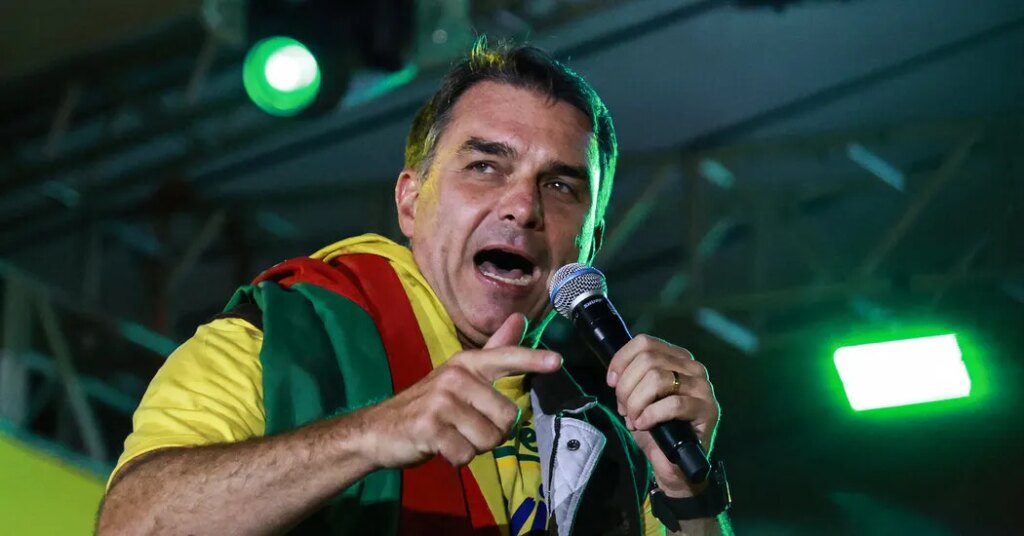
Clad in a yellow-and-green shirt over a bulletproof vest, Flávio Bolsonaro danced on a carnival float as thousands of euphoric supporters cheered in the crowd below. “Brazil already chose change!” he shouted, pumping his fist in the air.
Mr. Bolsonaro, a right-wing senator whose father was president not long ago, is heading into Sunday’s presidential race as the front-runner, having edged out President Luiz Inácio Lula da Silva, a leftist, in a first round of elections this month.
A victory by Mr. Bolsonaro would deliver the biggest win yet for an ascendant right-wing movement marching across Latin America.
Right-wing leaders, propelled in part by voter discontent over security, have won seven straight elections in the region over the last 18 months. If Brazil elects Mr. Bolsonaro, it would lift an enthusiastic ally of Washington to power in the region’s largest nation and leave Mexico the only big country still in the hands of the left.
Mr. Bolsonaro, 45, has aligned himself with President Trump on using lethal force to fight drug gangs and has offered Brazil’s vast critical mineral deposits as a way to reduce American reliance on China.
Mr. Trump has not formally backed Mr. Bolsonaro, but his administration has telegraphed its support in other ways, including by labeling Brazilian gangs as terror groups. The move put a spotlight on crime, a concern for many Brazilian voters and an area of vulnerability for Mr. Lula.
A right-wing victory would also mark the Bolsonaro family’s stunning return to power, less than four years after the senator’s father, former President Jair Bolsonaro, tried to stage a coup and inspired his supporters to storm Brazil’s capital, in an episode echoing the attack on the U.S. Capitol. He was convicted of plotting a coup and sentenced to 27 years in prison.
Mr. Bolsonaro and his family may now be on the cusp of gaining sweeping new powers to rewrite Brazil’s history, reshape its future and target their perceived enemies. If elected, Mr. Bolsonaro has promised to seek amnesty for his father and the rioters, impeach the Supreme Court justices who jailed them and change Brazil’s Constitution.
Just months ago, Mr. Bolsonaro’s candidacy seemed like a long shot, with many skeptical that he could overcome a string of scandals and ignite the kind of enthusiasm that catapulted his father to office in 2018. And with the elder Mr. Bolsonaro jailed for trying to subvert democracy after losing the last election to Mr. Lula, his movement appeared to be in tatters.
Then the younger Mr. Bolsonaro shocked many when he nearly won outright in the first round of voting this month, drawing more ballots than Mr. Lula, though the margin was the narrowest ever in Brazil.
“Bolsonarismo is winning the battle for the hearts and minds of a large portion of the population,” said Rosana Pinheiro-Machado, a professor at University College Dublin who studies Brazil’s populist movements.
Mr. Bolsonaro’s success has largely been rooted in sweeping, if vague, promises to tackle crime, high grocery bills and a stagnating economy — issues at the top of the list of concerns for Brazilian voters.
Taking a page out of the playbook of right-wing allies in Latin America, Mr. Bolsonaro has vowed to “declare war” on drug traffickers by building more prisons, labeling gangs as terrorist groups and lowering the age of criminal responsibility.
While violent crime has fallen to a 14-year low, many working-class Brazilians live side by side with drug gangs that have expanded their control over neighborhoods through fear and extortion.
“I will reclaim every meter, I will reclaim every street, every neighborhood, every city, every territory that these scoundrels have taken from the Brazilian people,” Mr. Bolsonaro said during a debate days before Sunday’s runoff.
Inspired by the chain saw used by President Javier Milei of Argentina to symbolize a leaner state, Mr. Bolsonaro has adopted a pair of giant scissors as his symbol, vowing to cut some $40 billion in public spending and privatize public companies. Speaking to a growing number of Brazilian workers who have migrated to the gig economy, he also pledged to lower taxes and decrease red tape for entrepreneurs.
Even as experts have questioned the economics of Mr. Bolsonaro’s promises, including how he can cut taxes without reducing welfare benefits, many voters have responded to his agenda with excitement.
Mr. Bolsonaro has also drawn overwhelming support in Brazil’s agricultural belt and in regions of the Amazon where farmers and cattle ranchers have cheered his promises to make it easier to explore the riches of the rainforest.
Crucially, Mr. Bolsonaro has also harnessed a deep sense of fatigue that many voters feel toward Mr. Lula, painting him as a corrupt symbol of the political establishment.
Between 2003 and 2010, during his first two terms, Mr. Lula helped lift millions out of poverty through generous social programs financed by a commodities boom. When he left office, his approval ratings topped 80 percent, but his legacy was later tainted when a sprawling corruption scandal landed him in prison.
In 2021, his convictions were tossed out by the Supreme Court amid evidence that the judge who convicted him was biased. This paved the way for Mr. Lula’s resurrection and return to the presidency in 2022, though he has struggled to clean up his image among voters who still link him to graft.
In Mr. Lula’s third term, Brazil’s economy has posted modest growth and has been mostly unscathed by U.S. tariffs, while unemployment dropped to record-low rates. Still, rising household debt and eroding affordability have dampened his approval and fueled Mr. Bolsonaro’s popularity.
Mr. Lula has also been saddled with the political fallout of a crisis engulfing Brazil’s Supreme Court. Against this backdrop, Mr. Bolsonaro’s attacks on the judiciary have grown more alluring to many Brazilians who have lost trust in institutions.
Mr. Lula did score points with many Brazilians by standing up to Mr. Trump last year when he tried to force the nation into dropping the coup charges against the elder Mr. Bolsonaro. Those efforts, the fruits of lobbying by a brother of Flávio Bolsonaro who lives in the United States, ultimately failed.
Even without a formal endorsement, Mr. Trump’s efforts to help the younger Mr. Bolsonaro in more subtle ways have sparked worries among Brazilians of U.S. meddling in the Brazilian elections and prompted Mr. Lula to cast his political rival as Washington’s puppet.
Corruption accusations have also weighed on Mr. Bolsonaro, who is under investigation for millions of dollars he raised for a biopic about his father from a disgraced banker at the center of a major corruption scheme.
He has also faced persistent questions during the campaign over properties purchased mostly in cash, his links to figures from Rio de Janeiro’s criminal underworld, and criminal charges accusing him of leading a kickback scheme that involved paying government salaries to phantom employees. Those charges were later dropped.
Mr. Bolsonaro has remained silent about these accusations.
During one debate, Mr. Lula challenged his rival to open his bank statements and phone records to public scrutiny, vowing to do the same.
If Mr. Bolsonaro is elected on Sunday, he may face little resistance to his agenda. With a deeply conservative legislative branch stacked with members of his party, he would have the backing needed to pursue many of his most ambitious goals, including remaking the Supreme Court.
“It’s a revolt against the system,” said George Avelino, a political science professor at the Fundação Getúlio Vargas, a Brazilian university. “The vision is to tear down everything that’s in place, to see if we can build something new.”
The post The Other Bolsonaro Who Could Become Brazil’s Next President appeared first on New York Times.