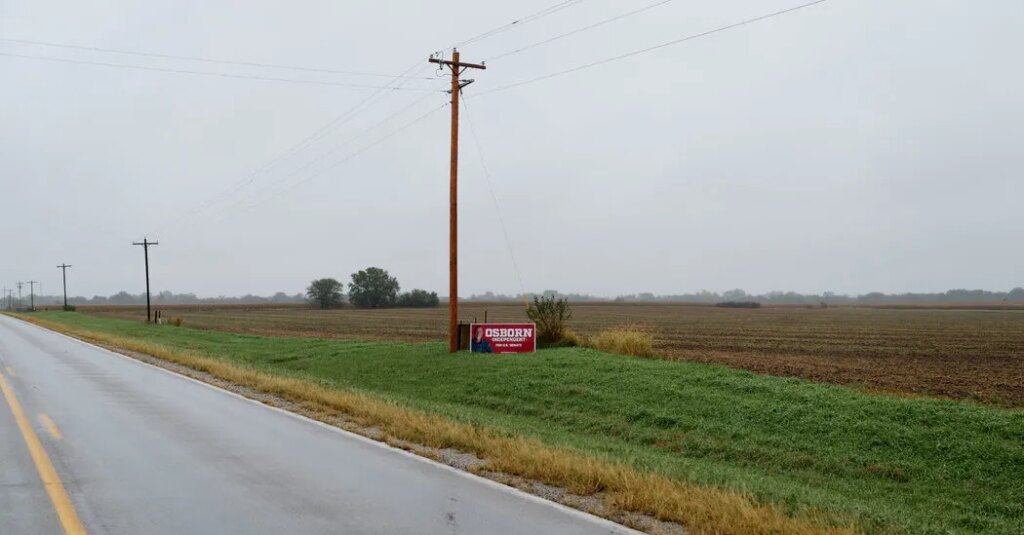
With a fortune estimated at more than $200 million, Senator Pete Ricketts of Nebraska is among the richest members of Congress. His independent challenger, Dan Osborn, reported an income last year of $108,089.91 from the heating and air conditioning company where he works as a mechanic.
That yawning gap, between a middle-class salary that is falling behind inflation and generational wealth that has soared over the past two years, is at the heart not just of Nebraska’s competitive Senate contest but House, Senate and governor’s races across the country. It’s not just the price of gas and groceries. It’s about those who struggle watching in wonder at those who don’t.
“The perspective has changed from left versus right,” said Jim Begley, director of the William Brennan Institute for Labor Studies at the University of Nebraska-Omaha. “Now it’s top versus bottom. And people on the bottom are wondering what the hell is going on.”
Democrats from Western Montana to Northeastern Pennsylvania are running against what they say is a “billionaire class” that has supposedly rigged the political and economic system. In Ohio, Amy Acton, the Democrat seeking the governor’s mansion, is airing an ad using her opponent Vivek Ramaswamy’s own words — “I’m like dirty, dirty rich, not quite filthy rich” — to portray him as out of touch.
In a House district around Palm Beach, Fla., Democrats are running against Republican Casey Askar’s wealth. In Maine, a new attack ad on Senator Susan Collins, the incumbent Republican, pits “working class people” against the “very rich.”
But perhaps nowhere are such class attacks more stark than in the Nebraska Senate race where Mr. Ricketts, the Republican scion of the TD Ameritrade finance fortune, faces Mr. Osborn, a mechanic who made his name leading a strike at a Kellogg plant in Omaha.
Two years ago, Mr. Osborn ran and lost against another Republican incumbent, Senator Deb Fischer, figuring that he couldn’t beat the vast personal fortune of Mr. Ricketts, who was also on the ballot in a special election to complete the term of retired Senator Ben Sasse.
This year, Mr. Osborn is running against that personal fortune. In advertisements and social media posts, he has portrayed Mr. Ricketts as a spoiled rich kid, whose father, Joe Ricketts, the founder of Ameritrade, bought him a Senate seat.
“The system’s working exactly like it’s designed to work — for them,” Mr. Osborn said after a town hall in Tekamah, Neb. this month. He added, “Nebraska has to make this decision and tell the rest of the country we’re not for sale.”
The portrait ignores Pete Ricketts’s tenure as governor and deep connections to Nebraska.
“Senator Ricketts delivers for Nebraskans; Dan Osborn lies to them,” said Max Oberg, a spokesman for the Ricketts campaign.
And Democrats and their allies have run class-conscious campaigns for years, often to no avail. Senator Bernie Sanders of Vermont failed to win the Democratic nomination for president twice on crusades against oligarchs and billionaires.
But in a year of economic struggles, class differences may be striking a nerve.
Sean Dell, 40, a machinist in Seward, Neb., voted for Donald Trump in 2016 and 2024. Then, he said, he looked at his own finances and decided to vote this year for Mr. Osborn.
“When you disrespect the American worker and tell them they’re not worth it — their opinions, their home life, having a job, making a mortgage, isn’t worth it — that’s what gets me going,” he said.
Few economists dispute that the wealth gap has grown in recent years, but the past two years have stood out. The richest 0.1 percent of Americans — about 250,000 people, with an average net worth of more than $140 million — has seen its wealth grow nearly 14 percent since President Trump returned to office, adjusted for inflation, according to data compiled by economists at the University of California, Berkeley, and the Paris School of Economics. The richest 0.01 percent, about 25,000 people, did even better.
Middle-class households have seen their wealth grow by less than 3 percent over the same period.
The richest 1 percent of households own more than half of all stock-market wealth, according to data from the Federal Reserve, meaning they have benefited most from strong market gains. At the same time, wage growth has been slowing and has lagged behind inflation for much of this year, taking a toll on the earnings power of the large majority of American households that rely on wages to pay the bills.
Lower-income households have been hit especially hard by prices at the pump because gas makes up a larger share of their monthly expenditures. And higher interest rates on credit cards and car loans are taking a toll on households that must borrow to make ends meet.
Democrats and even independents like Mr. Osborn still have to contend with a toxic brand in states like Nebraska, where opponents of the Republican Party tend to be associated with liberal social policies viewed as so anathema that they outweigh economic concerns. The Ricketts campaign has hit Mr. Osborn hard on issues like border security, the salaries he and his wife have drawn from their campaign and super PAC, and a general sense that, independent label aside, he is a closet liberal.
“Dan Osborn promised to help build the border wall, then got caught calling it ‘a symbol of racism,’” Mr. Oberg said. “He sells himself as working class while he lost 500 Kellogg’s workers their jobs and his family pocketed over $500,000 from his campaign.”
(Mr. Osborn’s recent financial disclosure reported that he and his wife earned about $61,000 in salary and consulting fees from his campaign and super PAC.)
Jim Thege, 57, a welder in David City, Neb., said he worried about access to health insurance and the price of housing, but his vote for Mr. Ricketts was based on fears that Mr. Osborn will be more liberal than he claims.
Mr. Thege cited Republican ads attacking Mr. Osborn on border security and transgender athletes. “The Democrat Party with men playing women’s sports, sharing a locker room? That’s just not right,” he said.
But for some voters this year, economics trump social policy. Angel Chavez, 40, a Columbus, Neb., plumber, considers himself politically conservative. Turned off by the Democrats’ positions on abortion, he voted for Mr. Trump in 2024.
But supporting five children has become difficult even in a town of 24,000, in the center of the country. He once considered himself middle class but now, he said, “we’ve had to step down to the lower class.”
He plans to vote for Mr. Osborn.
Michael Nguyen, 34, a machine technician at Schneider Electric, an electrical circuit breaker factory in Lincoln, Neb., has been picking up overtime shifts the past four months to help pay the bills for his four children. He said $20 could once buy a week’s worth of meals; now, that covers the eggs, milk and bread.
“Corporate has been breaking their revenue marks every single year, and the working class isn’t getting enough,” he said.
Mr. Nguyen said he has never voted because candidates have felt out of touch either with his conservative values or his labor experiences. This year he plans to cast his first ballot — for Mr. Osborn.
As for wealthy politicians such as Mr. Ricketts, “Why would they care about what my kids are going through?” he asked. “Why would they care about what I’m going through?”
Outside a worn, white farmhouse in Plymouth, Neb., Vern Jantzen, 68, worked in his machine shed while one of his daughters, Katie Jantzen, 36, weeded in her greenhouse across the driveway. They grow corn and soybeans on the land their ancestors tilled in 1891.
But the 108-acre property doesn’t yield enough money to be a full-time job anymore. Ms. Jantzen also works at a construction company in Beatrice, Neb., while Mr. Jantzen drives a school bus and helps on nearby farms.
“Look at the disparity between the people who are running the companies and what the workers are getting paid,” Mr. Jantzen said. “How did that get so out of whack? How can somebody who’s running a company make $5 million a year?”
Class consciousness seemed to saturate Nebraska.
“Supreme Court Judge Louis Brandeis said you can have wealth concentrated in the hands of few, or you can have democracy, but you can’t have both,” said John Dittrich, 71, as his daughter wielded a dusty combine in the family soybean field outside the town of Tilden, three hours north of the Jantzen farm.
Mr. Osborn has tried to skirt the Democratic Party’s lingering political toxicity in Nebraska by insisting he will not side with either party if elected. It isn’t working with some voters, even workers who might be expected to identify with his background.
Shawn Peasley, 42, a production employee at Kawasaki in Lincoln, Neb., said he worried that Mr. Osborn’s lack of party affiliation will prevent him from creating and passing legislation. Mr. Peasley, a registered independent who has voted for Mr. Ricketts in the past, refused to say how he will vote.
Ben Casselman contributed reporting.
The post When a Candidate Is Wealthy, and Many of the Voters Are Not appeared first on New York Times.