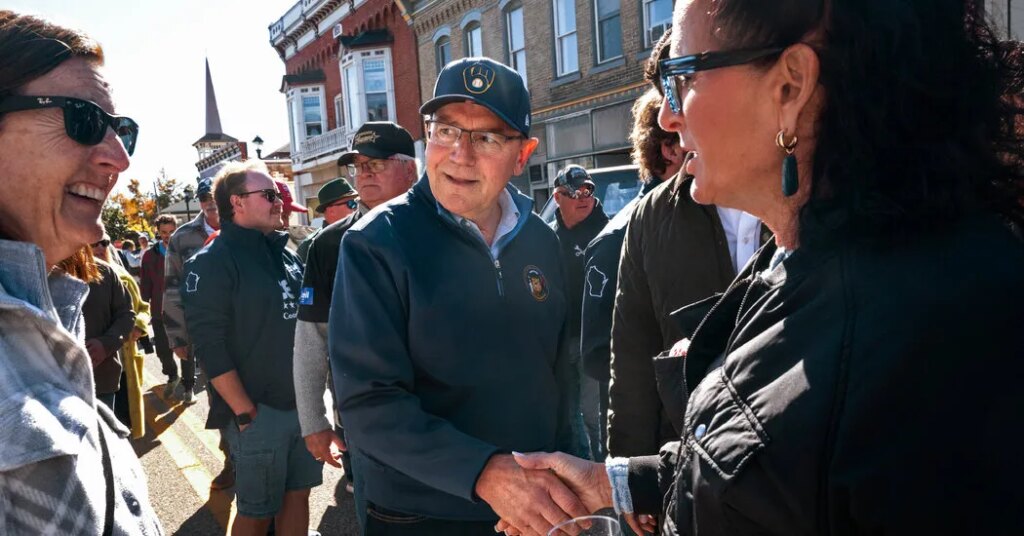
President Trump has been urging Republican voters to pretend that he is on the ballot for the midterm elections. One of his leading allies, the Wisconsin gubernatorial candidate Tom Tiffany, is clearly hoping they will not.
“My opponent, all he talks about is Donald Trump, MAGA, all the rest,” Mr. Tiffany, a three-term Republican congressman, said at a gathering for hunters in Green Bay earlier this month. He was referring to comments made by his Democrat opponent, David Crowley, the Milwaukee County executive. He added, “Wisconsinites want to know what you’re for, and I’m for Wisconsin.”
Mr. Tiffany enumerated a few other things he was for. Lower taxes. Abolishing sanctuary cities. Preventing the confiscation of high-powered hunting rifles. Protecting farmland from solar-powered data centers.
But Mr. Tiffany did not say that he was for Mr. Trump, though most hunters in the room, and across the state, likely knew that. After all, the president’s endorsement of Mr. Tiffany in January described the Wisconsin conservative in almost servile terms: “He has always been at my side.”
Mr. Tiffany, like other Republicans, has accused Democrats in the past of suffering from “Trump derangement syndrome.” But as Wisconsin voters have increasingly soured on the president, with 60 percent disapproving of his performance according to a Sept. 30 survey conducted by the Marquette University Law School, Mr. Tiffany has shown signs of a kind of Trump avoidance syndrome.
In speeches and ads, the congressman has emphasized his small-town biography and reliance on “common sense” rather than his legislative record as an ally of Mr. Trump.
Mr. Tiffany has also contrasted his views with those of the president, without ever mentioning Mr. Trump by name. Of the Iran war, the candidate said last month, “It’s time to wrap things up and come back home.” Unlike Mr. Trump, Mr. Tiffany has expressed reservations about — though not outright opposition to — data centers, saying that they should not be constructed without local approval and should not be offered tax incentives.
Mr. Tiffany is hardly alone. Republican candidates engaged in tight races throughout the nation have subtly asserted declarations of independence from Mr. Trump. In the race for U.S. Senate in Iowa, Representative Ashley Hinson, who vowed last year to become Mr. Trump’s “strongest ally” in the upper chamber should she win the seat, has more recently run an ad reframing herself as a “bipartisan fighter” dedicated to “working with both parties.”
In the Michigan Senate race, Mike Rogers, the Republican candidate and former seven-term congressman, has released ads criticizing the president’s trade war with Canada and the war in Iran. In Florida, the campaign of Representative Byron Donalds, a longtime ally of the president who is now running for governor, updated its website in late September by removing several references to Mr. Trump.
Still, Mr. Tiffany’s why-I-hardly-know-the-man distance from the president has not made the subject go away.
Mr. Crowley has called Mr. Tiffany a “lap dog” for Mr. Trump. His campaign ads and surrogates have relentlessly hammered the theme that Mr. Tiffany has voted with the president 100 percent of the time while in Congress.
“They’re trying to figure out how to work the word ‘MAGA’ into every other sentence when they’re describing Tom,” said Scott Jensen, a Republican former speaker of the Wisconsin state assembly who has known Mr. Tiffany for 25 years and is informally advising him.
Mr. Crowley’s campaign has argued that Mr. Tiffany is changing his tune now that he is running for governor in the purple state of Wisconsin. While representing the state’s most Trump-friendly congressional district, Mr. Tiffany voted five times against resolutions to end the war in Iran. He also voted for cutting taxes and environmental restrictions on data center construction.
“He’s running a campaign that’s desperately trying to distract voters from his long career in the MAGA trenches,” said Ben Wikler, the former Democratic state party chairman.
“He’s clearly tied to the president in the public eye,” said Charles Franklin, Marquette’s polling director.
At the same time, Mr. Tiffany, who often wears flannel shirts on the campaign trail and is fond of saying “you betcha” on camera, does not readily personify the MAGA warrior that both Mr. Trump and Mr. Crowley’s supporters say he is.
“He’s not one of the performance artists in Congress,” said Anthony Chergosky, a professor of political science at the University of Wisconsin-La Crosse. “He’s not a regular on Fox News or Newsmax. His social media accounts aren’t full of viral clips. Democrats have attempted to portray him as a radical Trump follower, and one of the challenges is that Tiffany doesn’t have an over-the-top bombastic personality.”
Mr. Tiffany’s campaign did not respond to repeated requests for comment.
‘Toxic Tom’
Mr. Tiffany, 68, had a life of his own before he knew Mr. Trump.
His campaign ads have depicted that life as having grown up “milking cows on a Wisconsin dairy farm” outside the village of Elmwood, on the northwestern edge of the state. His ads also highlight his work as a “dam tender” for 29 years on the artificial reservoir known as the Willow Flowage, a part-time job that earned him $5,458.47 in 2020, according to congressional disclosure records.
Through most of his adulthood, Mr. Tiffany made a living working first in the petroleum industry and later operating a 76-foot tourist excursion boat in the densely forested Northwoods region of northeast Wisconsin.
He also nurtured an ambition for public office. Mr. Tiffany won a seat in the Wisconsin State Assembly in 2010 and a seat in the State Senate in 2012. He sold his boat business in 2013, the same year he became the lead author of legislation that would streamline the permitting process for an iron mining company, Gogebic Taconite, to dig a massive open-pit mine at the headwaters of the Bad River in northern Wisconsin.
His support of the measure infuriated local conservationists, who labeled him “Toxic Tom.” The company abandoned the mining effort in 2015 after intense opposition.
Mr. Tiffany won his House seat fin a special election in May 2020 and at the time, promised to be “the ally President Donald J. Trump needs to keep moving our country forward.” Mr. Trump subsequently endorsed Mr. Tiffany as a “big Tax Cutter” who would “help me DRAIN THE SWAMP!”
(This past June, at a public gathering in Chippewa Falls with Mr. Tiffany present, the president disclosed an ulterior motive for his endorsement: “I liked his last name. You know why? Because I bought the air rights many years ago off Tiffany and I made a lot of money.” Mr. Trump was referring to his purchase in 1979 of the unused vertical square feet above the Tiffany & Company flagship jewelry store so he could build the 664-foot Trump Tower next door.)
Mr. Tiffany returned the president’s favor in December 2020, when Mr. Trump was disputing the results of the presidential election he lost. Hours after the riot at the Capitol on Jan. 6, 2021, Mr. Tiffany voted against certifying the election results, based on his factually unsupported claim that “hundreds of thousands of illegal votes” had been cast and counted in the liberal strongholds of Milwaukee and Madison.
When Mr. Trump returned to the political arena as the G.O.P. presidential nominee in 2024, he endorsed Mr. Tiffany again, calling him a “tremendous representative.” At the event in Chippewa Falls in June, Mr. Trump described Mr. Tiffany, who sat nearby, as “one of the best congressmen in our country.”
The two have not been seen together since then.
Trump Undeterred
Allies of Mr. Crowley maintain that Mr. Tiffany’s avoidance of the president is not fooling anyone. During Mr. Tiffany’s current term in Congress, he sought to codify Mr. Trump’s executive actions in a bill he introduced banning diversity, equity and inclusion programs from all federal agencies, although it ultimately died in committee.
He voted for Mr. Trump’s One Big Beautiful Bill, which he lauded for delivering “major wins for the American people” but which also, according to the Wisconsin Department of Health Services, could put 63,000 residents in the state at risk of losing their access to Medicaid. Mr. Tiffany also encouraged Elon Musk, who oversaw the DOGE government-slashing program, to consider moving federal offices out of liberal Dane County for not fully cooperating with efforts by U.S. Immigration and Customs Enforcement.
For his part, Mr. Trump appears undeterred by Mr. Tiffany’s cold shoulder. In a social media post on Oct. 7, the president announced that he had spoken to Mr. Tiffany about supplying millions in disaster aid to storm-stricken parts of the state. The president signed off by saying: “See you soon Wisconsin—I LOVE YOU ALL!”
Asked for his reaction to Mr. Trump’s post, Mr. Jensen, the informal adviser to Mr. Tiffany, offered a nervous laugh before saying, “I would advise the president to go to Minnesota instead.”
The post In the Wisconsin Governor’s Race, Another Case of Trump Avoidance Syndrome appeared first on New York Times.