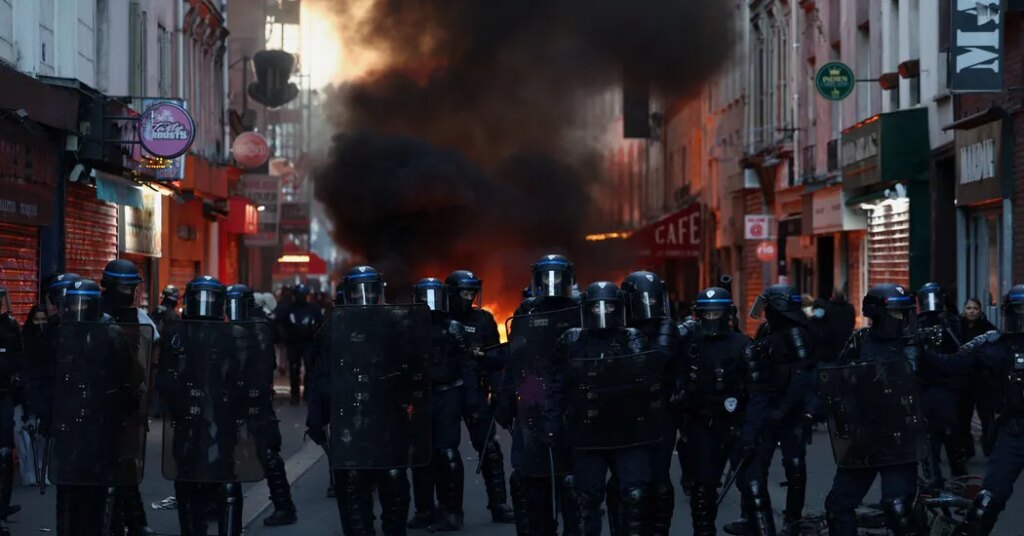
More than 70,000 police officers will be deployed on Saturday in France, when a new round of protests against deteriorating school conditions and high costs of living is expected across the country, a top official said on Friday.
The interior minister, Laurent Nuñez, made it clear that the government wanted to avoid a repeat of last weekend’s unrest, which spun out of huge and largely peaceful demonstrations in cities across France. Nearly 1,000 police officers were injured and more than 3,000 stores were looted or damaged, according to the authorities. More than 2,500 people were arrested.
“We will be inflexible toward rioters, looters and anyone who commits acts of violence,” Mr. Nuñez said at a news conference. He said that far-left movements had called on social media for demonstrators to commit acts of violence and that others called for looting, though he did not cite specifics.
The police response will be “extremely mobile, agile and effective,” according to Mr. Nuñez, citing the deployment of elite police units as well as mounted police officers, drones, helicopters, armored vehicles and water-cannon trucks.
On Saturday, demonstrators, supported by labor unions and some left-wing political parties, hope to take part in what is being referred to as the “second act” of the rallies last weekend, which the government estimated had more than half a million participants.
Some supporters identify with the “yellow vests,” a protest movement that erupted in 2018 to oppose a gas tax and led to weekly protests against high living costs. A website affiliated with the movement listed more than 600 meeting points for Saturday.
At the request of the French government, officials in cities most affected by the unrest last week have issued temporary restrictions on gatherings and curfews, often on a day-to-day basis and only in some neighborhoods. On Thursday, President Emmanuel Macron of France recommended that “there should be no protests in the coming days.”
The Paris police rejected several requests for protest permits on Saturday but authorized a demonstration organized by the C.G.T., one of France’s main unions. Protesters will be allowed to walk between two of the city’s main squares, Bastille and Nation.
The police also banned fireworks and fuel in Paris and parts of the metropolitan region until Monday. A curfew in two parts of Paris was extended until Monday.
Several cultural institutions in the city, including the Grand Palais, Louvre, Orsay, Orangerie and Picasso museums, will be closed on Saturday, the culture ministry said in a statement. The Jeu de Paume museum, next to the Orangerie, said it would remain closed for the day. The Paris police also postponed a match between Paris St. Germain, a top soccer team, and Olympique Lyonnais that had been scheduled for Sunday night.
In Orléans, about 75 miles south of Paris, the authorities were bracing for potential unrest. The city was preparing to welcome 15,000 people for a two-day convention of the National Rally, France’s main far-right party, which is leading in polls for next year’s presidential election.
The local authorities authorized a protest organized by the C.G.T. and other groups, which is expected to draw more than 20,000 people on Saturday, but banned requests for another protest on Sunday.
“To those who might come to Orléans this weekend with the intention of provoking clashes or committing acts of violence, I wish to issue an unambiguous warning: The security forces will be present in large numbers, well equipped, and they will act under my authority with the determination required to maintain order,” Hugues Moutouh, the prefect of the Centre-Val de Loire region, where Orléans is, said in a statement.
Montpellier, Rouen, Toulon, Nice, Le Havre and other cities banned protests in their downtown areas on Saturday.
Officials in Marseille, who initially banned all protests, said on Friday that a demonstration organized by a union would be authorized for Saturday.
The far-left party France Unbowed, accused by the government of stoking unrest, criticized the decision to ban organized demonstrations and said it would instead encourage fragmented and unpredictable gatherings.
“Civil liberties cannot be used as a bargaining chip by an executive branch in disarray,” the party said in a statement on Friday. By imposing restrictions and curfews, “the executive branch is crossing, one by one, the boundaries that separate a democracy from an authoritarian, police state,” it added.
The post France Plans to Bolster Police Presence, Expecting New Protests appeared first on New York Times.