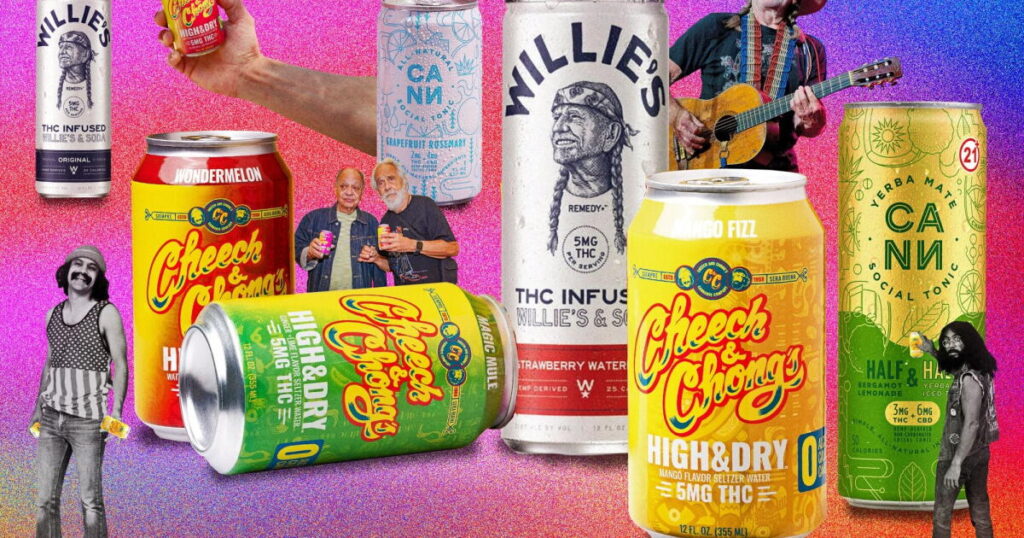
The $1.5 billion hemp drink market pioneered by legendary stoners like Cheech & Chong and Willie Nelson is facing an existential crisis, unless lawmakers in Washington strike a deal overturning legislation poised to make the psychoactive-infused seltzers and sodas illegal in the coming weeks.
The beverages — a favorite of everyone from alcohol-averse Gen-Zers to Boomers who sip THC-infused cocktails before bedtime — exploded in popularity, exploiting a loophole in an agriculture bill originally drafted by Senator Mitch McConnell that legalized hemp for commercial purposes.The powerful Kentucky lawmaker has since said that was a mistake that has left children at risk, and tucked a provision outlawing the beverages into subsequent legislation. But that’s put him at odds with other Republican lawmakers — and even potentially the White House — who worry that the new restrictions will hurt the hemp industry. They also know they’re risking the wrath of constituents used to grabbing THC and CBD products at breweries, restaurants and gas stations across the country.Caught in the middle is a nascent but quickly growing industry that says that if lawmakers can’t strike some sort of deal before the Dec. 11 deadline, their companies will face an extinction-level event.
JuneShine Inc., which produces “Willie’s Remedy,” an assortment of “social tonics” featuring the country music icon, would consider shutting down the line if lawmakers fail to act, company co-founder Greg Serrao said in an interview. That’s despite the spirits, sodas, and gummies being “wildly profitable,” projected to bring in roughly $200 million in sales this year — up from $30 million when the company launched last year.
Brandon Harshbarger, who runs a commercial holding company for the comedy duo Cheech Marin and Tommy Chong, says 80% of his company’s business is THC products, like their “High & Dry Seltzers” and “High Teas.” Sales would be cut in half without congressional intervention, he estimates, which is reported to be roughly $100 million annually.
“It’s just crazy that we’ve been living in this world where, in theory, something that has been so robust and so positive from our perspective as a business, and so well received by the broad public” could be shut down, Harshbarger said.
Ironically, it was McConnell who opened the door to the new industry, when he helped push a provision in the 2018 farm bill that legalized the cultivation of industrial hemp.
The idea was that the plant — which is the same species as marijuana, but harvested with lower levels of THC, the chemical responsible for users’ high — could be a boon for farmers in his home state of Kentucky. Hemp grows fast and produces durable fibers that can make rope, cloth, and paper that is longer-lasting.
But the law included a significant omission. While it defined hemp as having less than 0.3% of a certain type of THC, called delta-9, producers found that beverages could fly under that threshold and still get consumers high. They also extracted other, milder types of THC, as well as CBD, a non-intoxicating compound that some people believe can help with sleep or anxiety issues. Clinical evidence remains limited.
In the ensuing years, entrepreneurs seized on the new rule to create high-inducing, sometimes high-potency drinks, edibles and smokable flower available in grocery, liquor and convenience stores. Beyond greater retail access, hemp’s legal status allows companies to advertise, operate across state lines, ship directly to customers and be taxed like normal corporations — none of which is available to cannabis operators.
While some states moved independently to impose restrictions, the industry flourished. But McConnell, realizing his error, tucked language limiting the overall THC content of hemp products into a fiscal year 2026 appropriations bill over the objections of his more libertarian fellow Kentuckian, Rand Paul, who warned it would destroy the hemp industry. The law also said synthetic cannabinoids no longer qualify as hemp.
President Donald Trump signed the bill into law, but has subsequently posted to social media that Congress should pass legislation “to ensure that Americans can continue to access the full-spectrum CBD products they have come to rely on, and that help them, while preserving Congress’s intent to restrict the sale of products that pose Health risks.”
McConnell said his legislation would preserve the industrial hemp uses he originally envisioned while protecting kids from intoxicating hemp products. And a spokesperson for his office said the Kentucky lawmaker remains firmly opposed to an extended delay, which he believes would continue to expose children to unregulated, intoxicating hemp-derived THC products that are packaged similarly to well-known candy and snacks. “Children end up being the unknowingly consumers of these poisonous products and being sent to the hospital at an alarming rate,” McConnell said in a speech last November.
Closing the federal loophole would not restrict sales of marijuana in states like California and New York, which have legalized recreational sales of the drug.
The industry won a temporary reprieve with a massive lobbying effort — aided by the convenience store lobby, which doesn’t want to lose a lucrative business — that pushed new restrictions back from Nov. 12 to Dec. 11. But that doesn’t leave much time for a deal to be struck.
Senators Amy Klobuchar, a Minnesota Democrat, and Tim Sheehy, a Montana Republican, are drafting a bill that would provide the industry a bridge until full regulation is implemented. It would limit sale of THC products to those over 21 years old but also raise the amount of the psychoactive compound permitted in harvested plants.
A White House spokesperson, asked if the president supported the draft legislation, pointed to his original social media post but did not weigh in further. But there is still an array of groups seeking to remove the products from shelves, including competitors for sales of intoxicating products like cannabis and alcohol interests, who typically face tougher regulations.
“The hemp industry’s business model was a loophole, and loopholes close,” said Kevin Sabet, who leads Smart Approaches to Marijuana, a political organization that opposes marijuana legalization and sales. “That should be a warning to any industry betting its future on profiting from addiction at the expense of kids and vulnerable people. Our advice to these companies is simple: spend less time lobbying for another delay and more time planning for life after Dec. 11.”Other detractors point to the proliferation of synthetic hemp-derived products that appeal to children and often carry high THC content. The Senate only narrowly approved the one-month reprieve, and actual legislation is likely to face stiff opposition from lawmakers like Senator Ted Budd of North Carolina, who has said the hemp beverages lure in children at gas stations.
Hemp proponents say a proper regulatory framework will eliminate the majority of those products.
“The good operators want regulation,” Cheech & Chong’s Harshbarger said, adding that is the best way to protect consumer safety.
Getting it right could prove important for politicians, who face constituents both concerned about safety — and protective of a favorite way to unwind.
Over 58% of THC drink users are 45 years old or more, according to one survey conducted by beverage brand Crescent Canna. More than half of respondents said the drinks help them unwind or get to sleep, while three out of four report having decreased or eliminated alcohol consumption outright because of canned cannabis. Elder voters historically are far more likely to vote, which means the elimination of a favorite beverage could cause political headaches.
Absent regulatory clarity, the infrastructure around hemp has already begun to contract.
Prior to the proposed ban passing last year, FundCanna, which offers credit in the often opaque world of cannabis financing, had a loan book comprising 15% of hemp. In the ensuing months the financier has dialed back its exposure to around 1%, according to Chief Executive Officer Adam Stettner.
“Just from a standpoint of assessing risk, we began reducing our exposure by declining repeat business and not taking on new clients,” following the original hemp definition change last November, Stettner said in an interview. “I don’t want to be bridge financing where the bridge doesn’t lead to a place that you can identify and so we were in a position where we had to say no,” he added.
Edibles.com, an e-commerce platform and subsidiary of Edible Arrangements International Inc. that began selling THC products last year, was informed by one supplier three months ago that the latest shipment would be its last as they wind down their hemp business, the company’s president, Thomas Winstanley, said in an interview.
“We haven’t run into supply restrictions yet, but we know that they are coming and we are starting to have those conversations,” Winstanley said. “It’s really hard to build a brand new business, it’s really hard to build one in a very restrictive category and it’s even harder to do so when the government can’t figure out how to deal with your business and you might have an extinction threat,” he said.
Crescent Canna has already moved to lay off its entire sales force of 19 people in June, Chief Executive Officer Joe Gerrity said in an interview. Last year, the company sold more than 9.5 million cans, according to Gerrity.
“Our sales team is around the country and their goal is to grow accounts, to add more accounts, and at a certain point you can’t invest in the future of this industry right now,” Gerrity said in an interview.
Crescent Canna’s distributors have been making fewer, smaller orders. One important partner in Louisiana has already informed the company that its most recent purchase will likely be the last substantial one they make until they get clarity from Washington.
Some companies are launching promotions to move the product ahead of the December deadline. On Oct. 1, THC-infused beverage brand Wynk sent out an email to customers with the subject line “Last Call Coming for Wynk Nationwide”. Similarly, Pamos has been offering customers buy one, get 80% off promotions. Cheech & Chong launched a buy now, pay later option closer to the ban date so consumers can stock up with larger purchases.
“We’re fond in our country to say ‘existential threats’ — that’s this for hemp companies,” Terry Mendez, Chief Executive Officer of SHF Holdings Inc., said in an interview.
Brown writes for Bloomberg.
The post An existential threat to THC drinks pits Willie Nelson against Mitch McConnell appeared first on Los Angeles Times.