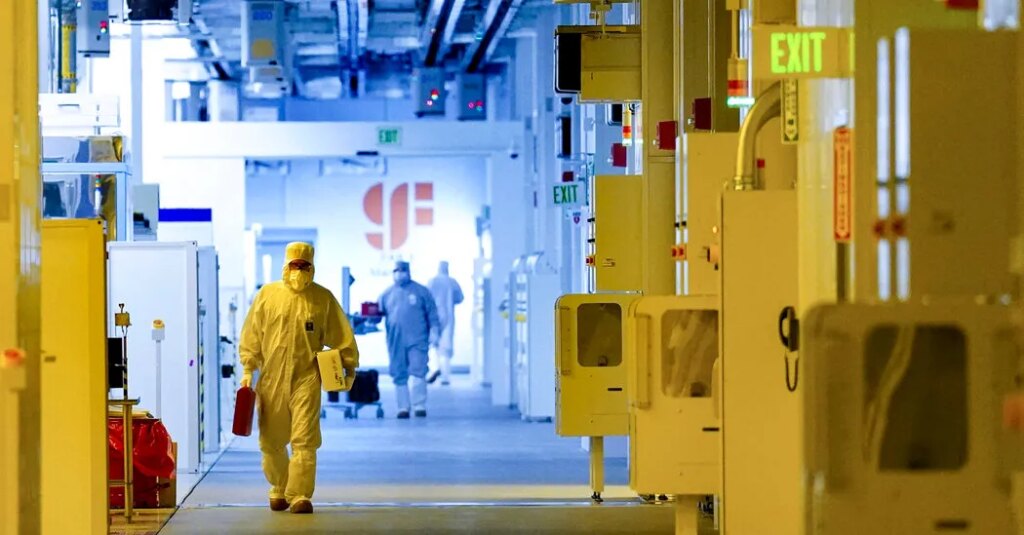
For years, the United States has tried to jump-start domestic semiconductor production through a mix of federal grants and loans. The Trump administration is taking a much different approach — channeling foreign money into the sector, and demanding a cut for U.S. taxpayers in return.
The latest example was an unusual agreement for a semiconductor factory in upstate New York that was unveiled this week. Billions of dollars in Japanese funding has been dedicated toward building a facility that will be operated by the U.S. chipmaker GlobalFoundries.
But unlike GlobalFoundries’ other factories in New York, the upstate project will be co-owned by the United States and Japan through a special purpose vehicle. Japanese financing of $10 billion is expected to accelerate the construction of the factory, which will begin producing chips for cars, factories and data centers in 2029. Another $10 billion could fund a second plant, if the parties later approve it.
Call it the financialization of government investment. The Japan tie-up is the brain child of President Trump’s commerce secretary, Howard Lutnick, a New York financier known for pursuing unorthodox and aggressive tactics to amass a fortune. In Mr. Trump’s second term, Mr. Lutnick has used the threat of tariffs as a cudgel to drum up big promises of international investment, and turned the Commerce Department into a deal-making operation that wields those funds.
With Japan, whose economy depends on exports of cars, technology and steel, Mr. Lutnick and Mr. Trump offered the country lower tariffs in return for setting up an investment fund that the president could direct toward chosen projects. So far, Japan has agreed to fund a natural gas plant in Ohio, a crude oil export facility along the U.S. Gulf Coast and a synthetic diamond manufacturing site in Georgia, among other projects related to nuclear energy, critical minerals and other fields.
Profits from the New York chip project are expected to be split between the U.S. and Japanese governments, with GlobalFoundries also taking a cut. The chip company will also be paid a series of fees for the use of its technology and for operating the site. And the U.S. government will take an equity stake in GlobalFoundries, one of dozens of equity stakes in private companies, including the chipmaker Intel, that the Trump administration has acquired since last year.
Speaking from GlobalFoundries’ New York factory on Wednesday, Mr. Lutnick heralded the project’s benefits.
“Not only does the United States of America make money from the tariffs in Japan, but we also make money on 50 percent of the cash flow profits of this $20 billion investment,” he said. “And then on top of that, because of the scale of this investment, GlobalFoundries has agreed to give us 7 percent of the company, which at current market value is about $2 billion.”
Mr. Lutnick said that Mr. Trump had not yet decided what to do with the equity shares the company had given to the United States, but that Mr. Lutnick personally favored putting them into Trump accounts, new tax-advantage savings accounts for children.
GlobalFoundries, whose majority owner is the sovereign wealth fund of Abu Dhabi, has long had U.S. government funding and contracts. The Biden administration approved $1.5 billion of funding and another $1.6 billion of loans in 2024 to support the company’s chips. The company also operates as a “trusted foundry,” providing semiconductors for the U.S. military.
The company had been pondering the expansion for years, and moved forward after discussions with the government and Japan. The project would increase the country’s capacity for semiconductors, which are used to power everything from cars and toasters to data centers, by 10 percent, and become one of the largest facilities in the country. Both Republicans and Democrats have been pushing to increase domestic chip production in recent years, after pandemic-era shortages slowed car production and stoked inflation.
Mr. Trump and his cabinet officials have been promoting investments in Alaska, Iowa and North Carolina — some of which seem more likely to be realized than others — as they try to buoy their approval rate ahead of the midterms. After an event last month to celebrate what Mr. Trump said would be an Alaskan gas pipeline financed by South Korea, officials there clarified that they had committed to move forward with the project only if it was deemed commercially reasonable.
Mr. Trump has repeatedly made exaggerated claims about foreign investments, including that his administration has brought $20 trillion into the country — a sum equal to more than two-thirds of U.S. gross domestic product.
On Wednesday, Mr. Lutnick ticked through his own accounting: a $550 billion commitment from Japan, $350 billion in promises from Korea, as well as another $500 billion to build Taiwanese semiconductor factories.
“No one has ever seen or heard of these kind of numbers before,” Mr. Lutnick said.
At GlobalFoundries, all the parties expressed their enthusiasm to go forward with the first $10 billion phase of the project. The second phase, which would take the total investment to around $21 billion, is still subject to a “go-no-go decision” between the shareholders before the end of 2028, the company said.
Tim Breen, the chief executive of GlobalFoundries, said in an interview that the company had wanted for some time to expand, but that the government had pushed them to “think bigger.” He added, “so we came up with this concept to expand this site in two phases.”
Pradip Singh, the chief manufacturing officer at GlobalFoundries, said the move would be positive for the company’s shareholders, allowing the firm to provide its customers with domestically produced chips, without bearing the extra cost of capital expansion.
U.S. officials have also described the fact that Japan is footing the bill as a benefit to U.S. taxpayers. Japanese officials, who attended the ceremony Wednesday, emphasized that the facility would use Japanese machinery to make its chips, and supply some of the products to a technology corporation in Japan.
The post U.S. Government Takes a Cut of Chip Business in Japan-Funded Deal appeared first on New York Times.