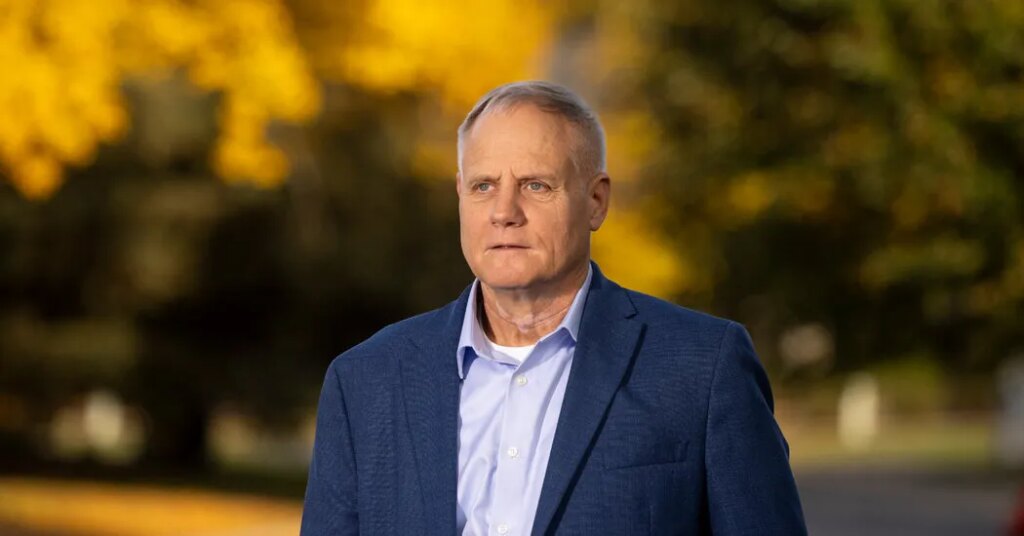
For years, Andrew Cilek and the tiny alliance of election integrity activists he leads have been locked in what he calls “an interpretation battle” over voting rights for felons.
His group, the Minnesota Voters Alliance, believes that the U.S. Constitution forbids voting by felons before the end of their sentences — including parole or probation terms. Minnesota law begs to differ: Since 2023, a criminal record does not affect a citizen’s right to vote in the state unless he or she is incarcerated for a felony conviction.
The disconnect, according to Mr. Cilek, put his group on a collision course with Minnesota’s law prohibiting deceptive practices around elections — part of a surge of rules proposed or passed by states to curb the intentional spread of falsehoods that could suppress the democratic process. Concerned that publicizing its views could trigger the law, Mr. Cilek’s group sued, claiming a First Amendment violation.
The case, Minnesota Voters Alliance, et al. v. Ellison, joins a growing push to govern election-related speech through the judicial system, rather than legislation. A federal appeals court recently ruled in the group’s favor, but Keith Ellison, Minnesota’s attorney general, has vowed to “continue to evaluate next steps.”
The case reflects a time of great confusion and distrust around voting. And with a contentious midterm election just weeks away, it could have major implications for how far states can go to control political expression — what can be articulated at election time, and by whom and where.
The court’s decision conveys to other states that legislating speech is very difficult, said Lawrence R. Jacobs, who runs the Center for the Study of Politics and Governance at the University of Minnesota.
“There’s a near panic among protectors of elections about mis- and disinformation — they consider it to be an epic threat,” he said. “This ruling is a striking example of the limits of what they can do.”
Mr. Cilek, who stressed that he had “a lot” of friends who are felons, said the government viewed his group’s advocacy “as disenfranchisement, but we never intended that — we never even came close to that.”
“We say there’s room for disagreement,” he said. “Reasonable people can disagree on things.”
The case has unfolded in a rapidly changing information environment, especially around elections. Public suspicion and polarization are exacerbated by lax content moderation, distrust in authoritative sources is fanned from the highest political office, and increasingly powerful artificial intelligence technology is undermining faith in reality.
Minnesota has been a hotbed for discussions about the quality of political communications. Local upheaval over federal immigration enforcement policies generated a spate of false narratives and altered visuals last year. Baseless claims of stolen elections dogged the governor’s race this year.
After the 2020 election, when similar voter fraud claims ran rampant, Minnesota was one of several states that tried to address the pollution in the public square by banning voting-related disinformation. Around the country, however, some of that legislation has been dogged by legal challenges, often on First Amendment grounds.
In just one example from last year, the social media platform X sued over a 2023 law that penalized certain election-related deepfakes in Minnesota. (The company claimed “government censorship.”)
Mr. Cilek’s group, founded in 2003 in suburban Roseville, has been involved in multiple cases that have gone before the Minnesota and U.S. Supreme Courts.
Mr. Cilek stresses that his group is officially nonpartisan, but allows that its beliefs can lean conservative. Its ties to conservative donors and legal groups have helped fuel its many lawsuits over voting practices in Minnesota — such as in 2023, when it sued after state lawmakers restored voting rights to felons who were not incarcerated.
One lawmaker, a Democrat, described that lawsuit as an attempt “to create confusion and fear.” In 2024, the Minnesota Supreme Court dismissed the case on standing.
The group also took issue with the state’s deceptive-practices law, which was passed in 2023. The law threatens misdemeanor charges and a fine of up to $1,000 against those who knowingly transmit falsehoods that could impede voting within 60 days of an election. Lawmakers hoped to prevent lies about logistics and eligibility that could suppress voting by Black citizens and others.
But Mr. Cilek’s group felt that its public advocacy on felon voting rules put a target on its back and could expose it to prosecution. Mr. Cilek wrote opinion pieces arguing against early re-enfranchisement, among other efforts. So the group sued again, pre-emptively, claiming that the deceptive-practices law enabled government retaliation against unsanctioned ideas.
Government officials filed a counterclaim, accusing the alliance of making intimidating statements that it knew were “materially false under Minnesota law.” State Representative Emma Greenman, the chief author of the deceptive-practices rule, said in an interview that the voters group and its allies were perpetuating “a cottage industry of challenging our voter protection laws”
“This is part of a strategy of moving the policy preferences and decisions out of the democratically elected legislatures and Congress and into the courts,” said Ms. Greenman, a Democrat and, for two decades, a voting rights lawyer. “At the end of the day, whether the intent is there or not, it weakens people’s relationship to their power and our democracy.”
The courts have delivered mixed decisions.
A federal judge first dismissed the Minnesota Voters Alliance’s case in the fall of 2024. Nearly two years later, in August, a panel of the U.S. Court of Appeals for the Eighth Circuit decided in the alliance’s favor, ruling that the group’s views qualified as protected political speech
Minnesota’s law cut off “open and vigorous expression of views” and could be abused by running out the clock until after the election, the judges wrote. Instead, the panel added, state officials could push back against false speech by publicly countering it with facts, and even informing parolees and probationers directly about their rights.
The ruling bars Minnesota officials from trying to block the advocacy group’s speech related to felon voting rights. This month, the full Eighth Circuit court rejected the state’s petition for a rehearing. The state attorney general’s office said in a statement that it would keep trying “to defend the constitutionality” of the law. On Tuesday, Mr. Ellison, the attorney general, introduced a form that Minnesotans could use to report incidents of disinformation or deceptive technology related to the midterms, including A.I.-generated deepfakes.
In the past, free speech cases have sometimes been resolved, even as high as the U.S. Supreme Court, in favor of calculated falsehoods, said Ciara Torres-Spelliscy, a law professor specializing in election law and the First Amendment at Stetson University’s College of Law.
“My fear, given the way they’ve ruled in past cases, is that they are going to side with the people who are producing disinformation in elections at the expense of American voters,” she said.
All of this is giving Mr. Cilek déjà vu. In 2010, he went to his polling place on Election Day wearing a button calling for photo ID requirements for voters and a T-shirt with a logo for the conservative Tea Party movement. He was temporarily prevented from voting.
The experience turned into Minnesota Voters Alliance v. Mansky. The case considered whether Minnesota’s law banning apparel with political messaging at active polling stations violated the First Amendment.
“I was hoping the case would go away because I hated it,” Mr. Cilek said. “I mean, it’s a T-shirt. I didn’t realize the magnitude of it.” The U.S. Supreme Court heard the case in February 2018 and voted 7 to 2 in the alliance’s favor.
Today, embroiled in another free speech case, Mr. Cilek, 62, said he had no interest in spending more time publicizing his group’s position on felon voting rights. He’s tired, and his priorities have shifted, he said last month during an interview at a mall food court in the Minneapolis suburb where he lives.
Still, Mr. Cilek said, he wouldn’t mind having another go at the Supreme Court.
“That’d be fun to just go there one more time, except this time I’d have a little more experience,” he said.
For Representative Greenman, the fight against election interference is far from over. Her own law was narrowly conceived, she said, meant to target a specific kind of deception historically used around elections.
”The much harder work involves the general disinformation that is coming from the president of the United States and then being recycled and passed on,” she said. “This isn’t going to help us, in the age of A.I. and technology, with some of the much more aggressive and prevalent falsehoods that are being spread, and spread rapidly.”
The post A Fight Over Felon Voting Fuels a Free Speech Debate appeared first on New York Times.