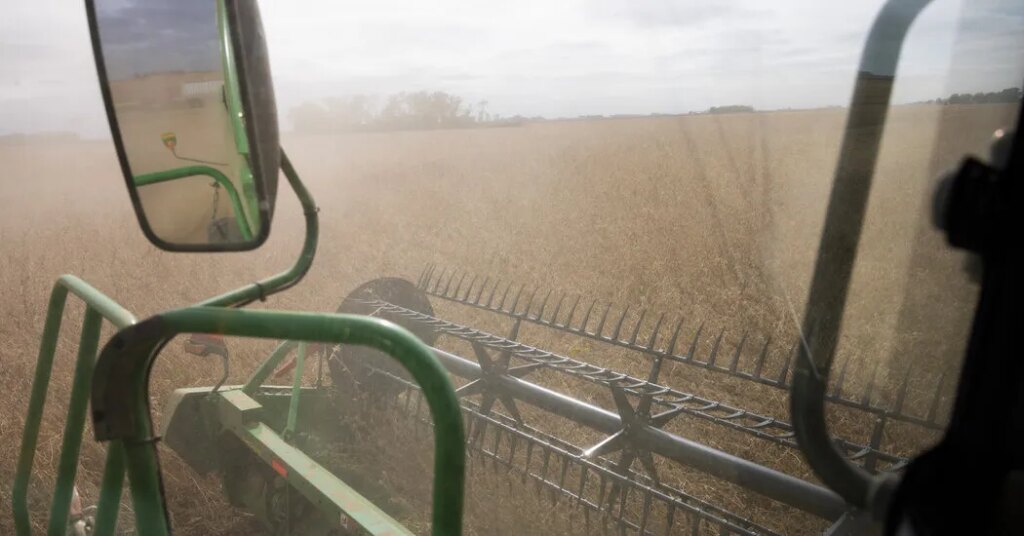
The diesel fuel that powers the tractors and combines on Kelly Nieuwenhuis’s 3,000-acre Iowa farm costs almost double what it did earlier this year because of the war in Iran. Fertilizer prices are also rising, as Russia’s war in Ukraine drags on. And sales of the corn and soybeans that he grows have been depressed amid trade fights with China, Canada and Mexico.
Mr. Nieuwenhuis, a registered Republican, voted for Donald J. Trump in 2016 and 2020, but not in 2024. He is frustrated with Mr. Trump’s policies as president, and plans to split his ticket in the midterm elections. He will support Rob Sand, the Democratic candidate for governor, but is backing Ashley Hinson, the Republican running for Senate.
“It’s the economy, stupid,” said Mr. Nieuwenhuis, echoing a political slogan that has doomed Republicans in the past.
He recalled spending $16,000 to fill up the fuel tanks on his farm in Primghar, Iowa, this fall. “Every election it comes down to the economy, and this policy is not working,” he said. “The Iran war, all the energy costs, the inflation — everything has gone up in price drastically.”
The country’s economic crosscurrents are cascading across Iowa. High gas prices, elevated interest rates and Mr. Trump’s unpredictable economic policies, including tariffs, have been battering rural America over the last year. Iowa’s economy contracted in 2025 and notched the weakest annual growth rate in the country, according to the federal Bureau of Economic Analysis.
Polls suggest that the state that helped propel Mr. Trump’s political rise could flip in favor of Democrats when voters cast their ballots next month.
The stakes are so high that Mr. Trump will head to Sioux City, Iowa, on Thursday to try and convince a once-stalwart Republican base to keep his party in control of Congress. He is expected to promote the $8 billion in economic aid to farmers hurt by high diesel prices that he announced on Monday night. It was the second time in two years that the president authorized billions of dollars in bailout money for farmers harmed by his administration’s policies.
The payouts are papering over a painful economic problem for Iowa’s farmers, who were hurt by international backlash to Mr. Trump’s tariffs in his first term and never fully recovered. Farmland values in the state have been tepid in recent years, and farm bankruptcies were up by 220 percent last year.
The economic doldrums in the state have spread, with big companies such as John Deere, Wells Fargo and Whirlpool announcing job cuts in Iowa in recent months.
Mr. Trump’s argument to let Republicans keep political power in Washington and Iowa could be a tough sell.
The Iowa Farmers Union, one of the state’s oldest farm organizations, backed the entire Democratic congressional slate this cycle, breaking a decades-long streak of abstaining from federal endorsements.
Matt Russell, a farmer and the group’s executive director, said that its members had been frustrated with Mr. Trump and the state’s Republican congressional delegation long before the war. He cited cuts to federal programs benefiting farmers, cancellations of promised grants and the expiration of Affordable Care Act health insurance subsidies.
The Iran war and trade tensions have only added to the strain farmers were feeling, he said, as rising costs have eaten into their slim margins.
“Republican leadership at the federal level has not been standing up to this administration and has not been actually delivering the investments that we were counting on,” Mr. Russell said.
Some top Republicans, including Senator Chuck Grassley of Iowa, have pleaded with the Trump administration to do more to help the state’s economy. Last year, Mr. Grassley called on Mr. Trump to exempt potash, an ingredient in fertilizer, from the tariffs the president imposed on Canada. He recently called on the White House to temporarily ban diesel fuel exports, saying it would “help family farmers.”
Peter Orazem, an economist at Iowa State University, said that economic output in Iowa had been far slower than most other states over the previous five years, recording an average annual growth rate of just 1 percent since 2021.
The state is not just vulnerable to dramatic changes in the agricultural sector. Tariffs have increased manufacturing production costs in the state, and Mr. Trump’s immigration policies have made labor costs more expensive. The president’s aversion to wind and solar has also weighed on Iowa’s renewable energy sector.
“Iowa is basically lagging the rest of the U.S. pretty much across the board,” Mr. Orazem said. “I believe that there are few states that have been more disadvantaged by Trump policies than Iowa.”
The agricultural concerns in Iowa also go beyond corn and soybeans.
The Iowa Cattlemen’s Association, which represents beef producers, has also expressed frustration about some of Mr. Trump’s trade policies. In August, the group criticized his decision to cut tariffs on 300,000 metric tons of ground beef, saying the move to sell meat below market rate would hurt struggling ranchers.
Economists said the imports would not significantly affect consumer prices. But they caused cattle futures to drop by hundreds of dollars, influencing the prices cattle ranchers could negotiate for at market. Numerous Midwestern Republican lawmakers, including Ms. Hinson, pushed back against the imports.
The executive director of the Iowa Cattlemen’s Association, Bryan Whaley, said that some of the Trump administration’s policies, and Mr. Trump’s comments, had driven market volatility, which he called the main challenge facing cattle ranchers in Iowa. But he said that ups and downs were part of working with any president.
“As in every administration, you’re always going to have things that you appreciate and some things that are done that you may not necessarily agree with,” Mr. Whaley, a rancher, said when asked about Mr. Trump’s performance.
Mr. Whaley added that the state’s congressional delegation had been “extremely receptive” to the group’s concerns.
The political arm of the Iowa Farm Bureau, the state’s largest grass roots farm organization, endorsed Ms. Hinson and all four Republican House nominees. But the group’s political action committee, which has historically supported Republicans at the top of the ticket, declined to endorse in the governor’s race. The group did not respond to a request for comment on the decision. The Democratic nominee, Mr. Sand, has appealed to Republicans and swing voters with a centrist message.
The backlash to Mr. Trump’s policies has Democrats feeling emboldened.
Josh Turek, the Democratic nominee for Senate, has slammed Republicans over high diesel prices and Mr. Trump’s tariffs on potash, which is largely imported from Canada. Last week, Mr. Turek visited the farm of a three-time Trump voter, Marcus Tomlonovic, to drive the point home.
Mr. Tomlonovic, a 30-year-old corn and soybean farmer in Colfax, Iowa, said he was planning to vote for Mr. Turek and other Democrats because he was frustrated that Mr. Trump had entered a foreign war after promising to stay out of them.
“I feel like we’ve been betrayed,” Mr. Tomlonovic said in a phone interview, adding that diesel had cost him an additional $1,000 each week. “How much more are we going to take before small farmers can’t hang on?”
Derek Eadon, a Democratic strategist from West Des Moines, said he was “cautiously optimistic” that Mr. Trump’s unpopularity would help Democrats perform well in November.
“The Iowa Republican Party has been in lock step with Trump the entire way since he’s been in office,” Mr. Eadon said. “And I don’t think there’s any getting away from that at the very end with a tweet or a vote here or there.”
In a state Republicans have dominated since 2016, when Mr. Trump flipped it after Barack Obama twice won it, major races have become unexpectedly competitive. Mr. Sand has led the Republican nominee, Zach Lahn, in every major nonpartisan poll this year.
Ms. Hinson, the Republican nominee for Senate, is neck-and-neck with Mr. Turek, a state representative. And Republican candidates in three of the state’s four congressional districts have struggled to establish clear leads over Democratic opponents.
“We do need to find ways to provide relief to our farmers who are at the fields every single day in the middle of harvest,” Ms. Hinson told reporters at an event this week in Des Moines, where she discussed pausing the diesel gas tax. “I think long term we need to be focusing on more refining capacity here in the United States.”
This week, the main super PAC supporting House Republicans canceled its ad reservations in the swing district held by Representative Mariannette Miller-Meeks, a Republican, signaling that the party no longer saw a path for the second-term lawmaker. Senate Republicans’ top super PAC has spent more than $40 million on advertising in Iowa to support Ms. Hinson, according to the media tracking firm AdImpact, a staggering sum in a state that Mr. Trump won by 13 points in 2024.
The political environment is “brutal” for Republicans in Iowa, said Alex Conant, a Republican consultant who has worked on Senate and presidential campaigns in the state.
“If the economy is the number one issue everywhere,” Mr. Conant said, “it’s the only issue in Iowa.”
Some Republican farmers are still planning to stick with their party.
Jolene Riessen, who grows corn and soybeans on her family farm in Ida Grove, is spending $6,000 every week to 10 days to fill fuel tanks with diesel. She has had to sell a dry spreader truck and a tractor to save money to offset the higher costs.
But she does not blame Mr. Trump for invading Iran, and thinks that oil companies are using that as an excuse to hike prices on consumers. She will continue to back Republican candidates even though inflation is making her life harder.
“I haven’t really seen the Democrats do me a lot of favors,” Ms. Riessen said. “I mean, I just go back to the Biden administration. What do they do for the farmer?”
The post Reliably Red Iowa in Play as Economic Woes Mount appeared first on New York Times.