China has tried to mediate, unsuccessfully. So have Russia, Turkey, Saudi Arabia and Qatar. And yet the conflict between Pakistan and Afghanistan shows no sign of ending, and each side appears to have abandoned diplomacy. Proxy groups are also playing a growing role in the unrest. In the latest round of fighting on Saturday, Pakistan’s military claims to have destroyed a military camp along the rugged, porous border and killed Afghan soldiers. A provincial spokesman for the Afghan military denied that there were any Afghan casualties and claimed instead that the Taliban had killed 13 Pakistani soldiers.
The conflict could become even more unpredictable, said Ibraheem Bahiss, an expert on Afghanistan at the International Crisis Group, as both sides embrace proxy groups: The Taliban in Afghanistan are accused of failing to restrain incursions by armed groups in the borderland that target Pakistan, while Pakistan is warming to the idea of supporting anti-Taliban armed opposition.
On Sept. 27, the Taliban said they had killed 28 militiamen and captured 32 others who had tried to enter Afghanistan from Pakistan. The Pakistani government called the accusations “baseless.”
“The proxy standoff is intensifying, and that’s a more dangerous escalation,” Mr. Bahiss said.
Pakistan’s military and intelligence officials have met with leaders of anti-Taliban armed groups in recent months to offer potential support, according to a Pakistani intelligence official, a former national security official briefed on the meetings, and a senior Afghan member of one of those groups.
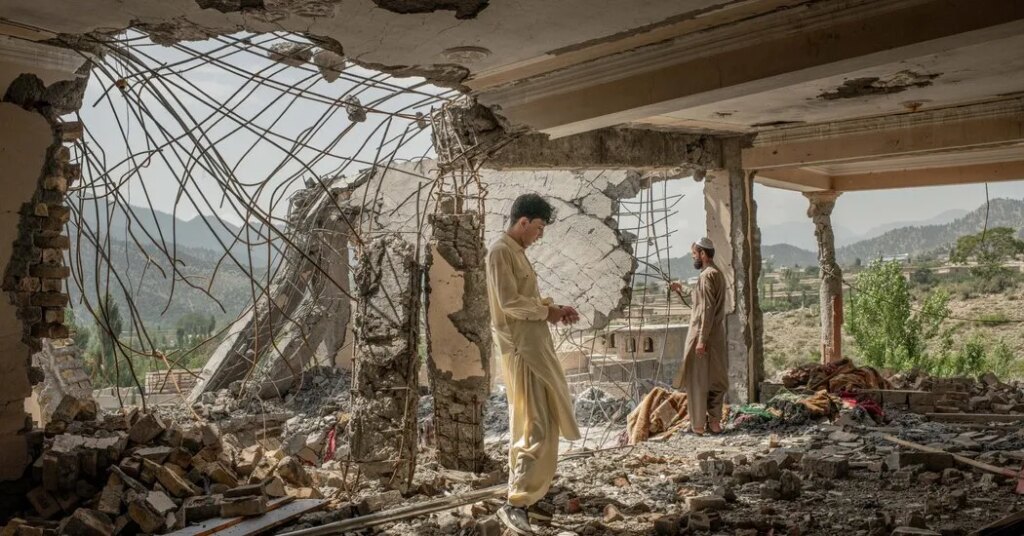
The conflict between the two countries, which escalated when Pakistan declared “open war” in late February, has stymied months of effort to broker peace and killed or injured at least 1,100 Afghan civilians. More than 730 civilians have been killed in militant attacks in Pakistan this year, according to the South Asia Terrorism Portal, a New Delhi-based monitoring platform.
In April, China hosted talks that went nowhere. On Oct. 5, a meeting in Moscow on Afghan security among 10 countries in the region failed to produce a joint statement because of disagreements between the Afghan and Pakistani delegations, according to Vladimir V. Putin’s special representative for Russia.
“The two sides are so fixated on their own position and righteousness of their arguments that no one has the ability to coerce or strong-arm either, even China,” said Mr. Bahiss.
“It is progressing from a low-grade confrontation to an entrenched conflict that has the potential to spiral out of control,” said Amira Jadoon, an associate professor of political science at Clemson University and a South Asia security expert. “But the underlying issue is never resolved.”
That issue is the Taliban’s support for the Tehreek-e-Taliban Pakistan, also known as the Pakistani Taliban. Thousands of militants from the group navigate the porous border to stage attacks on Pakistani security forces. Security experts and officials attribute a sharp increase in attacks on Pakistan to the permissive environment provided by the Afghan Taliban since 2021.
There have been, on average, more than one militant attack a day on Pakistani security forces this year, according to a tally by the Pak Institute of Peace Studies, a research center based in Islamabad, the Pakistani capital.
The Taliban have denied providing any support for militant attacks on Pakistan.
Publicly, both sides say they remain open to diplomacy, but the Pakistani government says it won’t negotiate with the Taliban until they commit to stopping supporting militant groups.
Until then, Pakistani military and political leaders view military action as the only option left, according to Aarish Khan, an analyst at a government-funded research center in Islamabad, even though that may push the Taliban to rely even further on the militants attacking Pakistan.
“It doesn’t seem to be as much a long-term strategy as the outcome of pent-up frustration,” said Mr. Khan, head of the Afghanistan program at the Institute of Regional Studies. “And pent-up frustration isn’t viable in the long term.”
Civilians on both sides of the border say they are bearing the brunt of the violence.
In the Pakistani province of Khyber Pakhtunkhwa, some residents said they worry that a recent power grab by the federal government against provincial officials could give the military an even freer hand in launching operations without any accountability.
“It will cause displacement again and create more chaos,” said Amjad Wazir, a university student from the region.
Across the border, Mohammad Idris Zazi, a taxi driver in Paktia Province, where Saturday’s clashes erupted, said he could not work because of the relentless airstrikes and shelling. He said, “What have we done wrong to deserve to become victims of disputes between the two countries?”
Zia ur-Rehman and Safiullah Padshah contributed reporting.
The post ‘Open War’ Between Afghanistan and Pakistan Adds a Volatile Element appeared first on New York Times.