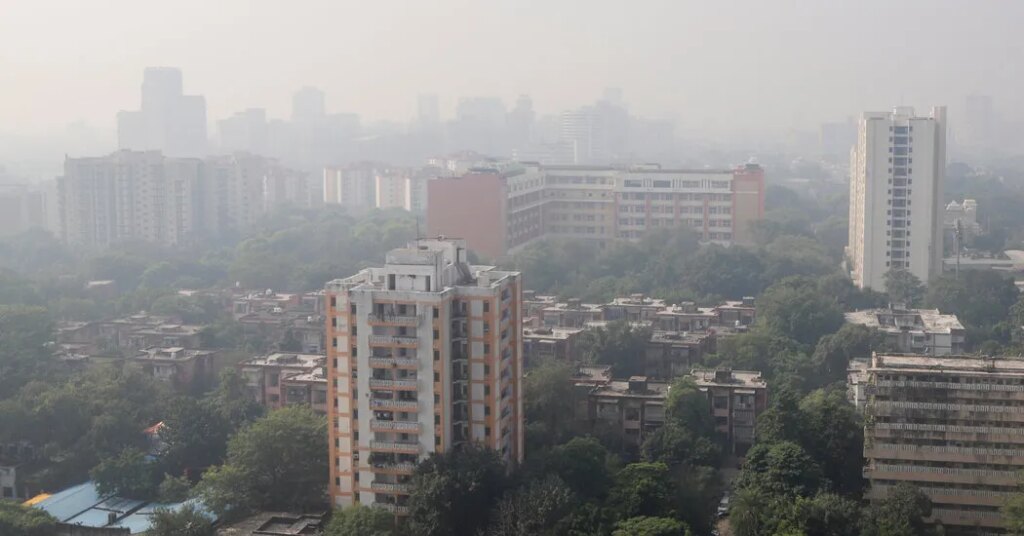
The air quality in Delhi, India’s largest metropolitan area, was designated “poor” on Wednesday for the first time in the season, prompting the government to implement the first stage of an emergency plan to mitigate the pollution that plagues the city each winter.
The air quality index, or AQI, in Delhi stood at 179 on Tuesday, which is considered moderate, but rose to 244 by 2 p.m. on Wednesday, tipping it into the “poor” category, according to a government notice.
The emergency measures are laid out in what the government calls a Graded Response Action Plan. The first stage, imposed on Wednesday, is meant to stop air quality from deteriorating further by placing limits on construction, banning the use of coal and firewood as fuel and reducing traffic congestion, among other measures.
Large parts of Delhi, which includes India’s capital, New Delhi, were hazy by Wednesday afternoon. Gray smog smudged the outlines of buildings, and people complained of scratchy throats.
Across Delhi on Tuesday evening, to mark the Hindu festival of Dussehra, people burned effigies of the demon king Ravana, which are typically made of paper and cloth wrapped around a bamboo skeleton, as well as fireworks. Air quality around Delhi often worsens during the festival, which celebrates the victory of good over evil.
The Commission on Air Quality Management, which issued Wednesday’s directive, was set up by the Indian government to manage pollution in the densely populated area around the capital.
On Nov. 1, the Delhi government plans to roll out an ambitious pollution control plan of its own that will last through the winter. It is designed to curb emissions with a host of measures, including restrictions on the entry of older vehicles, discouraging the use of private vehicles and increasing parking charges.
The government’s winter action plan also bans construction and demolition to minimize dust and requires the use of anti-smog water sprinklers, devices that are meant to help combat the toxic air for which Delhi winters are notorious.
Every winter, the air quality in Delhi plummets, largely because the winters are dry and windless. Dust, emissions from vehicles and smoke from the burning of agricultural stubble are not dispersed and sit atop the city for months. The pollutants are a mix of nitrous oxide, carbon monoxide, hydrocarbons and fine particulate matter, combined with winter fog.
Last winter, Delhi experienced at least eight days of “severe” air pollution, during which the air quality index surpassed 400, according to government data. Delhi’s levels of fine particulate matter are typically far higher than what is considered safe by the World Health Organization.
Pragati K.B. contributed reporting.
The post Delhi’s Winter Season of Polluted Air Begins appeared first on New York Times.