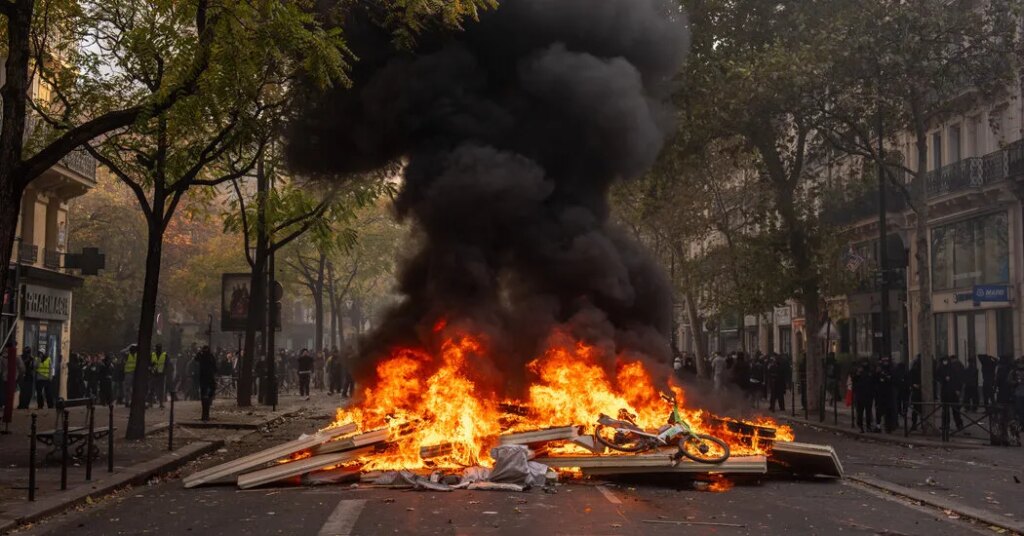
Bret Stephens: Frank, we’ve each spent a portion of our careers living in Europe and covering politics there — I was at The Wall Street Journal in Brussels while you worked for The Times in Rome. The protests that have unfolded in the last few weeks in France, Belgium, Italy and elsewhere feel ominous to me — not just as a brief spasm of discontent but as an omen of a continent coming apart at the seams. Matched to the political ineffectuality of Europe’s centrist leaders, the rise of extremist parties and Donald Trump’s latest leap into Vladimir Putin’s arms, and I fear we’re at a civilizational precipice.
Want to walk me back from the ledge?
Frank Bruni: I’d love to, but I’m right there with you, the Thelma (if you don’t mind, because I’m a huge Geena Davis fan) to your Louise.
Bret: I’ve always felt a certain affinity for Susan Sarandon. Too bad our politics don’t exactly align.
Frank: I think the countries you singled out, along with others in Western Europe, are confronting two enormous, overarching problems that largely explain what’s going on. One is that the extended era of affluence following World War II created standard-of-living and quality-of-life expectations that aren’t fiscally sustainable in many cases. The other is a velocity of religious, racial and ethnic diversification over the past quarter century that has exceeded what many longtime residents could easily make sense of and comfortably adapt to. Combine those dynamics, add the frustrations of young people who rightly feel that they have fewer opportunities than their parents did, and you wind up with a critical mass of Europeans of various ideological stripes who feel destabilized, dissatisfied — threatened, even — and who are demanding that their elected leaders answer for that. But those leaders lack answers, and that’s true whether they belong to the political left, right or center. France, Italy, Belgium, Spain, Germany — they have different governments failing at the same challenge. Which speaks to how daunting that challenge is.
Bret: I was living in Brussels the night that the old Belgian franc was retired in 2002 and I acquired my first crisp euro notes from a cash machine near the Grand Place. There was an incredible sense of optimism then about what the European Union could become. Now it’s falling apart for the reasons you mention, plus a third. Europeans at the time often thought that the end of the Cold War meant the end of traditional geopolitics and an inexhaustible peace dividend. They didn’t really reckon with the possibilities that Russia would again become a military threat, China an economic threat, Africa and the Middle East sources of unchecked migration, and the United States an isolationist, fickle, even belligerent power.
In other words, the continent really thought it had reached the End of History, capital E and H. A fatal miscalculation. I’m not sure there’s the political wherewithal in Europe to get its economic and strategic houses in order before these problems get much worse.
Frank: There’s a surfeit of sad ironies here. So many good intentions went terribly wrong. Liberal politicians in Europe opened up their societies and blurred their borders with the precise goal of interring forevermore the strains of nationalism that wrought such devastation and bloodshed. And yet their path to a better future is leading them back to the past. Because it was too hasty? Too sloppy? Because it minimized the human attachment to tradition? To tribe?
I don’t know. But like you, I remember vividly the ambitions of European integration, the exhilarating sense of possibility. During my time in Italy from 2002 to 2004, there were serious discussions about — and big hopes for — Turkey joining the European Union. That was just two decades ago. Feels like centuries.
Bret: My apartment in Brussels was a few blocks away from a neighborhood called Molenbeek. Going through it on my morning jogs felt like leaving Europe for the Middle East. Fifteen years later, after the infamous terrorist massacre at the Bataclan theater in Paris, I wasn’t the least surprised when it turned out that some of the assailants had been Molenbeek-bred.
I generally think that immigration is a blessing in any society, provided immigrants assimilate to their host societies’ values and cultures. Too often in Europe, that just didn’t happen. One result is that it has created a kind of permanent underclass of people with so-called immigration backgrounds. It’s a warning to centrist politicians everywhere, from Angela Merkel to Joe Biden, never to just open up your borders.
Frank: It didn’t surprise you that they were Molenbeek-bred … why? Because their isolation in that neighborhood — their sense of estrangement from the society around them — made it a breeding ground for anger and resentment? I want to understand because I don’t believe that different cultures living cheek by jowl ipso facto means violence. I want to be clear that this can’t be reduced in the cynical, nasty ways favored by Vice President JD Vance, who tweeted recently that France brought this upon itself because it “imported the third world.”
Maybe Vance was trying to impress his boss, who rants ceaselessly that Belgium or France or Italy or the United States gets the worst elements, the criminals, from the places that are the source of migration. Not true. In our country, an immigrant country, we’ve often gotten the hardest working, the most determined, the dreamers willing to take big risks. That’s one of the principal ingredients — maybe even the principal ingredient — of America’s towering economic success.
Bret: You’re absolutely right about the virtues of immigration. I’m immensely proud to be the son of a refugee who, with her mother, arrived in New York with $7 between them. But my mother immediately set herself to the task of becoming fully American (though she still speaks with the trace of an Italian accent). And it’s what America quite rightly demanded of her, too.
Frank: I hear you. My paternal grandparents were Italian immigrants, as I wrote about in this column, and my father didn’t speak English when he started elementary school. He never forgot the shock and panic of that first day. But those emotions were the seeds of his later accomplishments, his motivations to master the ways of this country and reap its benefits. They made him more American, not less.
Bret: That’s sometimes the pattern in Europe, too. But not nearly often enough. In Molenbeek, it was instantly obvious that many of its residents had no intention of adapting to European societal norms, including fundamental beliefs like women’s equality. And it was equally clear that Belgium really had no interest in requiring their assimilation. After the Paris massacre, Belgian authorities owned up to the fact that they had lost control of the area, but the problem was years in the making, and Molenbeek is far from unique in Europe.
My larger worry is that Europe’s immigration failures have simply breathed life into the once-dead European far right. It amazes me that Marine Le Pen is the odds-on favorite to be the next president of France. Or that the even-more-fascistic AfD in Germany is winning the largest share of votes in state elections.
Frank: It’s terrifying. But it’s not just about immigration. My larger worry is a shift in the Western psyche by which discontent with one’s station is less a fulcrum for striving and achieving than a prompt for fury, a sense of victimization and an insistence that someone else fix the problem. Idealism wanes; nihilism waxes. We reroute energy from creation to destruction, as the fires of France demonstrate. You know who understands this shift as well as — and maybe better than — anyone else? Trump. He saw it clearly. Exploited it quickly. And exacerbated it shamelessly.
Bret: You’ve just put your finger on what I think is the worst, and most important, development of the past 20 years. I’d call it the age of grievance. Wait — where have I heard that phrase before?
Frank: Sounds like the title of a book. And an immeasurably insightful one at that!
Bret: Decades ago, a psychologist named Julian Rotter coined the phrase “locus of control” and distinguished between two types: internal and external. To have an internal locus of control is to believe that our fate is mainly decided by our decisions, giving us agency but also making us responsible for our actions. An external locus, by contrast, holds that chance, luck or the decisions of others are the forces that determine the course of our lives. It is the abandonment of responsibility. What goes for personal life goes also in the lives of nations. Societies that can own their decisions, acknowledge and learn from their mistakes and take difficult steps to change course are going to succeed. Those that can’t — like much of the West today, on both sides of the Atlantic — will fail.
Frank: That’s grim but it’s also right. And, actually, it needn’t be grim. It can be a call to action, a summons to maturity. The crossroads at which France finds itself, at which Italy finds itself, at which we find ourselves, is one where we can indulge the easy emotion of self-pity and avoid personal responsibility by pointing fingers at everyone else or we can recognize how much damage those impulses are doing and correct that course. The clock is ticking.
Bret: Exactly. The future of free societies depends on whether we recognize that the blessings of choice — democratic, economic, personal — also come with the burdens of accountability. The tragedy of France is that it became a society that wanted things both ways. It wanted to be modern and dynamic while also having a gigantic mother state. It wanted to retain its national and cultural identity while also being wide open to the world. It wanted to spend like there’s no tomorrow and still have a tomorrow. Now it has to make hard choices and live with the consequences.
True for us as well, as America and as Americans.
Frank: Our colleague Maureen Dowd just wrote a gorgeous and important remembrance of The Times reporter Jeffrey Schmalz, who had AIDS in the early 1990s, when the disease was still poorly understood and those who suffered from it were stigmatized and reviled. He had ample cause for rage and recrimination. But he saw an opportunity for illumination — and drew on his personal experience to do some of the most important early reporting on AIDS before he died, in November of 1993. I recall what a hero he was to gay men like me who followed his work in real time. But I mention him and Maureen’s article for a different reason — because Schmalz modeled the opposite of self-pity.
Bret: The paragraph that moved me the most, Frank, was this one:
He spent his days talking to scientists and politicians, and to other men and women living with H.I.V. and AIDS — sometimes celebrities like Magic Johnson and Elizabeth Glaser — about their fear of death, their constant monitoring of their T cells, their trepidation that every cold might be the cold that would do them in, their humiliation at being pariahs, their rage at the slow progress on finding a cure. And then Jeff would go home to his Upper West Side apartment and deal with his own roller coaster of “horror, hope, hope, horror” and his fear that he wouldn’t wake up the next morning.
If ever there was a profile in journalistic courage — and an example of someone who took full responsibility for the days and hours left in a life that ended at the age of 39 — it’s this. Hats off to Maureen for delivering the tribute Schmalz’s memory richly deserves.
The Times is committed to publishing a diversity of letters to the editor. We’d like to hear what you think about this or any of our articles. Here are some tips. And here’s our email: [email protected].
Follow the New York Times Opinion section on Facebook, Instagram, TikTok, Bluesky, WhatsApp and Threads.
The post The One Thing We Can All Agree On Is That the World Is on Fire appeared first on New York Times.