In December 1931, economists gathered in Washington to discuss the threat that technology posed to American workers.
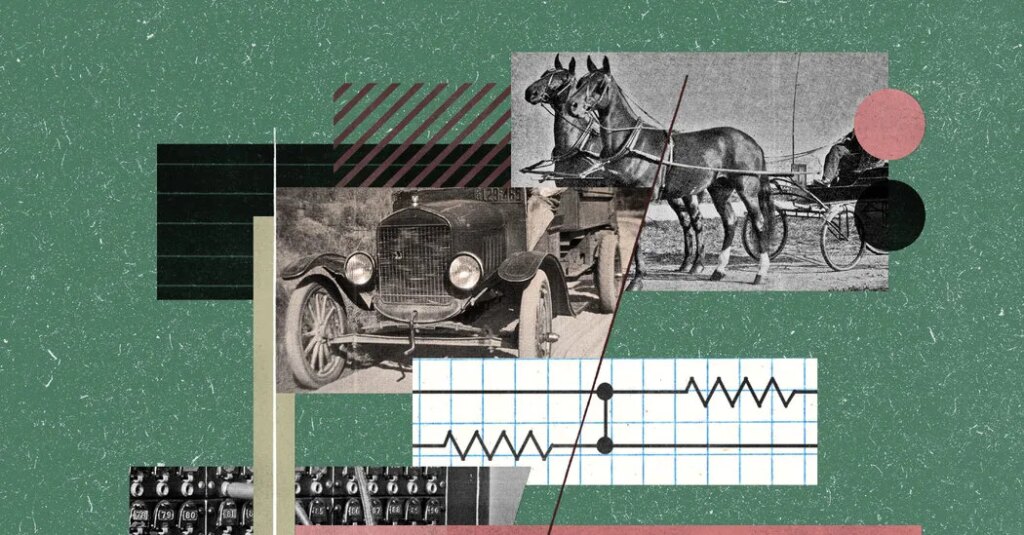
Switchboard operators were being rendered obsolete by the dial telephone. Movie-theater musicians were superfluous in the age of “talkies.” Teamsters — men driving teams of horses — were losing their jobs to drivers of gasoline-powered trucks.
Such disruptions were nothing new, the economists conceded. But with the Great Depression raging, the risks to the economy and social stability seemed greater than ever. And it was all happening “more rapidly than in any previous age,” warned Sumner H. Slichter, a Harvard economist.
“And yet we have failed, for the most part, to recognize that change presents a major social problem,” he told colleagues at the annual meeting of the American Economic Association.
Nearly a century later, a new generation of economists is trying to make sense of the consequences of another technology: artificial intelligence. And while the jobs they are focused on are different — computer programmers instead of telephone operators, scriptwriters instead of movie musicians, drivers of trucks powered by diesel, not animals — many of the questions they are asking are the same.
Would the undeniable benefits of technology be enjoyed broadly, or accrue only to the wealthy few? Would new jobs emerge in time to replace the ones being destroyed? Was government data up to the task of measuring the rapidly changing economy? And, most importantly, what could the government do to slow these disruptions, or at least to help the workers caught in their wake?
“Technological changes may be so rapid and so far-reaching that they bring about a condition in which all factors of production may be simultaneously unemployed,” Ewan Clague, an economist who later served as commissioner of the Bureau of Labor Statistics, told colleagues in 1931. He even proposed a policy that would not seem out of place in today’s A.I. debate: “Might it not be possible to work out a method of taxing machinery and equipment which would tend to slow down their development?”
Modern economists are revisiting these earlier eras to find lessons relevant to policymakers today. Why did mechanization in the textile industry create widespread unemployment among spinners but not among weavers? Why were the protests that workers staged against industrialization in the 19th century more violent in France than in England? (And why did other technological changes draw little protest at all?)
Why, in short, have some episodes of technological upheaval gone relatively well for workers, and others so badly?
Historical examples are particularly useful right now, economists argue, because this moment is so uncertain. The models that economists typically rely on offer an almost comically broad range of potential outcomes, from a modest productivity boost on a par with that of the internet to “an unprecedented transformation of our economy, larger than the Industrial Revolution, but unfolding over a vastly shorter time frame,” as nearly 200 economists warned in a recent letter.
History won’t provide a definitive answer, said Ben Schneider, an economist at the University of Oslo who studies how technology affects workers. But it can offer a window into the way societies have handled previous periods of rapid change.
“We can look to the past and we can say, well, the implications of the steam engine have basically played out by now,” Mr. Schneider said.
Context matters
When the economists met in Washington in 1931, unemployment was nearly 20 percent, and would hit 25 percent within a year, which remains a record.
Worries about technology’s taking jobs predated the Depression, but the crisis made them more acute. When telephone companies began replacing manual switchboards with dial telephones in the 1920s, tens of thousands of jobs disappeared. But most of the displaced workers — overwhelmingly young women — found other jobs relatively quickly.
“During the period of business expansion before 1929, technological displacement led directly to relatively little unemployment,” economists at the Bureau of Labor Statistics wrote in a 1932 report, “The Dial Telephone and Unemployment.”
The Depression changed everything. Women who lost their jobs connecting calls had little hope of finding work elsewhere. There were similar challenges in manufacturing, where automation allowed factories to produce steel, car parts and other goods with far fewer workers.
“How empty a modern steel mill seems!” The New York Times Magazine lamented in 1938. “There is something ominous about this — ominous because of the short cuts to come.”
A few years later, however, those mills were producing steel for the American war effort, and with men off fighting, labor-saving technology was a boon rather than a threat. And in the economic boom in the decades after World War II, concerns about technological displacement were mitigated by the abundant job opportunities — many of them tied to designing, manufacturing and selling cars, televisions and washing machines for a growing middle class — that ensured that many displaced workers could find new jobs relatively quickly.
A century earlier, the same pattern had played out in reverse, with much worse outcomes for workers. Landowners in England adopted threshing machines to fill in for scarce human labor when agricultural workers were off fighting Napoleon. When men returned from war, they found that a critical source of work — threshing accounted for as much as half of a rural laborer’s income during the winter months — had evaporated.
What followed were the “Swing Riots,” a wave of unrest in 1830s England that surpassed the better-known protests of the Luddites.
The state of the broader economy, in other words, plays a critical role in deciding how workers will fare when technology disrupts their livelihoods. Timing matters. So does geography — it’s better to lose a job in a region that is thriving than in one that is struggling.
Violent protests against the adoption of threshing machines were much more common in remote areas, said Bruno Caprettini, an economist who has studied the uprising. Closer to cities, where workers could seek other employment, protests were less intense. And by the mid-19th century, as the economy improved and wages rose, protests died down as workers found better-paying jobs.
“Nobody misses manual threshing,” Mr. Caprettini said. What they missed was the stability that threshing provided. If workers have other opportunities, they will adapt. If they don’t, they will protest, or even revolt.
Speed kills
One reason workers were hit so hard by automation during the first Industrial Revolution and in the 1930s is that their jobs disappeared so quickly — literally overnight in the case of telephone operators. Phone companies typically made the transition from manual to mechanized dialing at midnight on a Saturday, when call volumes were low. Operators who had jobs when they went home on Friday were out of work by Monday morning.
Such rapid changes gave workers little time to adapt. Not only were women who lost their jobs as telephone operators less likely to be working in the telephone industry a decade later, they were less likely to be working at all, according to a 2024 study. And those who did have jobs tended to earn lower wages than before the switch to dial phones.
In industries where the transitions were more gradual, workers tended to fare better.
By the time gasoline-powered passenger cars became prevalent in the 1900s, for example, it was clear that the technology would eventually come for delivery trucks. But it was only after World War I that motor trucks displaced horse-drawn wagons en masse. The number of teamsters actually rose from 1900 to 1910, then declined gradually in the 1910s before dropping precipitously in the 1920s and ’30s.
The relatively slow transition allowed young men, recognizing there was no future in driving horses, to pursue other industries. That left a shortage of drivers, which meant that wages actually rose for the mostly older workers who stuck around to finish out their careers.
Something similar may be happening today as modern drivers face a new technological disruption: self-driving trucks. That threat, too, has been clear for years, and there are signs that younger workers have become more reluctant to enter the industry, said Kevin Lang, an economist at Boston University.
But while truckers have had some warning, A.I. appears to be threatening jobs that until recently seemed relatively safe from technological upheaval, such as software development and legal services. That, too, has echoes of the 1930s, said Amy Bix, a historian at Iowa State University.
“There really was a deep set of concerns in the Depression era that technology was advancing faster than society’s ability to adjust, and that people were sort of being left to fend for themselves in the wreckage,” she said. “Today, you really do have a very similar sense of uncertainty and fear that these technological changes are all coming so rapidly.”
Jobs change
The A.I. debate, like earlier episodes of technological change, tends to focus on the threat of job losses. But economists say the true impact is often subtler. Technology sometimes costs jobs, they say, but it almost always changes them.
In 1851, about 220,000 people worked as boot makers in England. The number hardly changed over the next six decades, rising and falling only modestly before settling at about 207,000 in 1911.
“If you look just at that, you might think, OK, not that much has happened in this industry,” said Hillary Vipond, an economic historian.
In fact, the industry changed entirely over that period. The boot makers of the mid-19th century were artisans, working in towns throughout England. The boot makers of the early-20th century were factory workers in cities, producing far more boots per hour at far lower prices than their artisan predecessors.
The episode carries several lessons, Ms. Vipond said. Technology made workers more productive, but that didn’t result in a loss of jobs, because lower prices led to increased demand — a phenomenon known as “Jevon’s paradox.” More people could afford boots; owners of one pair could now buy several.
But while the number of jobs didn’t fall, the work changed. That is what often gets missed in discussions of technological disruption, Ms. Vipond said: Technologies destroy jobs, but they also create new ones. By one estimate, roughly 60 percent of jobs in the United States in 2018 were in occupations that didn’t exist in 1940.
“We don’t focus enough on the new jobs,” she said. “The reason this hasn’t been a crisis before is because in every decade we have seen new jobs emerge.”
Disruption is real, and this time could be worse
Still, Ms. Vipond said, just because new jobs eventually emerge doesn’t mean that transitions are easy for workers. The Industrial Revolution displaced so many workers so rapidly that it crushed wages for decades — a period known as “Engel’s Pause” — before demand caught up with supply and workers’ living standards began improving again.
Even shorter disruptions can be painful for the workers caught in the crossfire, said Mr. Schneider, the University of Oslo economist. Losing a job and being unemployed is costly for workers and their families, even if they eventually find another.
“It’s easy for us today to look back and say, yeah, there was some disruption, but basically, in the end, it was worth it,” Mr. Schneider said. “And maybe for us it was worth it. But for the people at the time, it might not have felt like it was worth it for them.”
Most economists don’t give much credence to predictions that A.I. will mean the end of work. But the disruptions it causes could dwarf past episodes. The A.I. revolution is also global, affecting not just the rich economies where the technology is being developed, but also poorer countries that have built their economies partly on call centers, tech support and other back-office industries that could be vulnerable to technological upheaval.
Mr. Lang, the Boston University economist, said that if A.I. wipes out a large share of white-collar jobs, it isn’t clear what would replace them.
“I have colleagues who say we’ve been worried the world is going to collapse many times in the past, and it never has,” Mr. Lang said. “To which my response is, I’ve been sick many times, but I’ve never died.”
The post For Clues About How A.I. Will Change Work, Look to the Past appeared first on New York Times.