LOS ANGELES — Seen from the air, the new David Geffen Galleries at the Los Angeles County Museum of Art look like an amoeba, or one of the soft-edged, biomorphic forms in a painting by Joan Miró. The concrete floor and ceiling plates curve and twist over Wilshire Boulevard, narrowing and expanding to create an amorphous sculptural form that seems to levitate some 30 feet above the noise, bustle and traffic of the city’s Miracle Mile and Hancock Park neighborhood.
Inside, unfortunately, the curators have indulged the contemporary ideological delusion that art can be experienced without reference to history, culture, context or ideas, and the results are also amorphous — in the worst possible way. No museum I’ve visited is as relentlessly hostile to curiosity, exhausting and ultimately depressing. I went twice one day in September, and a third time to visit with LACMA Director Michael Govan, who has made the building the defining legacy of his tenure at the largest encyclopedic museum on the nation’s West Coast.
He has achieved what many curators, scholars and museum professionals dream of: A museum that decontextualizes art, mixes it all up in a giant cauldron of visual distraction and isolates it from history and culture. But why? How could this happen to one of the country’s great art collections? And why are so many seemingly smart museum leaders loyal to an ideology that is ostensibly democratic — open and nonhierarchical — but leads inevitably to museums that express contempt for the visitor?
Named for the billionaire entertainment mogul David Geffen, who contributed $150 million to the project, the new structure was designed by the Swiss architect Peter Zumthor. The official price tag from LACMA is $724 million, though critics argue that the real cost is likely much higher. Zumthor, a Pritzker Prize laureate revered for projects that make the materials and clean lines of modern architecture feel ancient and earthy, was tasked with a building that displays art on a single level, with a fluid nonlinear arrangement of galleries that can be continually reprogrammed.
From the outside, the structure is striking. About 900 feet long, it rests on seven pavilions, housing a theater, restaurant, retail and education spaces, among other functions. The best feature of the building is the shaded plaza space this creates at ground level, which the museum hopes to use as a citywide gathering place, an urban center in a metropolis that resists centrality.
“You can get that feeling of the horizontal, chaotic, beautiful intermix of people,” says Govan, standing at the base of one of two extraordinarily long flights of stairs that make entering the building on foot feel a bit like boarding a giant cruise ship. “The diversity of our publics being together in the outdoor space — that was, that’s been driving the design the whole time.”
Once inside the galleries, however, the horizontal field of chaos is far less effective.
“The horizontal single-level design eliminates traditional cultural hierarchies, placing all works of art on the same plane,” reads LACMA’s official explanation of the design. “No single path through the spaces is prescribed by the architecture.”
No single path is prescribed, but the architecture is almost dictatorial in the patterns of motion it forces upon the visitor. The only way to get your bearings in this giant space, parceled into 24 small, boxlike galleries connected by what the museum calls open “plazas,” is to constantly return to the half-mile-long glass perimeter of the building, where there is full daylight and some sense of the basic geometry. The visitor becomes a spelunker, poking into the cave-like interior, emerging for a little fresh air, over and over again.
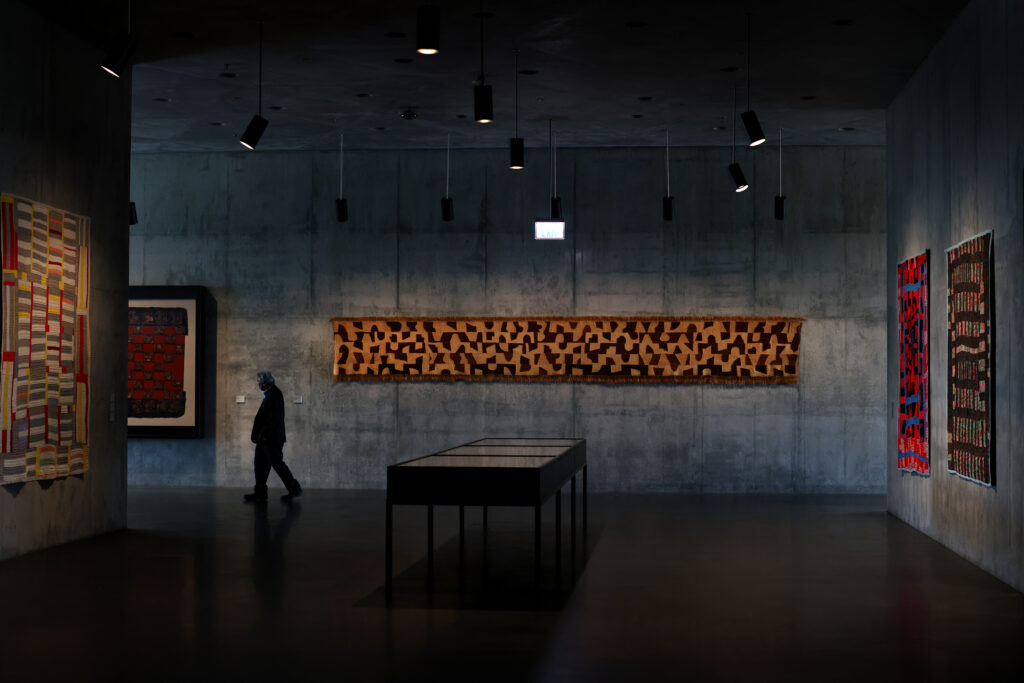
This isn’t just disorienting, it puts the art in constant competition with exterior city views; it makes it difficult for the eyes to adjust to the darker spaces where photographs, paintings and delicate works on paper are on view; and it interrupts the experience of escape and immersion. Bright light leaks into the inner galleries, glaring off the surface of a Dutch painting from the golden age. And in the more dimly lit plazas, many of LACMA’s most treasured paintings feel inert and indecipherable. One never feels settled, transfixed or arrested by beauty.
The art is displayed with minimal labels that give only the name and national or ethnic identity of the artist, the materials, the date and the donor — and the donor listing overwhelms any other information on offer. If you want to know more about the art or object, say what a hacha is (a sculptural carving associated with an ancient Mesoamerican ballgame), you can try using a QR code that links to the online gallery guide, but I couldn’t get it to work while in the building and found it counterintuitive and confusing once outside.
The basic organization is conceptually clever, but creates a confused, jarring experience. Rather than arrange work chronologically, or by schools or national traditions, or by large ethnic groupings, genera or materials, the galleries are thematically grouped by oceans and seas. The Pacific galleries include Mexico, Peru, Japan, Polynesia and Henri Matisse; the Atlantic galleries encompass European gold-ground painting, Latin American modernism, African textiles and Whistler. Is Central America home to Atlantic or Pacific cultures? Why are Korean and Chinese artifacts included in the Indian Ocean galleries?
The museum also offers a small printed gallery guide with a title that suggests how LACMA would like visitors to experience the collection: “Wander.” This reiterates the fundamental architectural idea: an open, nonhierarchical space that encourages free-form exploration. But wandering is to art what scrolling is to social media: fleeting, passing, ephemeral. And too many of the crazy juxtapositions in these jumbled galleries simply create new kinds of hierarchy. Displaying the oxidized mesh of a Ruth Asawa sculpture near a gleaming 1963 Studebaker just makes the Asawa feel old and ratty. That’s wildly unfair to one of the great geniuses of the 20th century.
This is a disaster for LACMA, and given how deeply the museum’s design reflects a deeply flawed curatorial strategy, it’s not clear whether it can be easily fixed. For decades now, curators have struggled to incorporate an academic critique of museum practice that is reasonable and necessary. For too long, art history and criticism meant the history and criticism of Western and European art, with its often rigid categories and hierarchies. Museums presented art as a chronological narrative of progress and innovation. If they displayed non-Western work, it was relegated to the sidelines and treated more as craft than art. When they attempted to trace patterns of cultural exchange, it was almost always the Western appropriation of non-Western art, rather than the fluid back-and-forth between cultures.
So, museum directors around the world sought to eliminate hierarchy, rigid narratives, Western preeminence and false or misleading categories. Of course, all of these ideas remained operative if not honored within the academic discourse. And some of them, like chronology, patterns of influence and exchange and national or ethnic groupings remained useful if deployed with care and critical skepticism. The public, however, was deemed insufficiently critical to use them at all, and so was left to swim in a sea of visual information without categories, definitions or historical background.
One term for this was “recentering” the object, allowing the art to somehow speak for itself. The visitor didn’t need context or history, just a pair of eyes and openness to visual form.
A necessary and essential academic critique thus yielded a fundamentally undemocratic contempt for the audience, which was assumed to be uninterested in learning, incapable of making deeper sense of objects beyond a few basics of their formal appeal. Recentering the object meant decentering the visitor.
It also led to a lot of dumb ideas. This entire museum is now grounded on a risible canard, that a horizontal layout is somehow nonhierarchical. Are the magnificent Byzantine silver plates displayed on the ground floor of New York’s Metropolitan Museum of Art higher or lower status than the paintings by Caravaggio and Poussin on the second floor? Or is it the other way around?
Chronology is too fundamental a human category to be dispensed with entirely. And if you want to understand and really feel the discontinuities in art history, the strange leaps that make some very old things feel magically modern and some more recent work strikingly dated, the best way to do this is stick to a rough but not rigid chronological layout.
Finally, if at any point your curators start talking about putting wildly different works “in dialogue” with each other, just stop and take a breather. You are indulging their private whim. And to foreground that whim without explanation is demeaning to the visitor. It isn’t polite to be opaque, especially when your knowledge is valuable to others.
For people who know nothing about art or care to learn nothing about art, and for people who digested the entire corpus of human artistic production, LACMA’s David Geffen Galleries may be the perfect museum experience. But for everyone who falls somewhere between these extremes — curious but not a connoisseur, knowledgeable but not a superhuman polymath — the museum offers nothing but frustration. LACMA needs to be more generous to its visitors. And museums need to understand how deeply they have fallen into an ideology that negates the fundamental reason for their existence, which is the expansion of human knowledge, empathy and visual understanding.
The post A new $724 million museum is a visually stunning train wreck appeared first on Washington Post.