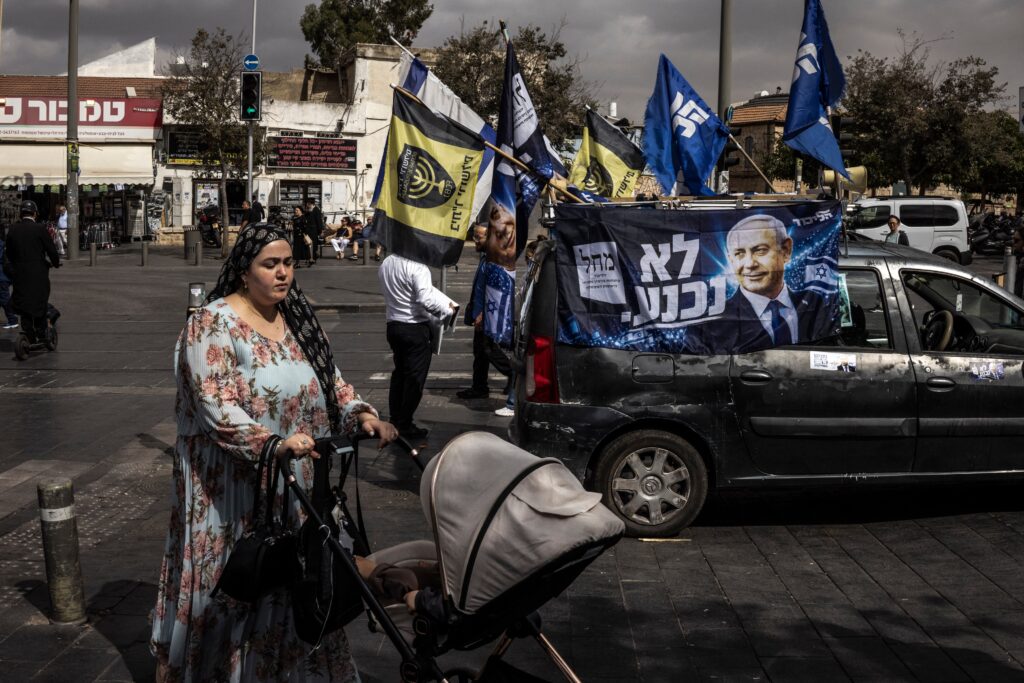
TEL AVIV — Israel’s Oct. 27 election is largely a referendum on Prime Minister Benjamin Netanyahu — whether he bears responsibility for failures that allowed the Oct. 7, 2023, attack by Hamas or gets credit for the forceful military response that followed and, to a lesser degree, whether he is tainted by corruption cases that have long swirled around him.
Polls suggest that many Israelis want to replace Netanyahu, who has led the country for nearly 19 of the past 30 years. But on many security issues, from viewing Iran as the gravest threat to Israel to rejecting the creation of a Palestinian state, there are almost no differences between the incumbent prime minister and his leading challengers, former military chief Gadi Eisenkot and Naftali Bennett, a former prime minister who has formed a joint ticket with Yair Lapid, the current opposition leader.
Opposition politicians “tacked to the right during a lot of the wars as a way to criticize Netanyahu,” said Mairav Zonszein, an Israel analyst at the International Crisis Group, a nonpartisan policy institute based in Brussels. “On the Palestinian issue specifically, I think the political consensus has never been more united.”
On Israel’s military initiatives there are some nuanced differences, with Netanyahu’s opponents saying they would seek to turn military gains into political advances. “The security zones created in Lebanon, Syria, and Gaza are a tool and leverage to advance Israel’s national interests,” Eisenkot said earlier this year, “not to stay there for generations.”
Here’s where the leading candidates stand:
Gaza
A year after U.S. President Donald Trump declared a ceasefire for Gaza, Israeli forces control about 70 percent of the strip, but Hamas still has armed fighters and remains in control of the rest, where most of the population lives. Netanyahu has stressed that Israel will not rebuild or withdraw its troops until Hamas is fully disarmed.
Speaking near the Gaza border last week, Eisenkot pledged that within 18 months of taking office, Hamas “will no longer rule the Gaza Strip.” That would happen, he said, “whether through action based on President Trump’s framework, which was accepted by Netanyahu’s government, or by using cunning and creative military and operational capabilities” to destroy Hamas’s military wing.
“As long as Benjamin Netanyahu is in power, Hamas will remain in power,” Eisenkot said.
Bennett vowed in August not to “move a millimeter from the Yellow Line,” the boundary of the Israeli-controlled area, “until Hamas is completely disarmed.” He also said he would end any advising role for Qatar and Turkey in Gaza, and rely instead on Egypt. Only then can his “Gaza 2.0” framework for rebuilding begin, he told Kan, Israel’s public broadcaster.
Iran
After two wars with Iran fought alongside the United States, in June 2025 and earlier this year, Netanyahu continues to promise that the Iranian regime will fall. “One day, and that day is not far-off, the Iranian people will be free,” he said last month at the U.N. General Assembly.
His rivals, too, see Iran as the central threat.
Bennett has said Israel must work to bring down Iran’s government before it obtains a nuclear weapon, using “every means at our disposal. Not just bombs.” The regime, he said, “is rotten and hollow inside. It will collapse. Our job is to speed that up.”
Eisenkot said the campaign against Iran “must end with Iran not having 440 kilograms of enriched uranium or the ability to reach nuclear explosive devices, with tight oversight of Iran, and with Iranian funding for Hezbollah cut off.”
Palestinian statehood
On Palestinian statehood, the leading candidates are nearly unanimous: not now or anytime soon.
“As long as I am Prime Minister, a Palestinian state controlled by Iran will not be established: not in Gaza, and not in Judea and Samaria. Period,” Netanyahu posted on X in August, after Mansour Abbas, leader of the United Arab List, called on the U.S. and Israel to recognize a Palestinian state.
Eisenkot also rejected the call, but also firmly opposes annexing the West Bank. “We don’t want to take control over” its 2.8 million Palestinians, he said, “and endanger the Zionist project with a binational state.”
Bennett, a former director general of the Yesha Council, the settlers’ umbrella organization, told Channel 12 he is “against a Palestinian state, against handing over territory.”
He told Kan he would not evacuate settlements, though he would remove illegal construction.
Avigdor Liberman, a former defense minister who heads the right-wing Yisrael Beiteinu party, warned on X this month that the next U.S. president will move to recognize a Palestinian state. He called for dismantling the Palestinian Authority, “including canceling the Oslo accords,” and having Jordan run civil affairs in the West Bank under Israeli security control.
With Israeli public opinion shifting rightward in recent years, candidates avoid positions that could be branded “leftist.” Yair Golan, who leads the left-wing Democrats, is the only prominent candidate open to discussing a political horizon with the Palestinians. “The challenge is not a Palestinian state, the challenge is annexation or separation,” Golan said this summer at the Herzliya Conference, an Israeli security summit.
Settler violence
Perhaps the clearest differences between Netanyahu and his rivals are over settler violence in the West Bank. Speaking at the U.N. General Assembly last month, Netanyahu dismissed international concern over the issue as “a distortion” and “an obsession,” attributing the attacks to “a handful of juvenile delinquents, about 150 in number.” “I won’t stand for vigilantism,” he added.
After recent high-profile attacks documented by video in the West Bank, Netanyahu’s office questioned the accounts of victims.
His rivals have condemned settler violence in far stronger terms.
Eisenkot said Israel must take “a very hard line against those who take the law into their own hands.” He has also said that he would remove “all illegal outposts in Areas A and B” referring to parts of the West Bank that are under Palestinian civil control.
Bennett called the attacks “certainly acts of terror” in an Army Radio interview in August, after settlers besieged Palestinian homes in the West Bank village of Qusra. “As someone who believes in our right to the land and in the settlement project, we must condemn this,” he said.
Lapid has said: “Settler terror is terror.”
Lebanon and Syria
In Lebanon, the Israeli military maintains a security zone of roughly 270 square miles. Hezbollah, the Lebanese militant group backed by Iran, is badly weakened, but has yet to disarm.
Netanyahu says a memorandum of understanding signed with Beirut in June lets Israel keep the zone “until we remove the security threat posed by Hezbollah.” Israeli troops also occupy positions in southern Syria, which they took up after the fall of Bashar al-Assad in December 2024.
Eisenkot said Israel’s gains in Lebanon should lead to Hezbollah’s disarmament, a handover to the Lebanese army and a multinational force, but that Israel’s security “rests on the shoulders of the Israel Defense Forces.”
Eisenkot takes a hard line on Syria, too, and has called President Ahmed al-Sharaa “originally a very extreme person, an ISIS man.” Still, Eisenkot has opened “some room for some kind of possible security agreement and withdrawal” from Syria — which Zonszein, the analyst, described as “nuance that you don’t necessarily hear from other candidates.”
Bennett said he would reverse what he called Netanyahu’s strategy on Iran and Hezbollah. Under Netanyahu, he said, the assumption has been that “if we shoot at Hezbollah, Iran will shoot at us.” He said he would flip that: “If Hezbollah fires at us — we will fire at Iran.”
The post Will next week’s election change Israel? Here’s where candidates stand on top issues. appeared first on Washington Post.