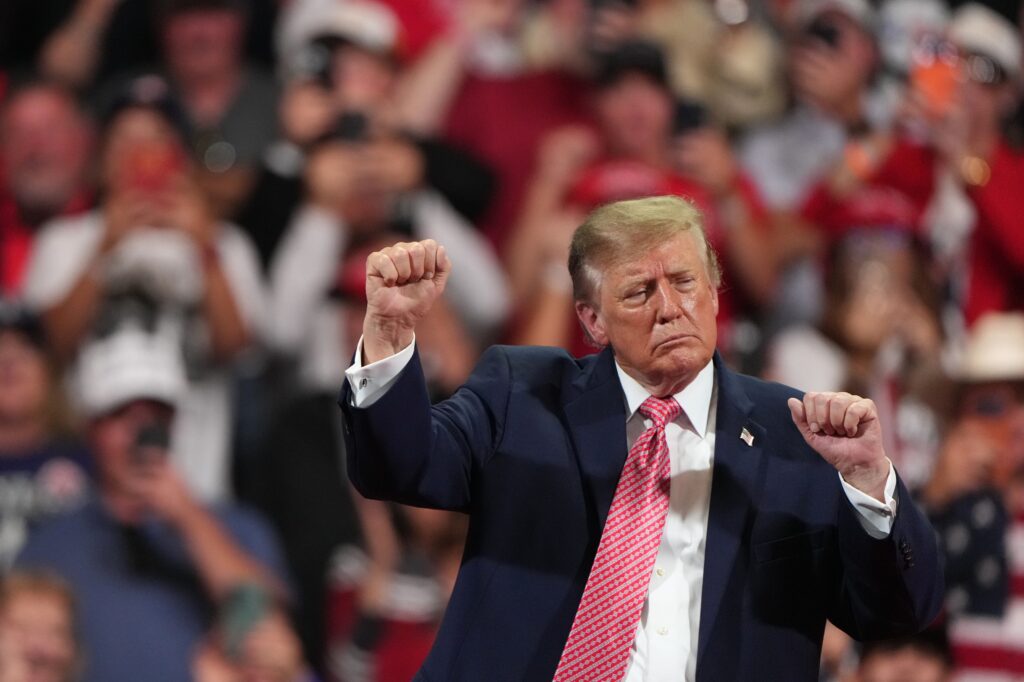
For the past decade, President Donald Trump has operated as if he discovered the political cheat code to winning elections: entertain the base and feed it red meat. He’s so certain of the formula that he’s bragged it makes him invincible. In 2016, he claimed he could shoot someone on Fifth Avenue without losing voters. Earlier this month in Tennessee, he told a partially empty arena of MAGA faithful, “I could say the stupidest things and you’d clap.” The crowd roared with laughter and applause.
As the midterms approach, Trump’s luck is running out. His approval rating has hit a record low, with just one-third of adults saying he’s doing a good job. The incumbent president’s party almost always loses House seats, a trend usually exacerbated by a weak economy or an unpopular executive; in Trump’s first midterm, Republicans lost 41 seats, though the economy was chugging along.
Most polls and analyses predict that Democrats will win the House majority this year, and that the only question is how large the blue wave will be. Trump’s response has been to star in the party’s midterm convention in late summer and to host more rallies heavy on entertainment and invective this fall. His closing argument doubles down on his secret to victory: Never mind the Republicans actually running, vote as if he’s on the ballot.
It’s bad advice this year. Early voting is underway, and voters’ top concern apparently isn’t inflation or health care; it’s government corruption, according to a Fox News poll. A record-high 89 percent of Americans believe corruption is widespread in government, an increase of 30 points since 2006. And Trump gets the blame: An overwhelming majority of adults believe he prioritizes his business interests over the country and ordinary Americans. Nearly 60 percent think he’s done something illegal or unethical in the process. Voters expect politicians to maneuver for political advantage, but using elected office to get filthy rich doesn’t play well. In a democracy, casting a ballot in high-stakes elections should empower voters, not make them feel like easy marks. When that happens, the majority party pays.
The backlash goes beyond dissatisfaction with the president, his party or the government. In bitterly polarized democracies, voters often behave like die-hard sports fans — seeing bias in calls against their side, taking losses personally and viewing rivals as adversaries. Corruption undermines the game, turning competition with meaningful outcomes into staged spectacles by ignoring the rules and letting offenders escape accountability. Voters tend to be reluctant to punish corruption, particularly when it involves politicians in their own party, but more-engaged voters are more likely to oppose corrupt incumbents — and they turn out at higher rates. Corruption can also depress turnout, but that can be countered when the minority party centers its appeals on anti-corruption and voters in the majority party sanction their own candidates.
In this way, Trump has become his own worst enemy. The spectacle he has brought to politics has contributed to his electoral success as much as the Republican brand and MAGA ideology did. In his first campaign, he promised his supporters so much winning that they’d get “sick and tired” of it — and they’d accept a little game-rigging in the process. Voters often forgive familiar forms of corruption, such as unethical campaign contributions, misuse of taxpayer dollars, partisan gerrymandering and bending the rule of law. But they don’t excuse being played for suckers, which also disrespects the idea of self-government and personal agency.
Now, voters are growing weary of Trump and his family and friends making a killing: His financial disclosure reported $1.4 billion in crypto-related income for 2025. His administration tried to establish a $1.776 billion slush fund to benefit allies. He accepted a jumbo jet from Qatar that could be transferred to his presidential library when his term ends, and he has pursued pay-to-play governance. Trump’s White House ballroom project secured $333 million in pledges, including from tech leaders seeking regulatory relief.
Trump’s entertainment value wears thin when taxpayers have to stretch their paychecks while corruption helps the rich get richer.
Democratic candidates will not let voters forget this. Campaigning for reelection, Sen. Jon Ossoff (D-Georgia) called Trump the “world’s most famous sore loser” who leads “the most corrupt administration of all time.” Meanwhile, Vice President JD Vance played stooge at a televised town hall in Michigan: “Do I see evidence of corruption from the president of the United States, from the administration? No … I just don’t.”
Americans disagree. Corruption transforms political competition into a circus for fat cats, and Trump seems to believe the spectacle will distract from the grift. But voters are not merely spectators — even a MAGA base trained on red meat hungers for something substantive. If a blue wave hits the midterms, the president and Republicans should not be surprised if the lion turns on its tamer instead.
The post Trump’s biggest political trick may be wearing off appeared first on Washington Post.