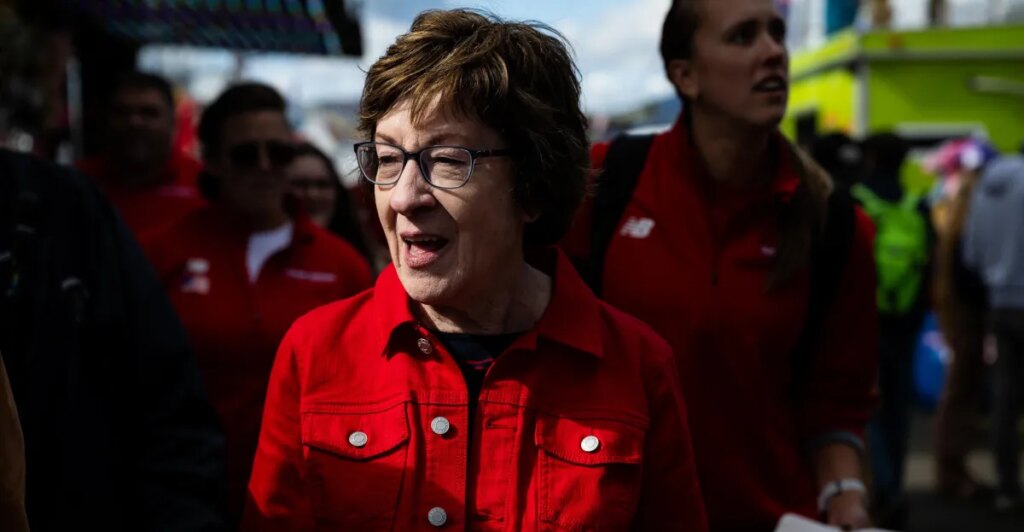
With two weeks until the midterm elections, Democrats are comfortably favored to take the House. Their path to Senate control, though, is harder — and it could run through Maine, where longtime Republican Sen. Susan Collins is in a tight race against former state Senate president Troy Jackson, a Democrat.
When Collins first ran for Senate in 1996, she pledged to serve only two terms in the Senate. But 30 years later, she’s still in office despite the odds, as Maine has grown more blue around her.
One secret to her political durability is her success in “bringing in the bacon” for Mainers: Her official Senate website features a map of projects that she says she helped fund as chair of the Senate Appropriations committee, including hospitals, bridges, affordable housing, public transportation, and water systems.
This year, though, all of that money might not be enough for Mainers to look past their frustration with another Republican: President Donald Trump.
To learn more about what Maine voters are thinking as they prepare to head to the polls, Today, Explained co-host Sean Rameswaram spoke with Washington Post reporter Dan Merica, who’s on the ground reporting from Maine, about why some Mainers who backed Collins before are now reconsidering their support.
Below is an excerpt of their conversation, edited for length and clarity. There’s much more in the full podcast, so listen to Today, Explained wherever you get podcasts, including Apple Podcasts, Pandora, and Spotify.
Tell me how this race got to be so fascinating.
Maine this cycle was going to be interesting no matter what. Susan Collins is the only Republican senator who is running for reelection in a state that Kamala Harris won in 2024 this cycle.
But since the outset, it has really defined, I think, these midterm elections. The rise of Graham Platner, the oysterman turned politician, really hinted at the populist anti-establishment fervor that was in the Democratic base. That fervor was so strong that it prevented the sitting incumbent Democratic governor from winning the primary here in Maine to challenge Susan Collins. I think that said a lot about the Democratic Party.
Obviously Graham Platner’s campaign then flamed out and he ended his campaign because of the allegations of sexual assault against him.
But then you have the Collins angle of it, and she is really the poster candidate for a Republican who, in this election where Donald Trump’s approval rating is so low, is having to basically suspend political gravity in a state that really does not approve of the job that he’s done as president.
I want to ground this conversation in how voters in Maine feel about him right now because I know you’ve been talking to voters. What is the vibe out there? Are people mad?
There’s a lot of anger for the president here. Maine is in a unique position where it’s been on the receiving end of a lot of what those people who are mad at Trump would say is harm that he has caused.
It’s a border state. It borders Canada. There’s a ton of cross-border relationships. And so his attacks on Canada, his suggestion that it’s going to be the 51st state, has really hurt the state of Maine because it’s hurt tourism in the state. Many Canadians come down south to vacation in Maine. And there’s been a drop in tourism because of that fight with Canada.
The tariffs have hurt Maine because so much of the wood and the lumber that is grown and cut here in Maine is actually shipped up north to Canada to be processed, and then what it is processed as is shipped back across the United States. The tariffs have been incredibly harmful for the state.
And then you have ICE. I’m in Biddeford. There was a shooting of an individual here in Biddeford. That has been an issue in this race as well.
So there’s a lot of anger at the president, and it’s very easy to feel that when you’re talking to voters. I actually just spoke with a voter who voted for Troy Jackson, dropped his ballot in an early voting box. And I just asked him, “What did you vote for? Who’d you vote for? Why did you vote?” And he got visibly emotional when he started talking about the Trump administration and how scared he was for the future of democracy and that was why he was voting for Troy Jackson.
I’ve also talked to voters who supported Susan Collins just six years ago at the end of the first Trump administration. They voted for her back then and they feel like the last six years have made it impossible for them to vote for her again. And then on the other side, you have people who are hardcore die-hard Trump supporters and they actually think that Susan Collins has been too hard on the president.
She’s in a really tough spot politically where on her left, there are a lot of voters, including some who have voted for her recently, who are furious with her, who don’t think she stands up to the president enough. And then on her right, there are voters who think that she stands up to the president too much.
It’s funny to think about these two figures representing the same political party because while they might agree on a few issues here and there, they couldn’t represent more different brands of Republicanism. What’s the truth of how much Susan Collins sides with Donald Trump?
She has sided with the president at times. She has voted against the president at times. I was struck that, in the debate on Thursday, she said, “I have been a senator under five different presidents.” I don’t exactly remember what her number was, but she noted that she had only endorsed one Republican president and that was George W. Bush.
I was just in Kennebunk, which is right next to Kennebunkport, which is a historical location for the Bush family. They have a large home at Walker Point. There is some relationship between the Bush family and Maine, [and it] makes sense that Susan Collins really does kind of line up more with the Bush-style Republican Party than she does the Trump-style Republican Party.
What’s her actual relationship with the president like? And surely he’s well aware that she was one of the few Republicans who voted to impeach him over the January 6 insurrection. Does that get in the way of their relationship?
I think he’s very well aware when somebody breaks with him. I would have to imagine he’s aware of that.
“It was a fascinating comment that there are rules for Republicans who are running across the country, but that maybe Susan Collins doesn’t exactly have to adhere to those rules.”
I was actually told by a Republican early in the campaign that President Trump demands loyalty from people that he supports, but this person actually said that there are rules for Republicans and that there are rules for Susan Collins and that Republicans were willing to kind of give her some leeway, which is actually an acknowledgement that they know the bind that she is in.
They know that she’s running for reelection in a blue state, in a state that the president lost, in a state that is very hostile right now to the president. It was a fascinating comment that there are rules for Republicans who are running across the country, but that maybe Susan Collins doesn’t exactly have to adhere to those rules.
Affordability is a huge issue in Maine, right? And Donald Trump hasn’t exactly helped…
That has really heightened the competitiveness of this race. The same race is always going to be competitive, but the fact that gas prices are where it’s at, the fact that we’re going into winter, it’s starting to get cold up here. Home heating oil prices are above $6 a gallon.
I think about 80 percent of homes that are heated by home heating oil are in the Northeast, a large portion of them probably in Maine and New Hampshire, two states with Senate races in November. It’s been a huge issue up here.
The Trump administration has actually tried to get rid of a low-income program to help with home heating oil that helps a lot of folks in Maine. You’ve seen Republicans, from the gubernatorial candidate to congressional candidates, break with the president on that because they know it’s a huge issue.
So when you talk about affordability, yes, we’re talking about the price of beef, the price of groceries, the price of gas, but there’s also these localized issues in a state like Maine, in particular. And I think home heating oil actually could be a really fascinating, underappreciated issue in this race. If you grew up or live in Arizona or Nevada or California, you’re not thinking about the oil that you need to heat your home. That could be a real issue here in a state like Maine.
Collins is a political survivor. For all of it to come crashing down because of, essentially, who the president was — is that a bit of a sad ending to this political story for her? Do you think she’d maybe have regrets about how she approached Donald Trump?
It’s certainly possible. And you’ve seen other senators who have bucked the president and have then retired and not run for reelection. I’m thinking of Thom Tillis, for example, in North Carolina. There is this fascinating case study in how the Republican Party has changed when you look at Susan Collins and you look at Donald Trump.
Someone like Susan Collins in an earlier iteration of the Republican Party would’ve had a lot of success and would’ve probably stayed onside the Republican Party in a way that she just hasn’t done under Trump. She represents a different kind of era of the Republican Party.
I think there was a time when bringing home the bacon to a small state really worked politically. I’m thinking about Harry Reid, for example — he represented Nevada. In 2010, he faced a really difficult reelection campaign and his entire campaign was bringing home the bacon to Nevada, a similarly small state, and he won reelection in 2010.
I think if Susan Collins wins reelection in 2026, it’ll prove that there’s still a lot of goodwill for politicians who can deliver funding projects for states like Maine, states like Nevada, smaller states that maybe don’t get the kind of national attention that others do.
If she does lose, a lot of it will be put at the feet of President Trump. I’ll be fascinated to talk to her if she does lose, because I do think she will have a lot to say that she probably hasn’t said yet, but I think that’s an if, and I think we have two more weeks to find that out.
The post Has Susan Collins’s political luck finally run out? appeared first on Vox.