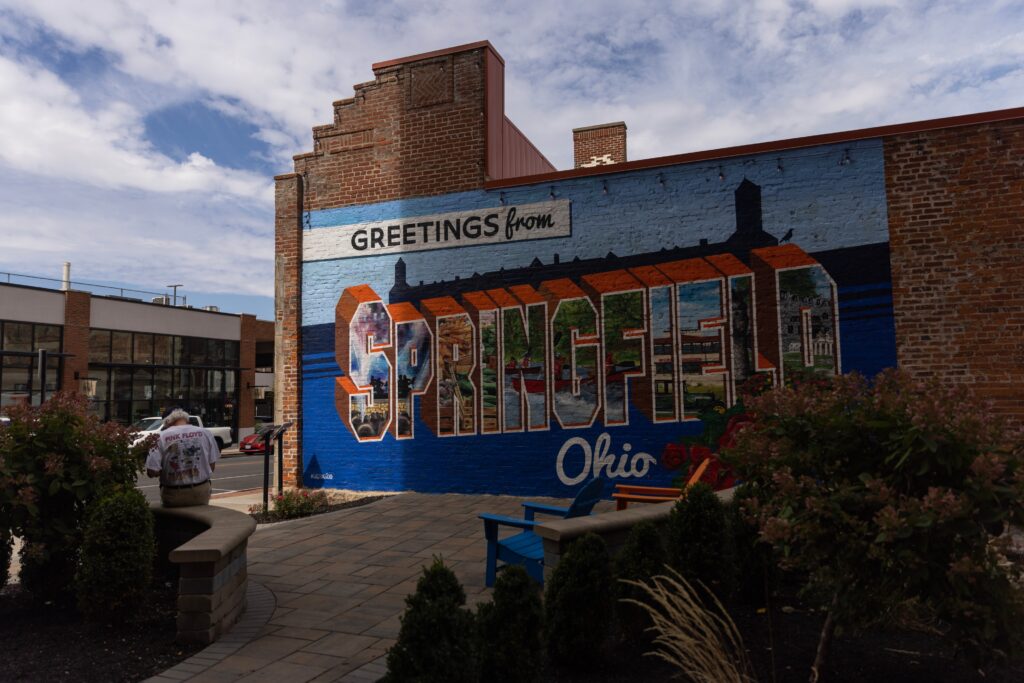
SPRINGFIELD, Ohio — The denizens of this once booming industrial Midwestern city were pining for something to rally people around when they coined the motto: “Speak a good word for Springfield or say nothing.”
It was the height of the Depression in 1932 and the slogan sought to inspire unity among those living in a place where the Shawnee once roamed, European immigrants arrived and freed Black families found a home.
Now some residents in Springfield, Ohio, say the city’s creed is being put to the test.
Since thousands of Haitian residents lost their protection from deportation this summer, dozens have been arrested, scores have lost their jobs and others have either left the country or decided to hunker down at home, out of view.
“Help wanted” ads for cooks, dishwashers and babysitters are going unanswered. Haitian residents are limiting their electrical usage as they worry about how they will pay the bills.
“I’m not sure there is precedent in U.S. history for this small a community to lose that much of its workforce and population cloistered at home,” said Tim Voltz, a Springfield resident who helps Haitian immigrants. “The situation is unsustainable.”
Ohio’s Miami Valley region had been growing in recent years, after decades of decline that began in the 1950s when factories shuttered and the area’s population shrunk. New immigrants, including people from Venezuela and Nicaragua, as well as Haiti, helped boost Springfield’s economy, adding thousands of new jobs. The county health department estimated the Haitian population grew to about 20 to 25 percent of the city over the last decade.
Then Donald Trump targeted the city’s Haitians during his 2024 presidential campaign, falsely claiming that most had arrived illegally, were “destroying” the city and were eating people’s pets. The economy began to falter in Clark County, where Springfield is located, losing more manufacturing jobs in 2025 than it had gained the two previous years.
Springfield now leads the state in year-over-year job losses. Federal job reports show the city’s labor force lost 1,100 manufacturing, leisure and hospitality jobs, contracting 2.2 percent in 2025. The downward trend has continued this year, preliminary data shows.
Many factors, including rising transportation and child care costs, help explain why Ohioans are exiting the workforce. But Molly Bryden, a researcher with the nonprofit Policy Matters Ohio, said the the timing of the data also suggests a possible correlation with Trump’s mass deportation campaign.
“We were seeing signs of the revitalizing industry in Springfield but those gains have been moderated by more recent losses that coincide with federal attacks on TPS,” Bryden said. “To have such an important community under threat is really destabilizing ”
One man took his lifeafter U.S. Immigration and Customs Enforcement outfitted him with an ankle monitor to track his whereabouts.
Some of Springfield’s Haitians have chosen to leave, advocates say, and many of those who remain are under what immigrants themselves described as a self-imposed house arrest.
Increasingly, some residents say, the city feels empty.
“Now, we are all struggling,” said Arturo Bojhay, the owner of “El Canario,” an auto repair shop on Springfield’s Main Street. “There are no people.”
Esther Getan’s husband, Peterson Nozil, was stopped by immigration officers in early September on his way home from a doctor appointment for his wife. The couple crossed the U.S.-Mexico border to request asylum in 2022. Like an estimated 350,000 other Haitians, they were granted temporary protected status, known as TPS. Nozil, a math teacher in Haiti, found work in Ohio operating a forklift.
TPS wasn’t a path to legal residency, but they hoped it would allow them time to pursue their asylum claim and hopefully obtain a green card.
Now Getan says she can barely eat or sleep. Her 2-year-old daughter screams for her father in the middle of the night. Both Getan and her child are losing weight.
“My heart is not at peace,” Getan said.
She is surviving in part with the help of Steven Merrin, pastor of the Northminster Presbyterian Church, and some of his parishioners. Even though many live on fixed incomes, they donate what they could. Some slipped money orders under the pastor’s office door to help pay for Nozil’s lawyer. Others provided meals.
Merrin said he is pained each time he looks at the pew Nozil usually sat in during Sunday services and doesn’t see him there.
“There is an absence and it’s frustrating,” he said. “I’m just not all right with this.”
Businesses that depended on Haitian clients are struggling to stay open. Ismael Saucedo, who operates several convenience and check-cashing stores, said sales are down nearly 40 percent compared to last year.
“People used to buy an entire bunch of plantains,” he said. “Now they take one or two.”
Bojhay’s auto repair business just west of downtown had become an unofficial hub for many arriving immigrants looking for housing, jobs or a friendly guide. The glass case at the front of his shop displays the currencies of different Latin American countries that customers gifted him. The U.S. citizen, who was born in Mexico, garnered loyal clients who helped him earn up to $30,000 a week repairing their cars.
“We got so many calls we couldn’t keep up with the work,” he said.
His financial fortunes took a nosedive as spooked Venezuelan and Nicaraguan immigrants, who had also lost TPS, decided to leave. Haitians stopped seeking his services. His profits disappeared, and he can no longer afford to pay even himself.
“That has never happened,” he said.
Outside Springfield’s immigrant community, the coffee shops and brewpubs are still crowded and lively. But those residents, too, are aware of the changes.
One woman at a local shop said she loves the diversity of her son’s high school, where he plays in the marching band alongside Haitian, Asian and Hispanic saxophonists. The woman traces her Springfield roots to her own family’s migration years ago — from Kentucky. She said many people are trying to rally around their Haitian neighbors, who are now part of the community.
But not everyone sees it that way. The woman asked to be identified only by her first name, Kari, saying she feared repercussions from coworkers for speaking out on a sensitive issue.
“The people here are not just cogs in the economic wheel,” Kari said. “They are our friends and neighbors and we are trying so hard to strengthen our community.”
Residents gather for a monthly peace walk downtown calling for solidarity with their immigrant neighbors. They keep an eye out for federal agents, and employers are slipping letters of support into immigration case files.
“Darline has been a great asset to her team,” Justin Dawson of Emergent Hiring, an industrial and health care staffing company, wrote recently on behalf of Darline Jean Baptiste. “We know that her workplace would love to have her back.”
Beaubrun Charles Ardouin, a U.S. citizen who is also Haitian, was driving Baptiste and other Haitian immigrants home from work in mid-August when they were stopped by ICE officers. He said the officers threatened to break his windows if he didn’t let them conduct an “immigration check.”
“TPS is over,” one of them muttered before checking the identifications of his passengers, Ardouin recalled in an interview. He repeated his account in documents submitted in federal court as part of a petition seeking Baptiste’s release from immigration detention.
One person who was inside his van has since been deported, Ardouin said. Baptiste, who arrived in Springfield two years ago through a Biden-era parole program, was supporting her two children back in Haiti by working the graveyard shift at an auto parts manufacturing factory.
“I understand if people break the law,” Ardouin said. “But my passengers came legally, had work permits and were in a process. They had worked 12 hours and were cuffed like criminals.”
Trump won Ohio in the last three presidential elections. But this fall, Democrats have a chance to win back a Senate seat and secure the governor’s office for the first time in decades. Polling shows growing unease with the Trump administration’s immigration enforcement, even before this summer’s TPS decision.
Springfield’s motto — “Speak a good word for Springfield or say nothing” — is plastered on T-shirts and souvenirs sold at the local visitors center. Numerous residents said they still think of it as the city’s creed. Local historian Kevin Rose said that for him it exemplifies what the city has long been: a home for generations of newcomers who went on to make Springfield what it is today.
More than anything, he and others said, residents hope national leaders will respect their city mantra this election season — particularly the part about saying nothing at all.
“This community is soul searching,” Rose said, “and we want to make sure none of this sets us back.”
The post ‘There are no people’: Springfield, Ohio, faces loss of Haitian residents appeared first on Washington Post.