A high-level Defense Department official sent a startling letter to Southern Illinois University at Carbondale this summer, alleging that the school had connections to China that potentially put U.S. research at risk of being stolen.
The letter sounded an alarm at the public university known for its aviation program, and it asked the school to conduct an audit of its relationships with nine Chinese entities.
But in its response to the government, Southern Illinois said it saw no need to end the relationships, because there was no ongoing work with any of the Chinese organizations, documents obtained by The Washington Post show. The school later terminated an agreement with one of the Chinese universities, Shenyang Aerospace University, at the insistence of the Defense Department, which noted that the entity had recently been added to a government blacklist.
Southern Illinois wasn’t alone. The Defense Department ordered 30 universities in August to review their relationships with “foreign entities of concern” and address any risks to remain eligible for federal research dollars.
This week, the Defense Department declared victory. The Pentagon said all 30 of the schools had ended or “fully mitigated” the foreign relationships. Collectively, it said, they took “more than 80 termination-related actions.”
“I am proud that the Department of War went 30-for-30 in working with these top-tier research universities to terminate relationships with malign foreign entities,” Emil Michael, undersecretary of defense for research and engineering, said in a statement released on Monday.
A Post review of documents and information from 17 of the schools, however, found that most of those universities told the Defense Department that they had already decided to end the foreign relationships before receiving the agency’s letters — or that the connections didn’t involve any sensitive technology. Some of the partnerships focused on undergraduate study-abroad programs or courses in hospitality, rather than work in research labs with military contracts.
Six of the 17 schools indicated they planned to maintain at least some of the ties to Chinese schools.
Others said they had already terminated the relationships, were in the process of doing so or would do so to address the government’s security concerns, even though most didn’t find that the partnerships put restricted American research at risk.
The Defense Department’s directive to universities focused primarily on foreign entities that show up on the Section 1286 blacklist, a roster of 130 foreign organizations that the government has identified as national security concerns. Section 1286 refers to the part of the fiscal 2019 National Defense Authorization Act intended to protect Defense Department-funded academic research.
Although the Section 1286 list includes entities based in Russia and Iran, most are from China, which has been a focus of U.S. national security concerns in recent years.
Still, some schools said they planned to maintain at least some of the relationships flagged by the Defense Department.
Drake University in Iowa told its campus community in September that the government raised concerns about its undergraduate joint degree program with Qingdao University in China.
Drake’s president said the school has no active Defense Department contracts or research funding, complies with federal research-security guidelines and noted that Qingdao University is not on the government’s list.
“We do not meet any of the criteria in the letter or the press release that would be cause for concern,” Drake President Marty Martin said in the letter last month.
Martin traveled to China to take part in the joint program’s opening ceremony last month, the university told The Post. The program has nearly 500 students.
By contrast, some other schools decided to wind down their relationships with entities in China or other countries.
The Defense Department praised seven schools for going “above and beyond by quickly terminating problematic relationships” and implementing mitigation measures: Oklahoma State University, Penn State University, the University of North Carolina at Chapel Hill, the University of South Carolina, the University of Southern California, the University of Texas at Austin and Virginia Tech.
However, several of those schools said the partnerships did not involve any restricted research.
For instance, Oklahoma State said it identified two limited academic agreements it had with Fudan University in China, which was recently added to the government’s list of problematic entities. One is a graduate degree program in hospitality and tourism management; the other is a student exchange program.
“We reviewed both programs and are confident that no sensitive, export-controlled or Department of War-funded research is at risk of exposure,” Kenneth Sewell, Oklahoma State’s vice president for research, wrote in an Aug. 31 letter to the Defense Department.
Oklahoma State said it decided to end the relationship “out of an abundance of caution” after receiving an Aug. 10 letter from the agency. It also will end agreements with Sun Yat-sen University, including a student exchange program, even though Oklahoma State concluded the programs posed no risk of exposing sensitive research.
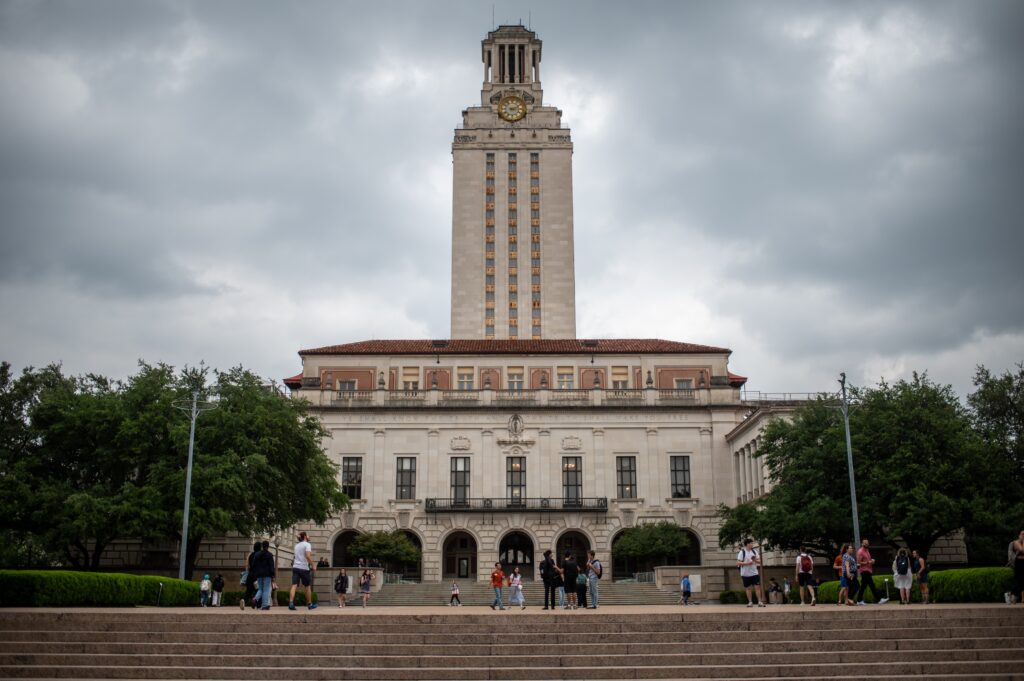
Similarly, the University of Texas at Austin said in an Aug. 31 letter that it would terminate an undergraduate student exchange program with Shanghai Jiao Tong University after it was added to the list. UT Austin said it also decided to end its agreement with Shanghai University “out of an abundance of caution” after the government cited potential concerns about the school, even though it is not on the Section 1286 list.
The University of North Carolina at Chapel Hill told the Defense Department in an Aug. 26 letter that it decided to end its study-abroad program with Fudan University “out of an abundance of caution” after the government added the school to the Section 1286 list. That’s despite the fact that UNC said the program was “unrelated to research activities, including sensitive research, Department of War-funded research, or export-controlled research.”
Virginia Tech told the government in an Aug. 20 letter that it ended its collaboration with Shandong University in 2019, and decided in 2025 to discontinue its undergraduate academic program with Xidian University in 2029 after fulfilling commitments to existing students. The school has since decided to close the Xidian program sooner, after the current academic year ends, the university said Tuesday.
Michael, the undersecretary of defense, made it clear the agency will continue to scrutinize these kinds of relationships and how academia handles research.
“Our work will continue,” he said in Monday’s statement. “Institutions that fail to meet research security standards are on notice: taxpayer dollars will not support institutions whose partnerships put the American warfighter or the Nation’s technological advantage at risk.”
The post The Pentagon pushed colleges to cut ties with China. Some pushed back. appeared first on Washington Post.