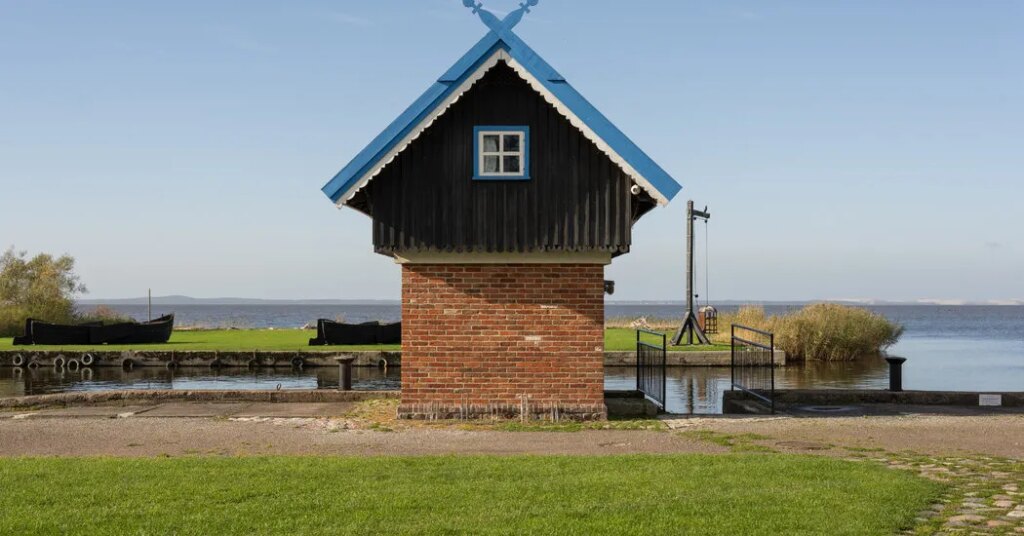
My wife and I arrived at Sturmu Svyturys, a small, family-owned resort on the edge of the vast Curonian Lagoon after hours of driving through the Lithuanian countryside. We entered the restaurant, and took in the wood tables where families were eating lunch, the fire on the hearth, the rural fishing village décor. Asta Zemaitiene, who owns the hotel with her husband, was busy at the cappuccino machine. I explained that we had booked the “fisherman’s cottage” on the advice of a friend.
She nodded but looked almost embarrassed. Unsure of her English, she said, “You may not want to stay there.” We looked at her curiously. “There are other rooms,” she said.
A server overheard the conversation and said to me, “It’s lovely. My friend and I come to stay in September and we sit in the window to watch the birds.”
Ms. Zemaitiene led us outside and pointed to a lone brick box the size of a utility shed, on which rested what looked like the top half of a toy cottage with a steeply gabled tile roof trimmed in blue. Ms. Zemaitiene handed me the key and reminded me again, “We do have other rooms.”
I opened the blue-and-white door and stepped into a small brick-and-wood room, not even 10 feet by 10 feet, with two small benches at a window looking onto the water; there were hooks on the wall for coats, and two short ladders leading up to a bedroom a little larger than the downstairs, with pine floor boards and ceiling, a window facing the water, and twin beds on either side.
In the scores of countries my wife and I have visited in 40 years of traveling, neither of us had been in a dwelling so adorable and comforting as this one. We wouldn’t be needing another room. This cottage was sublime simplicity, and a tribute to traveling to hard-to-get-to places.
Beyond the Capital Cities
We’d come to the Baltics in search of countries we had never even thought to explore, on a two-week driving trip through three countries that had been a part of the Soviet Union for 50 years: Estonia, Latvia and Lithuania.
We were visiting the capital cities, but we wanted to get beyond them. We wanted to experience the terrain of these countries, the flora and fauna, and meet the people who live outside major cities.
It didn’t matter how far we had to drive. We’ve always found that the harder a place is to get to, the more unique and surprising it proves to be.
No Sound But Birdsong
After several fine days in Tallinn, the capital of Estonia, we picked up our car and traveled south through Estonia deep into the Latvian countryside.
The Baltics are flat. Fields of barley stretch endlessly on either side of the highways, with virtually no tree lines to break them up. These would lead to forested expanses — walls of Scotch pine and stands of tall, skinny birch — opening up again to vast flat fields turned yellow with rapeseed and dotted by brilliant red poppies.
After skirting Riga, the Latvian capital, with its dreary Soviet-era housing, a relic of the occupation that ended 35 years ago, the countryside was a welcome relief as we made our way to hidden country inn called Zoltners, open since 2015.
Built by a farming family that owns 5,000 acres of land, much of it adjacent to the inn, Zoltners has 13 rooms in a small brick building with a clean, spare Scandinavian décor (rooms range from 105 to 120 euros a night, or about $115 to $135, with full breakfast included). It was a pleasure to spread open the windows to let the fresh country air in. Fields of farmland stretched for miles beyond the small oasis of ash trees around the inn, willows overhanging a pond and manicured gardens.
But what struck me most, after the noise and the traffic of the cities, and the five-hour trip from Tallinn, was the utter peace. We were 20 minutes from the nearest town, Dobele. There were no sounds beyond birdsong and a light rain falling on leaves.
After a quick shower, we strolled down a stone path to the inn’s 50-seat restaurant, which is recommended in the Michelin guide, where we sampled first the brewery’s beer with an order of thick, freshly made potato chips and toasted dark rye, garlicky and smothered in grated Parmigiano-Reggiano. A range of classic cocktails was on offer (including the trendy Hugo spritz). We started with a regional classic, chilled beet soup, and for entrees, we had our choice of salmon, veal, duck breast and a vegetarian dish of local asparagus and spinach with feta, grapefruit and almonds (entrees range from 17 to 27 euros).
Later that evening, with cool spring air coming in through the window of our room and the dead quiet of the countryside, I slept so deeply I wished we’d had at least one more day. While most of the land here is given over to farming, nearby is the 3,400-acre Tervete Nature Park, with protected walking trails through centuries-old pine forests and along the Tervete River valley. There are 14th-century castle ruins in Dobele, known as the capital of lilacs, with an 11-acre garden of more than 270 varieties. All we really wanted to do at Zoltners was rest, read, write and reflect on the trip before we hit our next destination, but we had to move on.
On the Lagoon’s Edge
Our route from Zoltners to Lithuania included a three-hour detour to Daugavpils, Latvia, the birthplace of the painter Mark Rothko, to see a museum dedicated to him — because who can say they went to Rothko’s hometown, about 20 miles from the Belarusian border, to see a handful of the man’s work? (Well worth it, not only for his abstract expressionist work, but also for his early, expressionist paintings.)
By the time we hit Sturmu Svyturys at the western edge of Lithuania, and had been given the keys to the fisherman’s cottage, we’d covered 700 miles. After the cosmopolitan city of Vilnius, the Lithuanian capital, we were delighted to have a glass of wine and a game of cribbage in our teensy fisherman’s cottage, to listen to the warblers and nightingales and lapping water (rooms range from 140 to 160 euros a night).
The Curonian Lagoon is a shallow, brackish, 625-square-mile body of water shared by Lithuania and Kaliningrad Oblast, a Russian territory cut off from the rest of the country. With a long history of fishing, it’s separated from the Baltic Sea by a 60-mile-long spit, a UNESCO World Heritage site of sand dunes, pine trees, vacation homes and cottages.
At 7 o’clock, we crossed a short path to the restaurant for dinner. We were seated by the large stone hearth, crackling with a wood fire, and were told what we’d be eating. The restaurant, known for its fresh fish, serves what the fishermen catch in the lagoon.
Tonight it would be a whole fish, zander, sometimes called pikeperch, the size of a branzino, cooked in the fireplace on a grill set over carefully managed coals. Charred and smoky, sweet and fresh, the fish was impeccable, served with just a little melted butter, a fresh salad and boiled potatoes with parsley (dinner was 100 euros for two without wine). Perfect simplicity.
We returned to our cottage, climbed the two small ladders to our beds. We fell asleep to the sound of water, and woke to the honking of geese. And, after a breakfast of excellent cappuccinos and Lithuanian pancakes called varskeciai, we got back in the car and headed to our next capital city.
Follow New York Times Travel on Instagram and sign up for our Travel Dispatch newsletter to get expert tips on traveling smarter and inspiration for your next vacation. Dreaming up a future getaway or just armchair traveling? Check out our 52 Places to Go in 2026.
The post Driving Inn to Inn to Discover the Hidden Charm of the Baltics appeared first on New York Times.