Pope Leo XIV’s doctors said Wednesday that the 71-year-old pontiff would require no further treatment for lung cancer after medical tests showed a malignant growth removed in surgery last week was “localized.”
The test results are perhaps the most positive sign yet that the pope’s lung cancer was caught early and that rapid treatment of his first major health event as pope has been successful, as Leo and the Vatican have indicated. Leo’s doctors have also said there is “no clinical reason” to stop him from continuing with his trip to Latin America next month — a 12-day journey through Uruguay, Argentina and Peru, where the pope is a naturalized citizen.
Leo underwent surgery to remove a nodule and part of his right lung on Oct. 13, two days after he made public the discovery of the mass during a regular appearance on the balcony above St. Peter’s Square. Concern heightened when the Vatican, after the operation, revealed that Leo had pulmonary adenocarcinoma — a type of lung cancer.
Any further action had been dependent on the results of histological and molecular biology exams — which are used to assess cancer stages and best courses of medical treatment — released Wednesday.
Leo’s doctors, Luigi Carbone and Stefano Margaritora, said in a statement those results “confirm that the condition was a pulmonary adenocarcinoma and that the disease was localized. A subsequent oncological evaluation has confirmed that no further therapy is required.”
Leo has already raced back to business, holding separate phone calls with Russian President Vladimir Putin and Ukrainian President Volodymyr Zelensky.
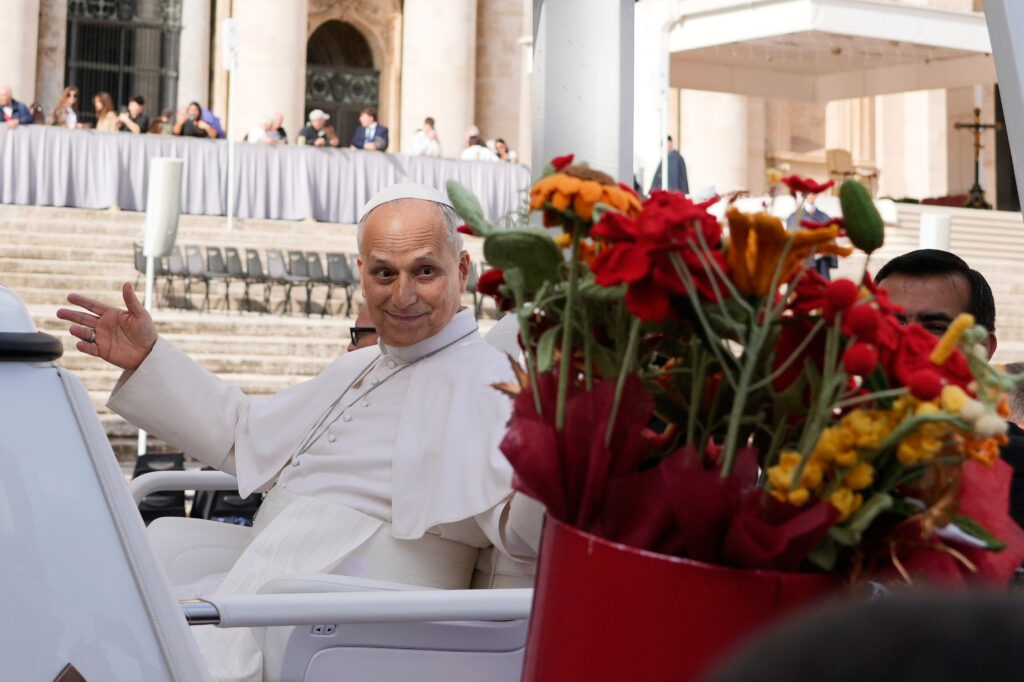
On Sunday — a week after he announced the discovery of the mass — a strong-sounding Leo was already back on St. Peter’s Square speaking to cheering throngs in his regular Angelus blessing.
“This experience has made me feel particularly close to all those who are living with illness or infirmity,” Leo told the crowd. “Now that this delicate phase is behind me, I will gradually resume my activities, always with God’s help and your prayers.”
Margaritora, the surgeon who operated on Leo, told Vatican News — the official outlet of the Holy See — that Leo’s recovery, including the re-expansion of his lung, was “proceeding according to the usual timetable.”
He confirmed the growth had been detected during a routine medical exam and estimated that Leo’s “complete physical recovery” would take about two weeks after the date of his surgery, meaning he should be fit for the long-haul flights and intense schedule on his Latin America trip starting Nov. 6.
“The Holy Father has put his heart and soul into his recovery, as the most motivated people do after this kind of operation,” Margaritora said. “As a result, he needed very little assistance from us. His determination to recover quickly has been effective in every respect.”
The pope is known to be otherwise physically fit, playing tennis regularly and swimming.
But Raffaele Angelo Madaio, an oncologist at Rome’s Israelite Hospital who is not involved in the pope’s care, said that removal of part of Leo’s lung, along with his age, is likely to be a drain on his physical capabilities, particularly in the coming weeks when a patient of the pope’s age would normally be asked not to overexert.
“If he wants to go for a light swim after recovering, he may do so, but he might face some challenges dealing with a pickup soccer match,” Madaio said.
He noted that Leo’s Latin America trip includes a potentially challenging stop in the high-altitude city of Cusco, Peru.
“That, for example, could pose a problem when ascending in altitude. Even in the best-case scenario, it is already complicated,” he said.
Stefano Pitrelli contributed to this report.
The post Medical tests show Pope Leo requires no further treatment for lung cancer appeared first on Washington Post.