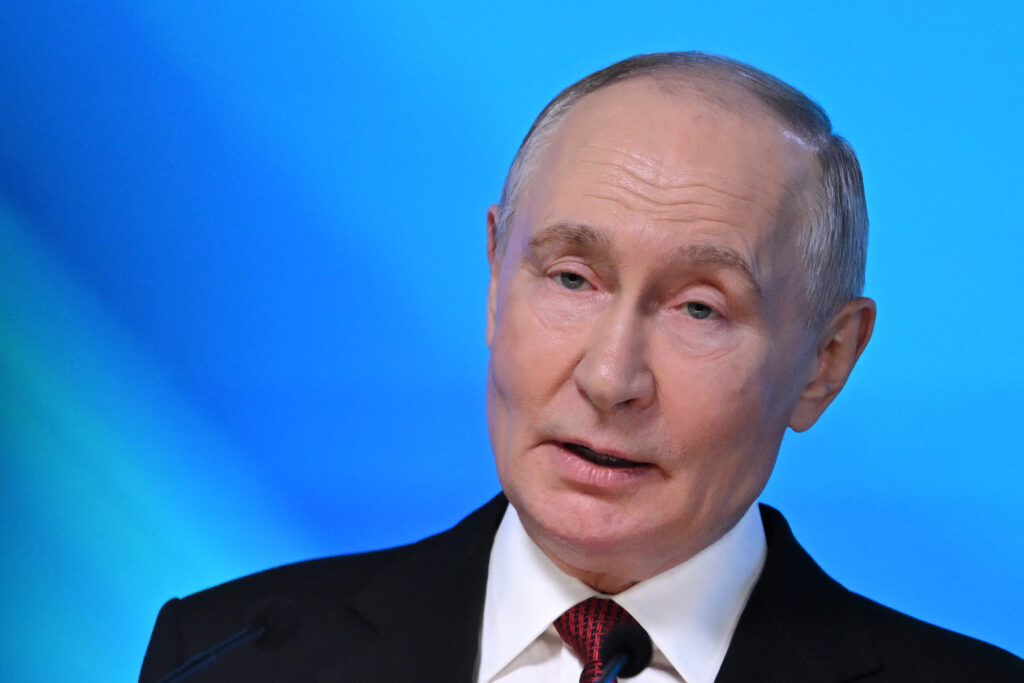
Vladimir Putin is hardly a “humanitarian,” despite the cringe-worthy homage that U.S. envoy Steve Witkoff paid to him in St. Petersburg on Wednesday. But is the Russian president ready to begin serious peace negotiations to halt the brutal war in Ukraine?
That’s what a top Kremlin aide claimed after the meeting, but we won’t know if it’s true until Russia, Ukraine and the United States begin negotiations that officials close to the talks said are tentatively set to start in November. This fledgling peace effort is at least moving in the right direction, though. For a change, the United States, Europe, Ukraine and Russia have found a framework for discussing an end to the war.
Yuri Ushakov, a top Putin aide, said after the three-hour meeting with Witkoff that “in principle Russia is ready to resume the trilateral talks around the 10th of November.” He said the talks would include “the establishment of a security system for Russia and Ukraine after the end of the conflict.”
The American evaluation was similarly upbeat. Sources close to the negotiations expressed “cautious optimism that both sides are trying to get something done before winter.” Witkoff and fellow envoy Jared Kushner, who joined the meeting by teleconference, explained to Putin the proposal framed Tuesday in Oslo with Ukrainian President Volodymyr Zelensky and representatives from major European countries.
But this is still the sound of one hand clapping, as I wrote on the eve of the meeting. Putin is inviting dialogue, not making concessions. And he seems to be encouraging the trilateral negotiations in part because he’s pleased that President Donald Trump recently leaned so far in his direction by waiving sanctions against Russia that had just been enacted by Congress.
The St. Petersburg meeting was sweetened by Russia’s release of Stephen Hubbard, a retired American teacher whom Russia had been holding on charges that he was a mercenary for Ukraine. Trump had asked Putin to free Hubbard. The hostage release was welcome news for Hubbard’s family and a nice bouquet from Putin to Trump. But it does nothing on its own to advance peace.
Kushner and Witkoff have tried to break the Ukraine impasse by expanding the problem to a broad discussion of postwar security for both Ukraine and Russia — and by exploring the postwar economic integration of Russia with Ukraine and Europe, especially regarding energy. Putin, who was seeking a “new security architecture” for Europe before he invaded Ukraine, seems intrigued by this invitation.
U.S. and European officials have been preparing a broad proposal for multilateral talks with Russia that would explore postwar security for the continent. It would begin with NATO-like pledges that the U.S. and Europe would respond to any future attack against Ukraine. But it would also address Russian security concerns, though the details are unclear. The goal, broadly, is to create a structure that will prevent a resumption of the bloodiest war on European soil since 1945.
Europeans fear the consequences of making concessions to Russia, given Moscow’s increasingly aggressive “gray zone” war over the past year against Europe itself. But the balance of forces on the continent is overwhelmingly in Europe’s favor. NATO has been bolstered by the addition of Finland and Sweden, Ukraine has creatively fought Russia to a bloody stalemate, and European leaders have finally begun to rearm to meet the Russian threat without relying on U.S. firepower.
What’s surprising is that this peace effort survived 10 days of sniping between Trump and Zelensky. Despite their anxiety about Trump’s pro-Moscow tilt, the major European partners participating in the talks — Britain, France, Germany, Poland and Finland — all remained aligned with the U.S. mediation. And Zelensky overcame his anger at what he feared was U.S. pressure to capitulate.
Zelensky seemed buoyed by the St. Petersburg meeting. He said after it ended: “We will support proposals regarding a ceasefire, ending the war, addressing the energy sector — and other sectors as well — as well as humanitarian initiatives, the return of prisoners, and the return of diplomats.”
The signs from the Kremlin were “positive,” Zelensky told reporters. In the November talks, he said, “the agenda, naturally, is to end the war, bring peace closer, and — as I understand it — lay the groundwork for a meeting at the level of the leaders.”
Still, despite the encouraging talk in St. Petersburg, my fear is that Putin may be leading Americans down a path of delay with hints of concessions that he is not actually prepared to make. But for now, at least, Putin is in the hot seat. If in the end he quits the peace process that began in St. Petersburg, everyone will know whom to blame.
The post Putin is no humanitarian, but is he ready to negotiate? appeared first on Washington Post.