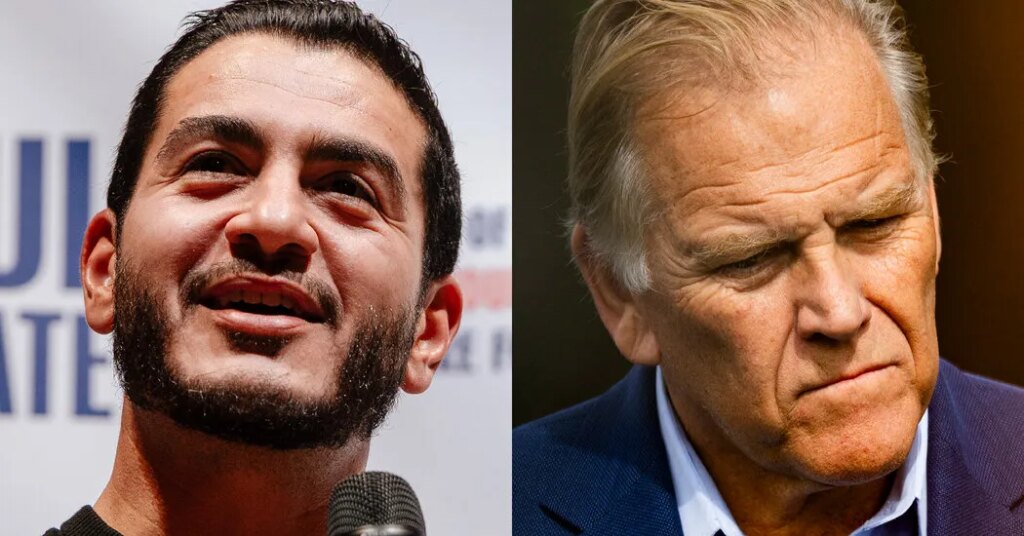
The country’s leading pro-Israel lobby has quietly made a major last-minute donation to support Mike Rogers, the Republican candidate for Senate in Michigan. His opponent, Dr. Abdul El-Sayed, is a vocal critic of Israel whom the group spent heavily to try to defeat in the Democratic primary.
The group, the American Israel Public Affairs Committee, has almost never backed a Republican in a competitive general election race. But it has started contributing in recent days to a pro-Rogers super PAC, and plans to give as much as $9 million, according to two people with knowledge of the plans who shared them under condition of anonymity because the spending was not meant to be immediately disclosed.
The donation comes after initial skepticism from the Rogers campaign about tying itself to AIPAC, whose support became an explosive issue in Democratic primary elections this year. At a debate on Oct. 8, however, Mr. Rogers opened to door for AIPAC’s engagement by responding to a question that he would “take all of that help.”
The donation went to the Great Lakes Conservatives Fund, a group exclusively focused on supporting Mr. Rogers, and was made after an Oct. 14 deadline that would have required it to be disclosed before Election Day. On Friday, the super PAC disclosed that it was making a $4.6 million media buy in Michigan.
AIPAC declined to comment on its spending in the race. The Rogers super PAC did not respond to a request for comment.
Several of the super PAC’s new spots target the Muslim background of Dr. El-Sayed, raising questions about his loyalty to Egypt and whether he has ties to the Muslim Brotherhood, an Islamist group with ties to extremists. He has denied any ties and dismissed the suggestion as part of a series of Islamophobic attacks.
AIPAC faces growing animosity in the Democratic Party — and even among some Republicans — for its staunch support of Israel at a time when a growing number of Americans object to the war in Gaza. Dr. El-Sayed turned the group’s support of his primary opponent, Representative Haley Stevens, into a central campaign issue.
The New York Times reported in August that Mr. Rogers had some reservations about AIPAC again spending heavily to defeat Dr. El-Sayed, worrying that it could backfire with voters. AIPAC’s super PAC has made disclosed expenditures of less than $300,000 in the last three weeks in Michigan, sending pieces of direct mail to Jewish voters in the state.
Separately on Wednesday, AIPAC announced some changes around the edges of its political operations. The group will no longer offer direct endorsements or donations from its federal PAC. It will continue to operate United Democracy Project, the super PAC that has spent about $85 million in congressional elections this cycle.
Though AIPAC backs many Democrats, the group’s strongest supporters and donors see Dr. El-Sayed’s candidacy as a major threat to Israel’s backing in Congress and support within the Democratic Party. Dr. El-Sayed has said he opposes Israel’s right to exist as an explicitly Jewish state, angering many Jewish leaders.
The day after Dr. El-Sayed’s primary win, Bernie Kaminetsky, AIPAC’s president, wrote to supporters that the group maintained a “principled opposition to the dangerous policies El-Sayed wants to bring to the U.S. Senate.”
The post Pro-Israel Lobby Puts Late Money Behind Republican to Thwart El-Sayed appeared first on New York Times.