Investors were looking for answers from Netflix’s third-quarter earnings results and investor call. Instead, they ended up with more questions.
The streaming giant is in the hot seat with Wall Street, with shares down 45% over the last 12 months and 27% year-to-date. On Tuesday, Netflix posted third-quarter revenue growth of 11.8% — the slowest since the third quarter of 2023, when it was wrestling with subscriber losses amid a password-sharing crackdown. What’s worse, it guided for even slower growth in the fourth quarter.
It was a chance for leadership to reset expectations, particularly in the wake of laying off 6% of its workforce, the firing of its chief content officer and film chief and the ousting of several other film and TV executives. Instead, they downplayed the issue.
“Our business and our business flywheel are working. There is no need for a fundamental shift in the strategy,” co-CEO Ted Sarandos said on the earnings conference call, before acknowledging, “We do need better execution in the U.S.”
{ “symbols”: [[“NASDAQ:NFLX|1Y”]], “width”: “100%”, “height”: “400”, “locale”: “en”, “colorTheme”: “light”, “isTransparent”: false, “showChart”: true, “scalePosition”: “right”, “scaleMode”: “Normal” }
That was an admission that the company needed to work on the quality of its content slate, a task that will fall to incoming Chief Content Officer Peter Rice. In addition, Sarandos and co-CEO Greg Peters discussed bulking up its library with more licensing deals, opening the door to add-on streaming services “where it makes sense,” continuing to lean on international markets as a growth driver and tapping the longer term growth potential of its ad business. They also defended big live events, like its inaugural Thanksgiving Eve NFL games, as crucial to customer retention, even as original movies and shows remain its core.
The points failed to register with investors late Tuesday, with shares down nearly 6% in late trading after the conference call ended. That’s because, while Netflix sees the fix as pouring an accelerant on an already solid business, Wall Street views the situation differently: slowing growth in revenue or engagement may trigger vulnerabilities down the line, including its future ability to raise prices or even hang on to subscribers.
“Given the miss on 4Q26 outlook and the lowered guidance for ad revenue, we’d expect modest pressure on shares,” said Citi analyst Jason Bazinet.
By the numbers
From a Wall Street expectations game, Netflix’s third-quarter results weren’t that bad. The $12.87 billion in revenue was right in line with expectations, and per-share earnings of 87 cents actually topped expectations by a nickel.
Netfilx’s customer turnover rate, meanwhile, beat its own forecast and continues to lead the industry in spite of price hikes that rolled out earlier this year.
But investors are always looking ahead and the fourth quarter doesn’t look so hot. One analyst tried to pry some answers about 2027 out of Chief Financial Officer Spencer Neumann, but he didn’t oblige beyond saying the company has an overall goal of double-digit revenue growth.
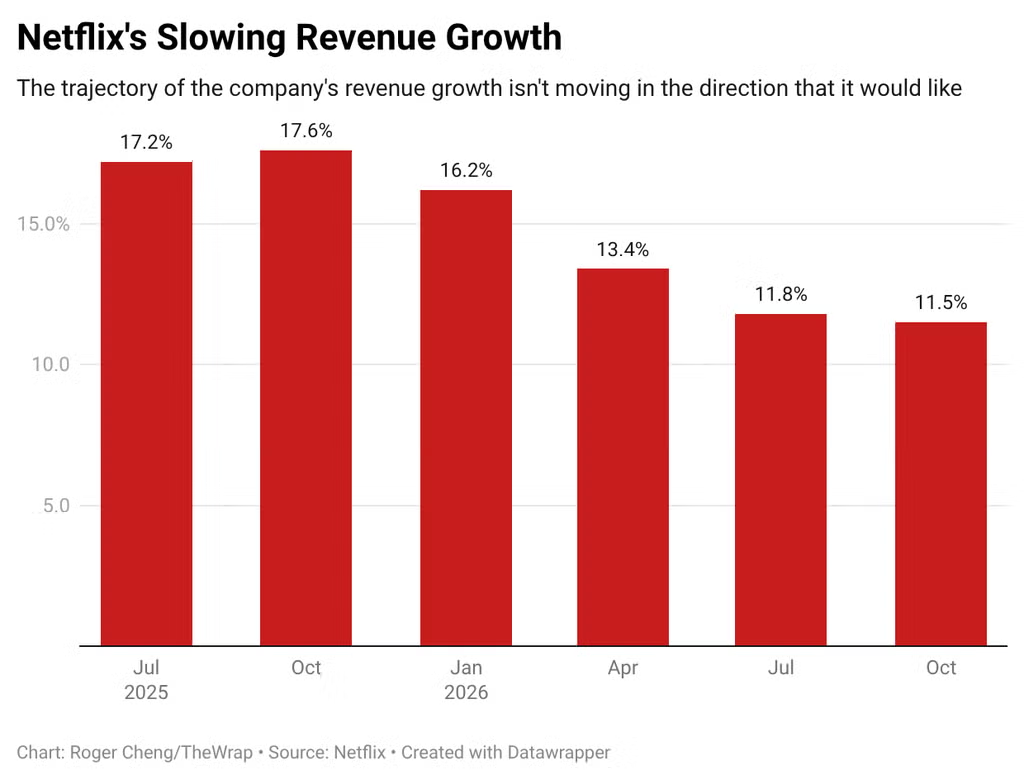
Whether that’s on the high or low end of double digits is what Wall Street is dying to know, especially after this quarter.
Another number of concern: $2.7. billion. That’s how much Netflix revised its forecast for how much its ad business, supposedly one of its growth drivers, would bring in, down from $3 billion.
But one industry watcher noted that Wall Street’s more short-term perspective misses the longer term outlook for the company, which remains solid.
“Nothing here to me is shocking,” said longtime media analyst Dan Rayburn. “Netflix really knows its business.”
Rayburn lauded Netflix’s ability to convert its revenue into operating profit at such a high rate, and noted its balance sheet is still healthy.
“It gives them flexibility with what they can do with their business,” he said, noting it’s a far cry from the company it’s often compared against, the debt-laden Skydance.
Key growth drivers
While Netflix shied away from any grand strategy changes, it did lay out how it expects to rev up its growth.
Netflix’s key catalyst remains its investment in content, with the company on track to spend $20 billion in 2026. Its slate through the rest of the year includes “The Further Mis-Adventures of Cliff Booth,” limited series “The Murder of JonBenét Ramsey,” new seasons of “The Diplomat,” “Nobody Wants This” and “Lupin,” the series finale of “Emily in Paris,” NFL games on Thanksgiving Eve and Christmas Day and the Tyson Fury vs. Anthony Joshua fight.
“The anchor of that strategy are the Netflix originals, differentiated, exclusive, ambitious, professionally produced series and films and live events,” Sarandos said. “Now, we’ve oriented the market to expect something great and new to watch every week, so we have to deliver on quality and quantity always.”
Though Netflix is a “streaming first” business at its core, executives added that the company will release 30 films theatrically this year. Only one of those films, awards play “La Bola Negra” that was acquired at Cannes, will receive a traditional 45-day theatrical window. The company has also started reporting box office grosses for theatrical releases, starting with that Spanish-language queer epic.

Meanwhile, in 2027, its slate includes Greta Gerwig’s “Narnia: The Magician’s Nephew,” “Charlie vs. the Chocolate Factory,” “Here Comes the Flood,” “Grown Ups 3,” “Bridgerton” Season 5, “Wednesday” Season 3, the Michael Fassbender-led series “Kennedy,” mystery thriller “The God of the Woods” and “Rabbit, Rabbit.” It will also have more NFL games and the Women’s World Cup in the U.S. and Canada.
Sarandos teased that Rice would have a hand in many of these projects.
“I believe that Peter will actually be able to have an impact on … those projects that are in the works, even in the short term,” he said.
Though its full-year ad sales will miss its original target, Netflix has bigger expectations over the long term. It plans to expand its ad tier to 15 new countries in 2027, with the first phase of the rollout kicking off in March, followed by launches in nine countries in the Europe, Middle East and Africa (EMEA) region, Colombia, Peru and New Zealand. Peters also said Netflix has an “underrealized revenue growth” opportunity in the near-term to narrow the gap between the ad-supported and standard tiers’ average revenue per member through improvements to its ad capabilities, including new products and formats.
But some questions remain about whether Netflix will be fully able to tap into that opportunity. Dan Larkman, CEO of connected TV ad firm Keynes, noted that there is lots of competition for ad-based streaming content, especially from services that don’t charge a subscription fee.
“The audience advertisers want on Netflix can also be found on free ad-supported TV, often at a very different price,” Larkman said. “Netflix is still premium, but limiting yourself to a handful of advertisers limits how much revenue you can make.”
Additionally, Peters touted Netflix’s partnership with France’s TF1, noting it has been incremental to engagement growth and that the company would look to replicate that deal elsewhere. Executives also highlighted licensing deals with Disney and Brazil’s Globo and plan to embrace add-on subscriptions as another way of expanding the reach of its entertainment offering, but declined to reveal any specific partnerships.
But Sarandos did spend a chunk of time touting the Disney deal on the call, which resulted in all five “Ice Age” movies entering Netflix’s Top 10. It was both a boast about how these kinds of deals are a boon to Netflix’s engagement, but also felt like a clarion call to other studios that Netflix is very much open to new business.
“This benefits Disney because, as they gear up to release their next ‘Ice Age’ movie in the theaters in February — it’s called ‘Ice Age: The Boiling Point’ — more people will be recent fans of the ‘Ice Age’ franchise,” Sarandos said, adding a shoutout to Disney CEO Josh D’Amaro. “And by the way, yes, Netflix just plugged a Disney movie on our earnings call. You’re welcome, Josh.”
Of the expansion into more licensing and add-ons, Peters declined to make any new announcements, but said, “You should expect that we are going to continue to find new ways to bring more core entertainment value to our members.”
With that entertainment value, they’re betting an acceleration of its revenue and engagement will come, providing the answers that Wall Street has been long looking for.
The post Netflix Explains How It Will Fix Its Growth Problem. Wall Street Isn’t Convinced | Analysis appeared first on TheWrap.