The final New York Times/Siena University national poll of the 2026 midterm campaign finds Democrats leading nationally by 11 percentage points, 52 to 41 percent, when likely voters were asked about the specific candidates for the House in their district.
Eleven is a big number. No party has won the national vote by such a large margin since the Democrats did so in 2008. While the outcome of the midterms will ultimately be decided seat by seat, anything like the results of the poll would probably yield a large Democratic House majority and give the party every opportunity to flip the red states they need to win the Senate, including in states where Democrats simply haven’t been competitive in recent years.
In today’s polarized era of closely fought elections, it can be hard to believe that a party could win by that much. The skepticism is not unfounded. The polls have raised the possibility of this kind of overwhelming Republican defeat before in the Trump era, only for the polls to ultimately overestimate Democratic support in 2016, 2020 and, at least in crucial red states, in the 2018 election.
This kind of polling error is possible — it’s happened before — but it’s not inevitable, either. And at least in this particular poll, the Democratic lead is large enough that the party would still deliver a significant victory even if it were off by as much as the polls were in 2016 or 2020.
But there’s another reason to be skeptical of a decisive Democratic victory, even if one assumed the polls were in the ballpark. To win by such a wide margin, Democrats need modest but meaningful support from Republican-leaning voters who haven’t usually been up for grabs during the Trump era, or they need Republicans to stay home. Either way, the G.O.P. could avert a worst-case scenario by winning back some normally reliable Republican voters over the final two weeks. It sounds simple enough.
In practice, it’s not so simple. The poll offers no reason to think that Republicans have stopped the bleeding, let alone made progress toward winning back their usual supporters.
A foreboding part of the poll for Republicans is the trend line: President Trump and his party have continued to slide since the last Times/Siena poll in September, even as they might have hoped to rally supporters with the campaign heating up.
If there is a particular finding that’s most ominous for Republicans, it’s Mr. Trump’s approval rating. It’s extraordinarily low and still dropping. It fell by another three points since the September poll, to 34 percent among registered voters and 36 percent among likely voters. That’s his worst approval rating in a Times/Siena poll. Taken together with other recent polls, it seems Mr. Trump’s backing has fallen through his long supposed “floor” of support, and at the worst time for his party.
If there’s a reason to believe Democrats could really win by such a wide margin, Mr. Trump’s approval rating is it. In his first-term midterm election in 2018, when Democrats posted a decisive-but-not-landslide margin to take the House but not the Senate, his approval rating was nearly 10 points higher than this. He was popular, with an approval rating over 50 percent, in all of the key red-state races where he barnstormed over the final weeks of the campaign and where the polls underestimated Republicans, like Tennessee, Missouri and Indiana.
This time, his approval ratings are barely at 40 percent in the crucial red states that will decide control of the Senate.
Mr. Trump’s low ratings look just as dangerous for Republicans in the broader context of historical approval ratings heading into midterms. The president’s party almost always fares poorly in midterm elections, but especially when the president’s approval rating is low. In this poll, Mr. Trump has the lowest approval rating for any president before a midterm election since Harry Truman and the Democrats were routed in 1946 at the dawn of modern polling.
His only rival for that distinction is George W. Bush in 2006. Mr. Bush’s approval ratings slipped to comparable levels under eerily similar circumstances: a quagmire in the Middle East, rising gas prices and allegations of a culture of corruption among Republicans in Washington. That year’s midterm election ended in a decisive Democratic victory, including Democratic victories in the sort of red states that they hope to flip this November.
As Mr. Trump’s support has slid, Democratic strength has grown. On the congressional ballot, the Democratic lead grew to 11 points from nine since the Times/Siena poll in September (though the September poll asked a generic question about party preference, not the named ballot used in this poll). The Democratic lead on the named ballot for Senate and governor has remained essentially unchanged, despite an enormous Republican spending advantage over the same period.
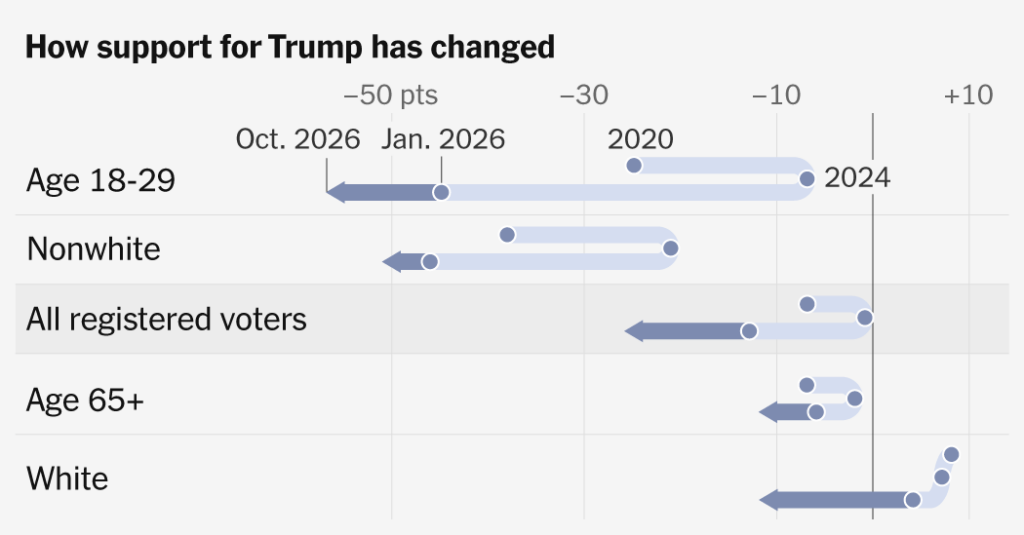
The erosion of Republican strength has gradually transformed the demographic story of the election. At the outset of the campaign, Republican losses were concentrated among young and nonwhite voters, who moved toward Mr. Trump in 2024 but snapped back toward the Democrats after the administration’s aggressive moves on ICE, DOGE, health care and more. Since then, Republican weakness has spread far beyond those traditionally Democratic constituencies. Support for the party and Mr. Trump’s approval ratings have slipped among men, white voters and other Republican-leaning constituencies the party might have hoped to win back with a polarizing campaign.
Even if many of these disaffected Republican-leaning voters ultimately can’t stomach a vote for a Democratic candidate, it’s an open question whether they will actually vote. The Times/Siena poll relies on two measures of whether voters will turn out: whether voters have a record of voting in the past, and whether they say they will vote in the coming election. In this election, the two measures suggest pretty different outcomes.
If only the relatively Republican-leaning voters with a track record of voting show up, Republicans could outperform the polls: Democrats lead by nine points among registered voters who have actually voted in a prior midterm or a primary. On the other hand, Democrats could win by even more if only those who say they intend to vote show up: Democrats lead by 14 points among those who say they’re at least “very likely” to vote or have already done so.
The Republicans lead among only one group by likelihood of voting: those who said they were “not at all likely to vote.”
Rachel Buigas-Lopez contributed graphics.
The post Democrats Have a Wide Lead in Our New Poll as Trump Slides appeared first on New York Times.