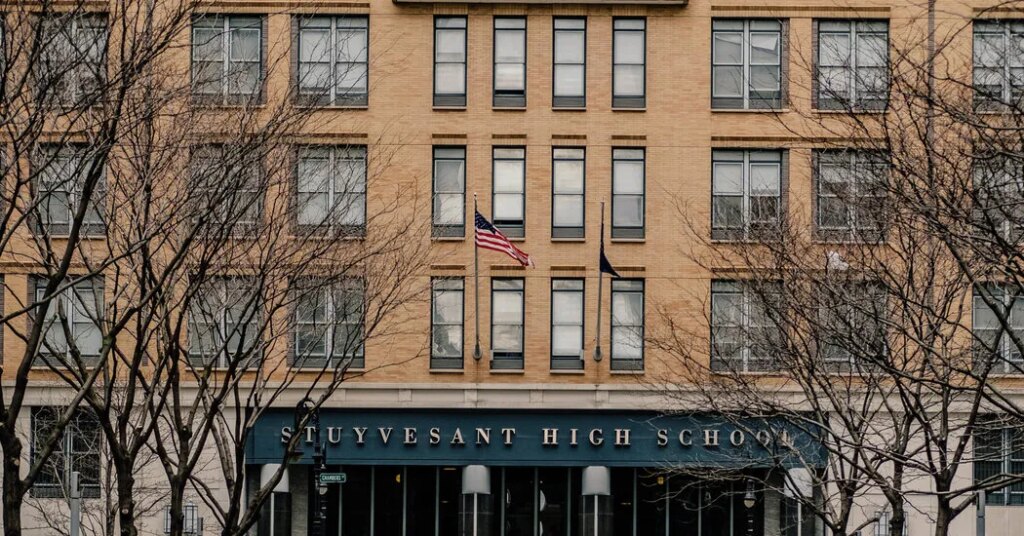
Until recently, I thought my worst New York City experience was the time I was waiting to cross Houston Street and a cackling vagrant punched me in the face. That, however, was before I started the process of getting my oldest kid into a public high school.
New York has an almost purely school choice system; most families don’t have a default high school that they’re zoned for. The admissions process, a mix of meritocratic culling and sheer chance, is time-consuming, psychologically taxing and so byzantine that it’s hard to describe to anyone who hasn’t endured it.
“I was somehow holding it together with all the balls in the air until this high school process,” Eva Pinkley, a single mother in Brooklyn, told me last week, as her neurodivergent son worked on an application essay with a coach she could barely afford. Now, she said, “I’m completely falling apart.” An education reporter I know contemplated moving out of the city after seeing high school applications up close. Friends of mine who’ve endured the process say the only consolation is that it makes applying to college seem easy.
I’d heard how miserable it was before it was my turn, but was still shocked by it, in part because of a stroke of particularly bad luck. My kid will, I think, be fine — I will go to great lengths to assure it — but I’m not sure how people with fewer resources cope. And the whole nightmare made me curious about how it got this way, and who all this punishing complexity serves.
“By many measures, New York is the kind of city where school choice is supposed to shine,” writes the Princeton sociologist Jennifer L. Jennings in her recent book about school choice, “The Scarcity Loop.” It’s huge and wealthy, with hundreds of options and good public transportation. But the problem in New York, as in most other big cities, is that there aren’t enough seats in excellent schools to go around.
So getting into high school feels like playing multiple games of musical chairs simultaneously. Places are distributed according to a bewildering mixture of lotteries, grades, tests, interviews, essays, auditions and portfolios. School choice is meant to be fairer than rationing education by ZIP code — as typically happens in suburbs — and in some ways it is. But the system in New York is a bureaucratic Rube Goldberg machine that locks out families that don’t know how to operate it while driving privileged ones crazy. It demonstrates the way school choice policies can shift responsibility for securing each kid a great education away from government and onto individuals. They trap us in a joyless competition and make us feel like it’s our fault when we lose.
“Families with institutional fluency and flexible schedules are better equipped to manage this hidden curriculum,” Jennings writes in “The Scarcity Loop.” “Others, facing language barriers or inflexible work, are filtered out by the grind itself, excluded by process rather than lines on a map. Even for savvy parents, the process leaves its mark in the erosion of evenings, weekends and mothers’ sleep.”
On New York’s high school application, families list the schools they’re applying to in order of preference. Students are divided up into five tiers based on their marks in seventh grade, and, separately, assigned a hexadecimal lottery number — really a combination of letters and numbers — that determines their priority in the city’s school-matching algorithm. (The meaning of the lottery numbers is indecipherable to laypeople, but parents in the know turn to a chart created by the computer science professor Amélie Marian, a revered figure on the school-application message boards.) Some schools take kids only from the highest tier, which can shut out those who get a single A- in seventh grade. But perfect grades are no guarantee, either, if you get a bad lottery number.
This year my son was in the top tier, but Marian’s data showed that his lottery number was among the worst possible. That means we’ll be matched to a school only after the other 99 percent of city kids are given their choices of the schools they qualify for. By then, the schools that usually take kids only from the top tier are expected to be full. So will the most desirable schools that accept kids from across the academic spectrum.
We’re hanging our hopes on the SHSAT, an SAT-like test that determines access to eight of the city’s specialized high schools, as well as a handful of other public schools with their own tests, essays and interviews. And while I respect arguments against the charter school movement — I even agree with some of them — we’ve applied to a well-regarded Brooklyn charter school and I have found myself wishing there were more.
Since none of these options are sure bets, we’re seeking out safety schools that are well run but not too selective, reasonably rigorous and, importantly, no more than an hour away by public transportation. To find them, we’ve relied on social media, word of mouth — parents we know have assembled spreadsheets — and a Zoom meeting with an embarrassingly expensive consultant. Having come up with a handful of backup schools, we’re trying to visit them during tours and open houses, though often these fill up so quickly that parents trade spots online.
Obviously, the lottery system isn’t unfair just because we got the short end of it; someone has to be last. What infuriates me is the underlying shortage of seats in schools that are challenging and well resourced, forcing parents to scratch and claw for a place, or to settle. The system creates a sense that “if it fails, it’s on you,” Jennings told me. “If you jump through the right hoops and know the secret codes at the right time, you’ll be able to get a seat.”
There’s no way to know how many families are driven out of the public school system by this ordeal. But we do know that enrollment in New York’s public schools is shrinking. In an Education Department survey released last year, 41 percent of families that withdrew from the city’s public school system said they were seeking “more rigorous” education. Forty percent departed because their families moved. Among that group, half said “concerns about schools” were one of their reasons for leaving the city. It seems obvious that the “Hunger Games” aspect of public high school admissions is a drag on New York’s fortunes, one Zohran Mamdani needs to address, though he didn’t create it.
Some of the system’s maddening features date back to Michael Bloomberg’s administration. Bloomberg closed underperforming neighborhood schools and encouraged the proliferation of small, career-focused high schools. Today, the city has lots of themed schools — there are schools for sports management, marketing and hip-hop — but not nearly enough neighborhood high schools with broad, general-interest offerings and honors tracks. Without a zoned high school, families have little incentive to lobby to make their local ones better. Ambitious kids often must resign themselves to long commutes. “High-achieving kids travel a lot farther than lower-achieving kids,” said Jennings.
Public school inequality is a wicked problem, and I won’t pretend to have an easy solution to it. Ultimately, I think part of the answer is bringing back neighborhood high schools, not as a replacement for school choice, but as a supplement. “The process is extremely stress-inducing because people feel that they don’t have agency and they don’t have predictability,” said Marian, the computer scientist. If all parents had at least one community school they could depend on, some predictability would be restored.
But that’s a long-term goal. In the short term, Mamdani’s administration, so focused on making government more responsive to its citizens, can look for ways to take some of the pain out of the application process. Here’s one small idea:
Several of the most sought-after schools ask students to submit essays about how they will both contribute to and benefit from those schools’ unique pedagogical approaches. In a system in which families are scrambling for any foothold they can find, these assignments do not encourage sincerity. They are unrewarding to write and tedious to oversee. If schools want a writing component, there should be one essay, maybe with a choice of prompts, used for all of them.
Overall, the goal should be more ease and simplicity. “Rationing always imposes work somewhere; the moral question is where that work lands, and who pays,” writes Jennings. Right now, most of the work falls on parents. The one resource this system treats as inexhaustible is families’ time.
The Times is committed to publishing a diversity of letters to the editor. We’d like to hear what you think about this or any of our articles. Here are some tips. And here’s our email: [email protected].
Follow the New York Times Opinion section on Facebook, Instagram, TikTok, Bluesky, WhatsApp and Threads.
The post The Unrelenting Nightmare of Applying to High School in New York City appeared first on New York Times.