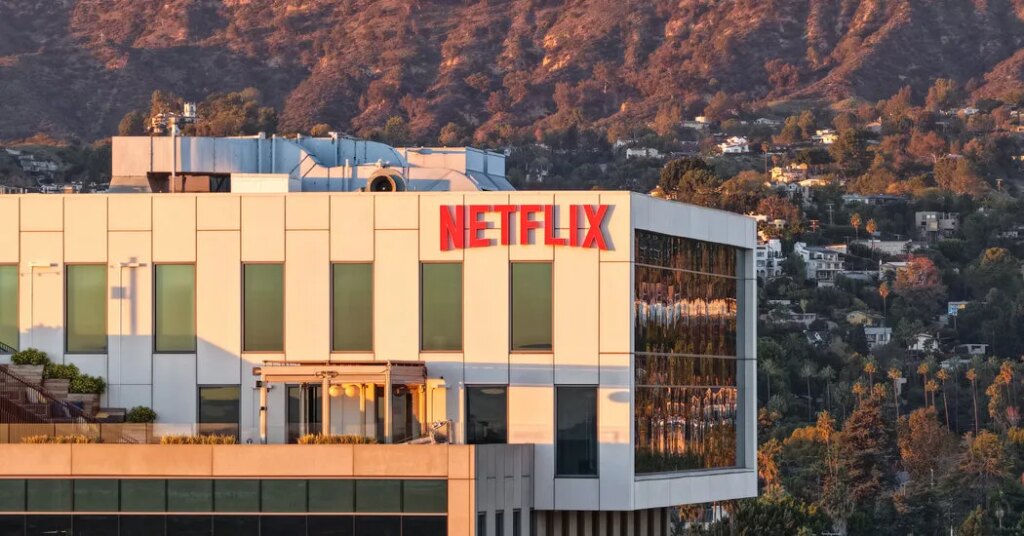
After a tumultuous week, when Netflix laid off 1,000 employees and fired its chief content officer and top two film executives, the world’s largest streaming service showed that one thing isn’t in flux: its ability to make boatloads of money.
The company said on Tuesday that its revenues in the third quarter grew 12 percent from a year earlier, to nearly $12.9 billion, while net income rose 48 percent, to nearly $3.7 billion. For the year, Netflix said, it expects revenue growth to be 13 percent, roughly in line with its previous estimates.
But the company also acknowledged the undercurrent that led to the recent tumult: concern about stagnating attention time on its service.
“We know there’s some investor concern about our view-hours growth,” particularly in the United States and Canada, Netflix told investors in a letter. Revenue in those countries grew 11 percent in the most recent quarter, down from 17 percent a year earlier.
Still, the company reiterated that by executing on its strategy for growth — delivering “differentiated, exclusive, professionally produced series, films and live events” while trying to bring “more third-party content to its service” — it will boost engagement time.
Netflix delivered its quarterly results while at a crossroads. Despite being the most-watched paid streaming service in the world, with 325 million subscribers, the company is not growing fast enough for either its top executives or its shareholders.
The time that viewers spend on the service has stagnated, as YouTube increasingly becomes a competitor. Netflix has struggled to create a pipeline of new hits to replace shows like “Stranger Things” and “Squid Game.” Returning shows like “Beef,” “The Night Agent” and “Avatar: The Last Airbender” lost significant viewership for their most recent seasons, according to Netflix’s metrics.
And no film released this summer became a breakout hit, a contrast with last summer, when “KPop Demon Hunters” and “Happy Gilmore 2” captivated viewers. Indeed, the company’s biggest film hit for the quarter was “The Last House,” which generated 91 million views but scored dismally with both critics and audiences.
Netflix’s stock has been on a slide since September last year, when it announced its intention to purchase Warner Bros. Discovery’s studio and streaming business in a nearly $83 billion deal. Even after the company bowed out of the pursuit, not willing to get in a bidding war with the eventual victor, Paramount Skydance, the stock continued to languish. Its price is down nearly 45 percent from a year ago.
Still, last week’s shake-up jolted Hollywood. A day after Netflix announced it was cutting 6 percent of its work force, it fired Bela Bajaria, a well-respected company veteran who, as chief content officer the past three years, expanded Netflix beyond scripted TV shows and movies into reality shows, live events, sports and video podcasts.
Peter Rice, a film and television executive who spent 30 years at Fox before becoming a top executive at Disney, has taken her place.
One of his first decisions will be choosing a top film executive to replace Dan Lin, who was fired late Friday after two and a half years at the company. Mr. Lin’s mandate to lower production costs and be more selective about what the streaming service makes faced great resistance by the talent. The directors Noah Baumbach and David Fincher ended their relationships with the company.
According to a letter that Mr. Lin sent to his team on his departure, which was obtained by The New York Times, the 53-year-old executive accomplished many of his goals. “For our film slate the past two years, per-title views are up 12 percent and view hours are up 11 percent,” he wrote, adding that in the first half of 2026, 10 of Netflix’s 13 films were rated “loved” by subscribers.
He leaves behind a robust slate of movies, including “The Mis-Adventures of Cliff Booth” — a sequel of sorts to “Once Upon a Time … in Hollywood,” with a script from Quentin Tarantino and directed by Mr. Fincher. It will receive a two-week exclusive IMAX run this year, as will Pete Berg’s war drama, “The Mosquito Bowl.” Next year will bring “Narnia: The Magician’s Nephew,” directed by Greta Gerwig (“Barbie”), and an animated “Charlie vs. the Chocolate Factory”
Many in Hollywood are curious whether Mr. Rice will expand Netflix’s tentative foray into releasing films in theaters before they appear on the service. Ted Sarandos, the company’s co-chief executive, has for years insisted that theatrical distribution is “an outmoded idea,” and that Netflix movies are made for its subscribers.
This past weekend, in a first, the company reported box office grosses for “La Bola Negra,” a Spanish-language multigenerational epic that it acquired at the Cannes Film Festival. The film will remain in theaters for 45 days before it debuts on the service.
Netflix’s television team has also been busy buying up projects over the last year. The streamer gave a straight-to-series order to “The Corrections,” an adaptation of Jonathan Franzen’s 2001 novel, with Meryl Streep expected to star and Cord Jefferson (the writer and director of “American Fiction”) expected to direct the limited series. Netflix also ordered “Rabbit, Rabbit,” a thriller starring Adam Driver and Regina Hall that is expected to premiere next year.
Production also began recently on an adaptation of the Dan Brown novel “The Secret of Secrets.” Carlton Cuse (“Lost,” “Jack Ryan”) is the showrunner, and it stars Morgan Spector (“The Gilded Age”).
The company is banking on these movies and shows, and Mr. Rice’s changes, to reverse the trend of subscribers’ engagement with its offerings. Netflix accounted for 7.8 percent of all television viewing time in the United States in July, according to Nielsen, a full percentage point drop from a year earlier. YouTube’s share was more than 14 percent.
Despite all the turmoil, Netflix maintains a loyal following. According to a report released on Tuesday by Antenna, Netflix has the lowest churn numbers, or cancellation rate, of any streamer.
John Koblin contributed reporting from New York
The post Netflix Is Great at Making Money. Its Problem Is Keeping Viewers Hooked. appeared first on New York Times.