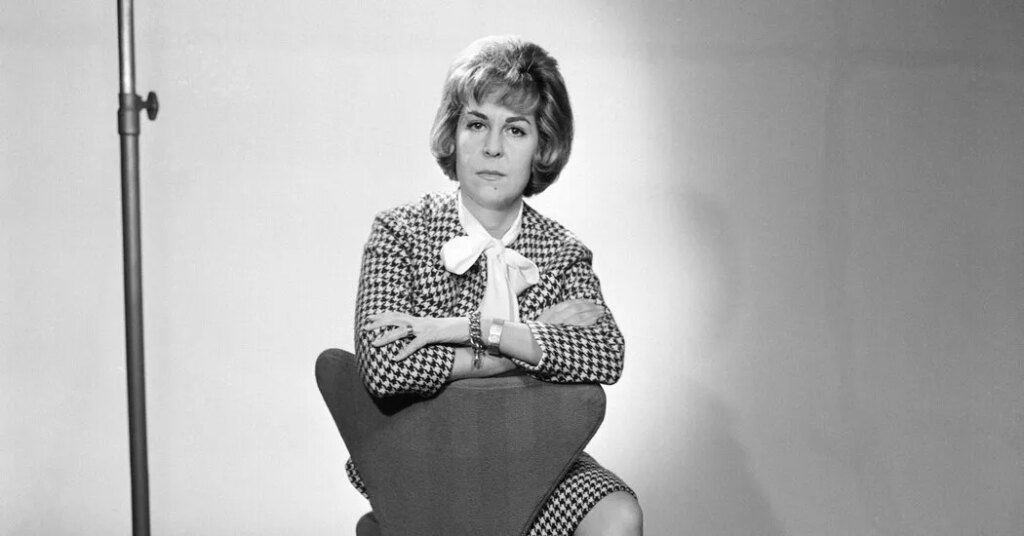
Felicity Green, the influential fashion editor at The Daily Mirror, Britain’s populist tabloid, who introduced its five million readers to the spirited street style of the Swinging Sixties — notably the youthful fashions of Mary Quant and Biba — horrifying the paper’s male hierarchy, died on Sept. 10 at her home in London. She was 100.
Her death was announced by Deborah Bee, a friend and former student.
In 1960, Ms. Green was working as a fashion editor for Woman and Beauty magazine when she was summoned to a meeting with Hugh Cudlipp, the editorial director of the Mirror Group, which had just introduced a Sunday women’s paper.
“What do you think of it?” he asked her.
She thought it was awful, and told him so.
“I do, too,” he said, as she recalled in her 2014 memoir, “Sex, Sense and Nonsense: Felicity Green on the ’60s Fashion Scene.”
“Right,” he said. “How soon can you start?”
The Sunday women’s paper was short-lived, however, and soon Mr. Cudlipp had moved Ms. Green to The Daily Mirror.
It was an auspicious time to cover fashion in London. Young people were chafing at the buttoned-up styles of their parents, the uniform of the establishment. Fashion, theretofore the province of Paris ateliers, was percolating up from the streets — from boutiques on Carnaby Street and on Kings Road, where Ms. Quant was slicing the hems ever higher on the short, flared skirts she sold.
Ms. Green’s pages were photo-driven, and very cheeky. There was a lot of skin. Her mission, she said, was to appeal to both women and men.
So there was Grace Coddington, the model and future Vogue editor, wearing a medley of striped mod outfits, photographed in January 1963 in the locker room — and steam room — of a local football club. (The players kept trying to flash her, Ms. Coddington recalled in a recent interview.) There were models in bikinis cavorting on the tables of pubs, and lots and lots of stories about underwear: clingy bodysuits and other sexy accouterments designed to fit the skimpy new styles.
The Mirror covered the international furor when lovely Jean Shrimpton, the “It” girl and model known as the Shrimp, wore a white minidress — with bare legs! — to the 1965 Melbourne Cup in Australia.
Ms. Green also produced a feature on tights — a revolution and a revelation for the garter-and-stocking set — as a must-wear item for women who planned to sit down in their micro-miniskirts.
She brought a photographer (Doreen Spooner), a model and a few minidresses to Russia in 1967 as part of a British Board of Trade delegation, and photographed the mini-clad model on a Moscow street as passers-by looked on, dour and disapproving.
Perhaps not surprisingly, some of her male colleagues were discomfited by the new styles.
The Mirror’s chairman, Cecil King, once accosted Ms. Green in a stairwell at the office. “When are you going to stop putting those dreadful miniskirts in The Mirror?” he demanded.
“Only when they stop being fashionable, Mr. King,” she retorted.
The Daily Mirror was a working-class paper, and the styles that Ms. Green trumpeted were often extremely affordable. One do-it-yourself silver-foil mail-order minidress was held together with sellotape (that’s Scotch tape, for American readers) and cost 16 shillings (about $27 in today’s dollars), plus another shilling for postage.
“Oh and by the way,” Ms. Green wrote in her Nov. 4, 1966, story, “I am assured by Those Who Know that the newest essential for really In-type modes is noise.”
She added: “Rustling, I’m told, is out. Rattling is in, so this dress is very in indeed, as the moment you move it sounds like a pop-crazy audience applauding the Beatles.”
Ms. Green made mail-order history in 1964 with a story on four young women who owned fashion companies.
One was Barbara Hulanicki, who was working for The Mirror as an illustrator and ran a mail-order clothing business with her husband, Stephen Fitz-Simon, on the side. They called it the Biba Postal Boutique, a name derived from her sister’s nickname.
To accompany the story, Ms. Green asked Ms. Hulanicki to design a shift dress with a matching head scarf that they could offer to readers for 25 shillings. Ms. Green thought they might sell 2,000 or so.
Readers ordered 17,000 in pink gingham, and another 5,000 in blue. By the time all of the orders were fulfilled, the story goes, Britain had run out of pink gingham.
That success enabled Ms. Hulanicki and Mr. Fitz-Simon to start Biba, the clothing brand that became a lifestyle emporium on Kensington High Street, where peacocking mods could outfit themselves and their flats in Biba’s “total” look — a funky bohemian style that epitomized the so-called youthquake that had become Britain’s most interesting export.
Ms. Green often courted controversy. In October 1969, she covered the claim that Ms. Quant’s husband, Alexander Plunket Greene, had trimmed the designer’s pubic hair into a heart shape; the story ran under the headline “Has Mary Gone Too Far?” (It was Ms. Quant’s belief that pubic hair might become a fashion statement.)
Readers loved the article, and the concept. Strangers bought Ms. Quant drinks in pubs, and John Lennon suggested other shapes she might try.
But Ms. Green was hauled into her editor’s office with a company lawyer; to their horror, the story — and the paper — had been reported to the British Press Council, presumably for indecency. Happily, the case never went any further.
Ms. Green was born on June 26, 1926, in Dagenham, East London, the only child of Annie and Emanuel Green, who worked in a shoe store.
Theirs was the only Jewish family in the neighborhood, she told The Telegraph in 2014, but she “just wanted to be like the other children.”
At Clark’s College, in Ilford, she skipped classes. She went on to attend secretarial school, where she was an underachiever as well. But she was interested in clothes and sketched her own designs, which a dressmaker made up for her.
In her early 20s, she wrote to Phyllis Digby Morton, the editor of Woman and Beauty, asking for a job. The magazine was an outlier for its era, covering “virginity, frigidity and infidelity,” Ms. Green wrote in her 2014 memoir, at a time when most other women’s magazines were teaching readers how to knit an egg cozy for Easter.
Her first job there involved menial tasks like lighting the fire, making tea and walking the boss’s malevolent, overweight dachshund. But after six months, she became the assistant to the fashion editor; a few years later, she was promoted to fashion editor.
Ms. Green married Geoffrey Hill, a cigar importer, in the early 1970s. He died in 1992. They had no children, and she has no survivors.
In 1973, Ms. Green became a director on The Mirror’s board. She resigned five years later after discovering that a new male director was being paid twice her salary. (At the time, she said, she was making 14,000 pounds a year — roughly $72,000 today.) She went on to work for Vidal Sassoon, running the company’s British office, and served as a consultant to various newspapers and magazines, including The Daily Express and The Telegraph, as well as teaching at Central Saint Martins College of Art.
“Fashion is not a bloody religion, as most fashion editors seem to think,” she told The Telegraph in 2014. “There is a difference between fashion and clothes: One is the real stuff, which is the clothes; then there is fashion, which is some kind of mesmeric stuff out there that persuades the world to go in certain directions rather mysteriously.”
She added: “It’s all big business. And I’d rather people spent money on clothes than arms.”
The post Felicity Green Introduced the Miniskirt to Millions. She Has Died at 100. appeared first on New York Times.