In an industry riddled with abuse, the world’s banks and governments rely on one entity to keep gangsters, warlords and human rights violators from selling gold into the mainstream market.
That group, the London Bullion Market Association, is the self-described “global authority for precious metals.” With the power to blacklist companies, the L.B.M.A. is the closest thing the multi-trillion-dollar industry has to an international regulator.
Governments rely on the association’s stamp as a sign that gold has been mined without human rights abuses, environmental devastation, financial sanctions or criminality. In the most literal sense, the L.B.M.A. sets the gold standard.
But a New York Times investigation found that the association has repeatedly allowed gold into the market that has been mined by criminals, cartel members and children. Refiners lie with impunity about the origins of their gold. The rules are pocked with exceptions and vagaries, and the L.B.M.A. has repeatedly decided not to enforce them.
And in the case of Madagascar, the L.B.M.A. helped change and backdate key paperwork that certified gold as free from abuse.
As prices skyrocketed in recent years and evidence emerged that gold was financing armed groups in Sudan and polluters in the Amazon, the industry perpetuated the notion that it kept such dirty gold out of the mainstream marketplace.
The Times investigation shows that the divide between “clean” and “dirty” gold is an industry fiction. There is just gold. And as Wall Street, central banks and investors stockpile and trade the precious metal, they’re profiting off a supply that includes gold from illegal sources.
That matters now more than ever. Two decades ago, when gold sold at about $600 an ounce, it was not profitable to drive mining barges into the deepest parts of the Amazon or use bulldozers to tear up acres of Madagascar rice fields to find gold. The price this year crossed the $5,000 mark. That has made it profitable to mine in inefficient, destructive and politically destabilizing ways.
The industry works like this: Miners and brokers sell raw gold to refiners, which melt it, remove impurities, and form it into bars. The major international marketplace accepts bars only from the 67 L.B.M.A.-certified refineries. Those refiners must document the source of every ounce of gold in every bar. They are subject to independent audits to assure that their suppliers aren’t linked to criminals, child abuse or financial sanctions.
The L.B.M.A. is financed and run by the gold industry’s biggest players, including large refiners, like Asahi, and financial houses such as HSBC, Morgan Stanley, J.P. Morgan and Deutsche Bank.
National governments may regulate mining, but if the L.B.M.A. does not certify the gold, it becomes all but unsellable in the world’s biggest markets.
But for all its talk about being a global authority, the L.B.M.A. is mostly a paperwork collector. The association relies on refiners to inspect the mines and to self-report the details.
One way to see how the association fails to live up to its claims is to compare its public statements with what it says in private.
On the association’s website, its chief executive, Ruth Crowell, declares, “We’re the standard-setting organization that defines how precious metals are refined, as well as traded around the world.”
In court documents in London, where Tanzanians are suing the L.B.M.A. over violence in a mine, the group disavows those very words: “The assertion that the L.B.M.A. is ‘the standard-setting organization that defines how precious metals are refined and traded around the world’ is denied.”
Ms. Crowell wrote in 2024 that the L.B.M.A. was a global authority that sets standards for “85 percent to 90 percent of the global gold production.”
In court, the association says it is “a small, not-for-profit organization” that “does not possess the levels of staff, the expertise or the resources necessary” to be held responsible for what happens in gold mines.
In an interview and written statement, Ms. Crowell said the L.B.M.A. held refiners to “the highest level of international guidelines.” But she downplayed the association’s responsibility.
“The L.B.M.A.’s role is we designate what is acceptable for entry into one market,” she said. It is up to governments to oversee the industry, she said.
With few industry guardrails, gangs have diversified from cocaine into gold. Islamist terrorist groups have gotten into the business. Russia and Iran use gold to prop up their wartime governments.
And a few years back, Madagascar’s central bank decided to capitalize on booming prices by buying and stockpiling gold, including from illegal mines that employ children.
The Madagascar case reveals how the L.B.M.A. failed in its oversight mission, the one on which the entire mainstream gold industry rests.
To see how it happened, I began at the mines themselves. I took a propeller plane from the capital, Antananarivo, and drove three hours through farmland to a mine called Madagold. The mine sits in a dry valley in the northern part of the island, surrounded by a busy market fueled by gold-rush cash.
Miners have worked here for generations, but the increase in gold price in recent years has created a bustling unlicensed operation.
The L.B.M.A. says it bans gold that “is likely to harm the health, safety or morals of children.”
Everywhere I looked, at Madagold and at mines across the country, children were in danger.
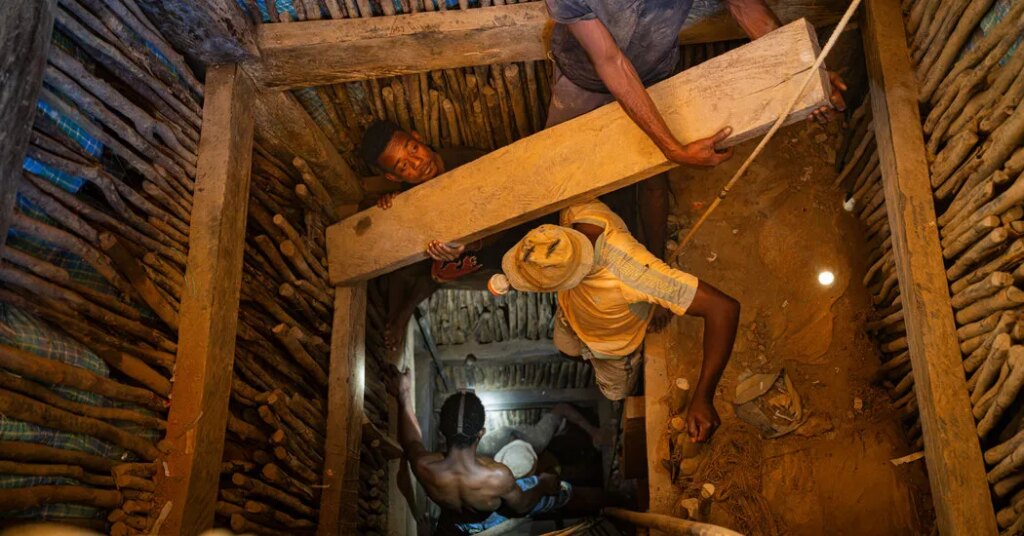
Children in Madagascar’s mines crushed rocks and hauled buckets of ore. Toddlers wandered between 100-foot-deep shafts.
Rising gold prices have fueled such rogue operations around the world. Miners linked to a Colombian drug cartel have sold gold into the U.S. Mint’s supply chain, via an L.B.M.A.-certified refiner. An illegal mine in Papua New Guinea was busy with child workers this month. A manager showed me a receipt. He was selling to a subsidiary of a major L.B.M.A.-certified refiner.
The association says that mines must be licensed and legal, and that they cannot destroy the environment. But illegal mines and environmental damage were rampant across Madagascar.
In the gold-rich northern region of Diana, miners follow no laws, the government’s regional mining supervisor, Firmin Razafindratondra, said. All of the area’s gold mining, he said, is illegal.
Outside Mananjary, on Madagascar’s east coast, miners operated despite government shutdown orders. Excavators turned rice paddies into a giant pit. In the north, workers felled trees in a protected forest to make beams for mine shafts. Such destruction plays out around the country.
“The environment is destroyed,” Elys Karena Hanitriniaina, the governor of another gold-mining region, said.
So there were obvious signs, to anyone who visited, that Madagascar’s mines would be hard-pressed to meet L.B.M.A. standards. Yet the gold breezed onto the market.
Here’s how it happened.
Several years ago, Madagascar’s central bank decided to start a national gold stockpile. Bank representatives bought gold from around the country. Government documents show that some came from Madagold, the mine where children worked and drank from wastewater pipes.
Other gold came, Madagold’s chief executive said, from muddy pits nearby. When I visited, toddlers panned for gold there. Much of the rest came from intermediaries who bought from informal mines.
For that gold to be worth anything, it needed to be “certified L.B.M.A.,” Madagascar’s central bank governor, Aivo Andrianarivelo, said.
So he dispatched his gold chief to Switzerland to find a refiner. Initially, it did not go well. Refiners questioned the gold’s origins and legality, Mr. Andrianarivelo said. “The answer we gave them didn’t give enough satisfaction or trust to the Swiss,” he said.
“Nobody wanted to touch this gold,” said Marc Ummel, a gold-supply-chain specialist at the nonprofit group SwissAid who met with Madagascar’s representative during the trip.
This was an example of the system working.
Small-scale mines are considered red flags. The L.B.M.A.’s rules say that any refiner accepting this gold would be required to conduct mine inspections. Swiss refiners worried that the bank couldn’t even identify all its sources.
Even if it could have, the required inspections would have revealed children, pollution and criminality. “‘It’s impossible,’” Mr. Ummel remembers telling Madagascar’s banker. “You will never be able to find an L.B.M.A. refiner.’”
On that point, he was wrong.
The central bank cut a deal in 2023 with the Istanbul Gold Refinery, one of the world’s biggest L.B.M.A.-certified refiners.
The Turkish refiner’s auditor filed paperwork with the L.B.M.A. claiming that it “does not do any business” with mines that raise red flags, records reviewed by The Times show. That claim freed the company from having to conduct inspections.
In an interview, Mr. Andrianarivelo acknowledged that children worked in Madagascar’s mines and said that his understanding was that they provided support work to miners, rather than hammering rock themselves. He acknowledged, too, that the mines did not follow safety laws. The workers, he said, were “very small and very poor people” who believed that only God, not safety equipment, would protect them.
The raw gold was melted into 12 kg bars at a plant next to Madagascar’s international airport. From there, tens of millions of dollars in gold was shipped to Turkey to enter the legitimate supply.
Normally, once the Turkish refiner filed the paperwork with the L.B.M.A., that would be the end of it. Unless discrepancies surface — from whistle-blowers, journalists or law enforcement authorities, for example — the L.B.M.A. does not typically independently verify that the paperwork matches the reality.
When discrepancies do surface, the refiners seldom face serious consequences.
Three years ago, for example, the L.B.M.A. learned that a refiner had received illegally mined gold from the Amazon. The refiner blamed the supplier, and the association took no action.
When an Australian refiner bought gold tied to child labor and other abuses in Papua New Guinea, the association blacklisted the auditor, not the refiner. The L.B.M.A. said it required the refiner to make unspecified management improvements. But the gold still sold.
And in 2021, emails show, the L.B.M.A. learned that Istanbul Gold Refinery itself had received gold originating from small-scale mines in Mauritania, where forced labor is well documented. The refiner did not disclose this and reported no inspections. The association determined that the refiner had broken no rules.
It was only by chance that anyone at the L.B.M.A. took a look at the Madagascar gold. The European Union happened to be considering certifying the association for a new oversight role. An E.U. inspector noticed the Madagascar deal and began scrutinizing it.
How, the inspector asked, could a refinery process gold from Madagascar yet claim no red flags? UNICEF has reported more than 230,000 children working in the country’s mines. The Justice Department and the International Monetary Fund have documented industry abuses there.
L.B.M.A. staff escalated the problem to a “compliance panel” that included the chief executive, Ms. Crowell. The association could have punished the refiner. Instead, the L.B.M.A. helped cover up the problem.
Association officials worked with the Istanbul Gold Refinery’s auditor to create a new report that made it seem like the refiner had disclosed the red flags from the beginning and had taken steps to scrutinize the supply chain, according to documents and the refiner.
The second report acknowledged that the company bought gold that originated in small-scale, red flag operations. But the report concluded that the mines “do not use child labor.”
The report was backdated, as if it had been filed in real time.
That backdated report remains on the L.B.M.A.’s website, with no indication of any alterations. The document serves as proof that Istanbul Gold Refinery processed only gold that had no connection to child labor or other abuses — claims that are undercut by what I saw in the mines.
A close look at the backdated report shows that, even with the changes, the Istanbul Gold Refinery did not follow L.B.M.A. rules as written. Those rules require refiners who process high-risk gold either to inspect the mines themselves or to use independent third parties to do so. The Istanbul refiner relied instead on the seller, the central bank, to self-certify that no child labor was used.
The rules as written make no allowance for such a self-certification. But Mustafa Salali, the Istanbul Gold Refinery’s compliance officer, told me that, in this case, he relied on the word of a government entity, the bank. As far as he was concerned, he said, everything was by the book because the L.B.M.A. signed off on the audit.
In response to questions about the backdated audit, Ms. Crowell acknowledged “non-conformances” in the process and said that “the chronology of these documents could have been explained more clearly.”
Initially, she said the refinery had been punished by being subjected to a publicly announced compliance investigation. She later said that no such investigation had actually been announced.
She said that the L.B.M.A. had mandated a “corrective action plan” — but the refiner said all it had to do was update the report.
The matter was closed. The gold was certified as meeting the world’s most rigorous standards.
It all worked out quite well for Madagascar’s destructive and exploitative gold industry.
Back when Mr. Andrianarivelo was shopping gold in Switzerland, many companies had turned him away. Now those same refiners are calling him looking to buy gold, he said, because the L.B.M.A. had declared that “there was no issue” with it.
Drone piloting by Andrianotahinarisoa Faraniaina Mamy
The post The Cover-Up: How a Trillion-Dollar Industry Launders Illegal Gold appeared first on New York Times.