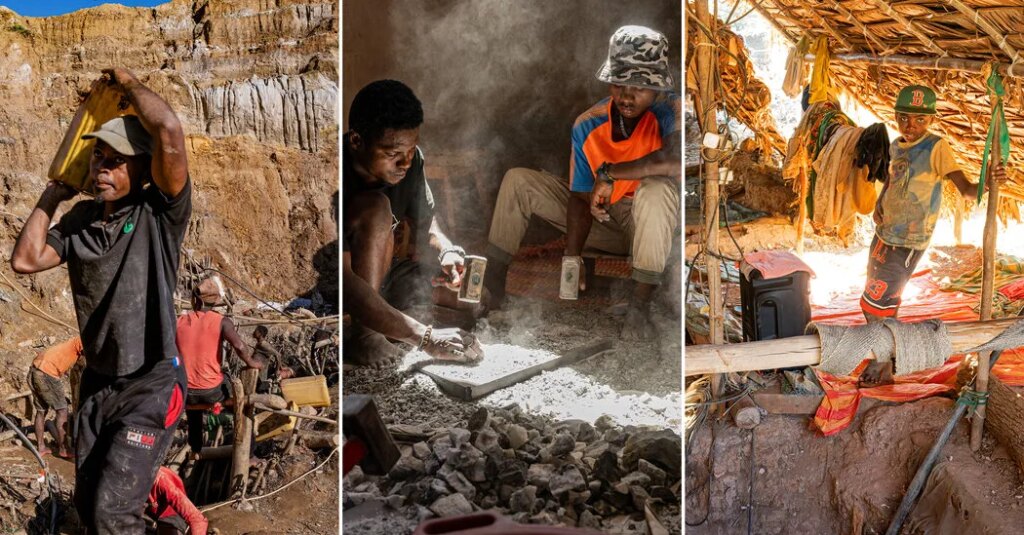
In the past year, I’ve seen toddlers working in gold mines. I’ve met miners who pay a drug cartel for the right to dig, and watched a boy drink from an underground mine’s wastewater pipe. I met workers in Colombia whose hands tremble from mercury poisoning.
One thing they have in common is that they supply gold to the supposedly tightly controlled marketplace of Wall Street financiers, central banks and government mints.
As my colleagues and I unraveled how that was possible, we kept coming back to one key point: The people who are supposed to keep dirty gold out of the legitimate marketplace rarely actually visit the mines.
That’s the gaping hole at the center of the world’s mainstream gold market. The industry has layers of people tasked with certifying that supplies are free from abuse and criminality, but nobody makes them leave their desks in places like London and Geneva.
The Times this week reported that the London Bullion Market Association, the closest thing the industry has to a regulator, has repeatedly allowed gold into the market that has been mined by criminal gangs, a drug cartel and children. In one case, we found the association helped a refiner paper over apparent violations.
Human rights abuses and criminality are often obvious, if you show up and ask. Earlier this year, I visited a mine in Northern Colombia, where miners told us they pay a drug cartel for the right work there. The gold was certified as meeting the industry’s highest standards, and was sold to a supplier of the U.S. Mint.
Similarly, my colleagues revealed that President Trump hurriedly allowed gold imports from Venezuela before independent inspectors could visit the mines and before traders had finished their due diligence.
Venezuelan mines are notoriously linked to corruption and criminality; the national gold company is designated a U.S. security threat. The importer hired one of the world’s top supply-chain experts, who praised the import plan without ever visiting the mines.
A Times reporter visited and quickly found that gangs were profiting from the gold.
I visited mines in Madagascar where children panned for gold in raw sewage and workers hammered rock, with no helmets or shoes, in shafts hundreds of feet deep. Adolescents said the pull of gold is stronger than that of school.
“I’ve already tasted money,” said a 15-year-old boy named Fredo who hauls 20-liter water tanks for miners.
Four decades ago, the Bank of England regulated the gold market, effectively as an arm of the British government. But in 1987, it passed its oversight to the L.B.M.A., an industry group run by the world’s biggest banks and refiners.
For years the L.B.M.A. was mainly concerned with gold purity and weight, not rights abuses and environmental damage. Gold was so much cheaper then. So illegal gold mining, while problematic, was not nearly as profitable, widespread and catastrophic.
But over the past two decades, wealthy investors and governments fueled a price run-up that sent gold to record highs (today’s price is roughly four times what it was in 2010). A destructive illegal-mining boom followed in some of the world’s poorest places.
Miners, and criminals who profit from them, have rushed into areas that are ecologically and politically sensitive, and often dangerous.
Brazilian gangs have moved mining barges hundreds of miles upriver, into some of the Amazon’s most remote corners. Gold mines have dumped millions of tons of waste into Papua New Guinea’s rivers. Close to 200 people have died this year at mines in Uganda, the Central African Republic, Sudan and Sumatra.
In an effort to fight the worst abuses, the United States and the European Union passed laws attempting to exclude so-called “conflict minerals” from the global supply.
In response, the L.B.M.A. issued rules aimed at eliminating money laundering, corruption, organized crime and child abuse from the supply chain. Since 2012, refiners have had to conduct annual audits to show that they followed those rules.
One major requirement: Refiners who process gold from small-scale operations must inspect the mines. This is different from government inspections. Officials in corrupt governments or countries with weak human rights records have an incentive to say that their gold is mined cleanly. The industry inspections are meant to ensure it.
But loopholes and lax enforcement mean inspections don’t always happen. If gold from a high-risk mine passes through a middleman, for example, the refiner can obscure its source. That’s how drug cartel gold ended up at the U.S. Mint and the Royal Canadian Mint. The drug connections melted away in a cauldron of gold in Texas.
In Madagascar, gold from unlicensed mines sailed into the legitimate marketplace. Despite the L.B.M.A.’s written rules, the refiner said it did not need to inspect the mines itself. The gold was certified as meeting the highest levels in the industry.
The post To Find Criminals and Child Exploitation in Gold Mines, We Just Had to Look appeared first on New York Times.