Off the Reservation
by Stephen Graham Jones
You don’t need to have read “The Only Good Indians” to enjoy Jones’s newest novel (though you should — thank me later). OFF THE RESERVATION (Saga Press, 400 pp., $32) is more of a companion to his 2020 breakout than a sequel, and follows Nate Yellow Tail, whom we last saw alive but gutshot at the end of “The Only Good Indians.”
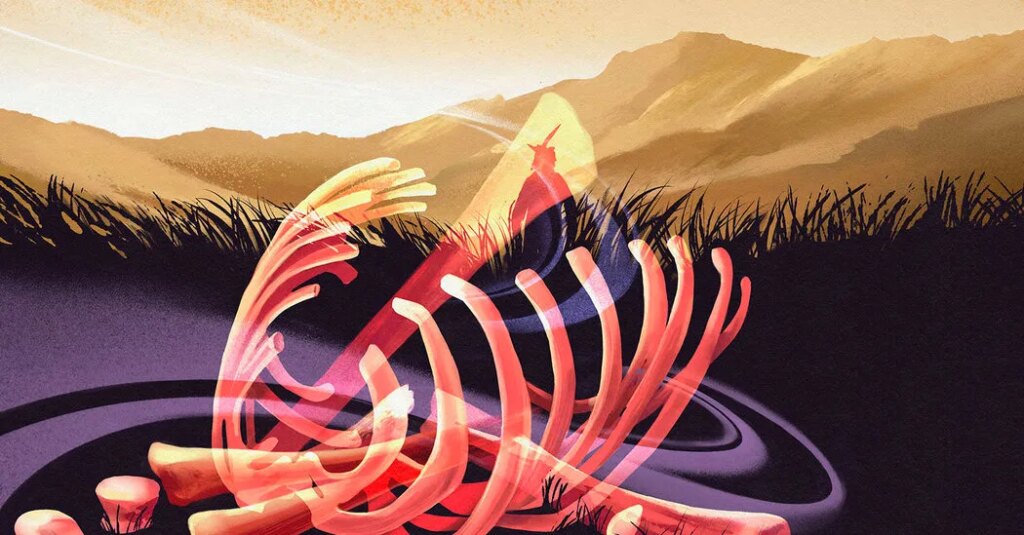
While Nate, now 20 and rudderless, is recovering from a head injury, a kind nurse enlists him for an illicit road trip to recover the bones of a Blackfeet boy who died at the Carlisle Indian Industrial School in Pennsylvania. Nate, who considers himself a “bad Indian,” is mostly just along for the ride, until, in a clever structural echo of “The Only Good Indians,” everything we understand about this story is suddenly upended at the halfway mark. When I realized where the novel was really going, I got goose bumps.
“Off the Reservation” is a coming-of-age tale, a fabulist possession novel and a revenge epic rolled into one. Jones is a delightfully idiosyncratic storyteller; his sentences flow and bend around unexpected corners of logic and feeling, and he has the confidence to let details hang unresolved until you’ve almost forgotten about them. This novel shines through a wondrous blend of wry humor, casually devastating revelation and unimpeachable skill.
Crone
by Keith Rosson
Some authors establish a universe across different books by locating their stories in the same fictional town; the common denominator linking Rosson’s electrifying horror-noir novels is an organized crime syndicate. In CRONE (Random House, 336 pp., $30), Rosson introduces us to Eli Lamp, a cop-turned-addict-turned-enforcer for the Crooked Wheel gang who’s never stopped searching for his vanished daughter, Hannah.
The monotony of Eli’s grief is upended by the gruesome murder of one of the Crooked Wheel’s leaders and the reappearance of Avery, a young woman who was with Hannah the night she disappeared. As accusations fly and bodies fall, it becomes impossible for Eli and Avery to deny that there’s something in the woods behind Eli’s trailer — something powerful and angry. Something that knows more than it should about lost girls and the need for justice.
“Crone” is a brutal, violent and soulful novel. Rosson understands how to evoke sympathy for the fallen and the broken without reducing them to stereotypes. He also has a knack for incorporating horror in unexpected ways — one of the book’s driving forces, a Cronenbergian narcotic called “wire” which is inserted under the fingernails, had me involuntarily clenching my fists to protect my own nail beds.
Mazywood
by Tananarive Due
Due’s powerful 2023 novel, “The Reformatory,” solidified her reputation as the reigning empress of Black historical horror. In MAZYWOOD (Saga Press, 504 pp., $32), she introduces us to Mazelle Washington, 7 years old in 1926 and already poised to be a star. Her act, Little Mazy and Scout the Wonder Dog, has landed her a role in an “Our Gang”-style silent film series. But Mazelle has a secret: She made a wish that brought Scout to her side, and that wish has deadly ramifications.
In the present day, her grandson, Johnny, reluctantly brings his family to Mazywood, Mazelle’s lodge on the slopes of Mt. Shasta. Years after her death, something hungry still lingers in the woods around Mazywood.
Due delights in situating her stories against the backdrop of Black cultural history, and she’s very good at it. Mazelle’s journey through old Black Hollywood finds her navigating predatory studios and racist executives and rubbing shoulders with Hattie McDaniel, Lena Horne and other Golden Age luminaries.
But Due seems more creatively animated by Mazelle’s life than by Johnny’s, and the present-day sections suffer for it. Johnny’s story is fractured by the decision to spend too much time in the minds of his wife and daughters, and all four characters get short shrift. The two timelines never quite mesh, leaving the novel feeling disjointed and uneven.
American Nightmare
by Kelly McWilliams
More successful is AMERICAN NIGHTMARE (Crown, 289 pp., $29), which follows Clark Wendell White, a light-skinned Black man trained by the N.A.A.C.P. to go undercover to investigate lynchings during the Red Summer of 1919. Clark perceives a kind of animating spirit in the eyes of the white perpetrators he meets, which he comes to think of as the Nightmare — a formless entity that foments racial violence.
Clark’s chameleonic appearance makes him a valuable asset in the fight against hatred, but it also isolates him. McWilliams does a beautiful job articulating the double-edged nature of passing: Clark is hypervigilant about how he speaks and behaves in both white and Black spaces, always calibrating his safety based on who the people around him believe he is (or isn’t). The emotional and psychological toll is tremendous.
The speculative elements of “American Nightmare” are handled with a light touch — McWilliams confidently lets the historical horrors here speak for themselves, and the novel is stronger for it. It’s a timely and haunting exploration of an oft-overlooked era in American history.
The post Horror Novels Filled With Slow- Burn Dread appeared first on New York Times.