On Saturday, protests shut down large swaths of Paris. In parts of the city and around the country, pockets of these demonstrations turned violent. Looting and arson marked streets near Place de la République and in the First Arrondissement, where shop windows were broken and electric bikes were set on fire. In the city of Limoges, the 19th-century Hôtel de Ville went up in flames; in Lyon, a tourist office blazed.
Protests here began in late September with students in the suburbs exhausted by the conditions of their schools, including their inability to cool or heat classrooms, keep out rats or simply keep teachers. This weekend, hundreds of thousands of French men and women joined the students on the streets in an expression of mass frustration over the cost of living, extreme wealth disparity, government paralysis and a faltering social welfare system.
For the past decade, I have spent part of every year in Paris. Protests are a fact of life here, but Saturday’s were different, larger, more intense. Many groups, including the Gilets Jaunes (Yellow Vests) — a protest movement that seized the country in 2018 and 2019 over the falling quality of life — joined the students, along with labor unions.
I left the Left Bank and set out on foot for Bastille, 30 minutes away across the Seine, on Saturday around noon. The Bastille column was covered in graffiti from a demonstration the previous week. There I caught the tail end of a procession of people making their way toward Place de la République. It was a largely peaceful group of mostly young people, some holding signs mocking President Emmanuel Macron, some waving French flags. Intermittently, marchers would break out in chanting and clapping.
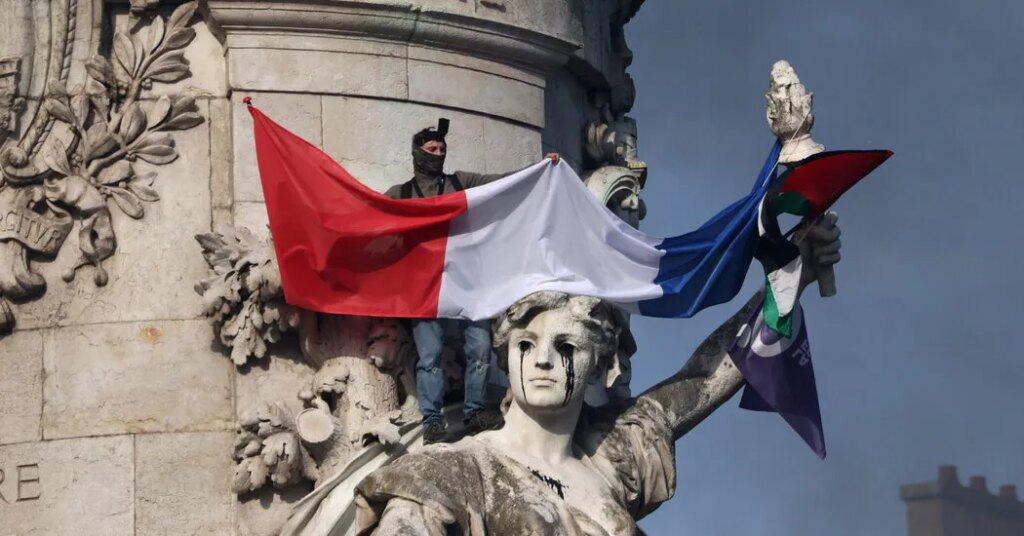
At République, police officers ringed the square, dressed in riot gear as though preparing to go to war. It was crowded but civil. Some people wore surgical masks, others gas masks, ready for tear gas, the faint smell of which was already in the air. Television crews interviewed protesters. A few climbed the statue of Marianne, the symbol of the French Republic, and waved French flags. Shortly after I arrived, flash bangs began going off on one of the side streets toward Canal St. Martin, and canisters of tear gas could be seen sailing through the air. Crowds began running back into the square. As the tear gas grew thicker, I sought a quick exit down the narrow path the police had provided for people to leave.
It was only on Sunday that I saw the shattered windows, looted stores and charred remains of electric bikes.
The violence of the protests, which were amplified on social media and apparently the result of rioters exploiting the moment, threatens to undermine the message of the students and risks resulting in the exact opposite of their goals, which is to petition for more government resources devoted to education and, by extension, a more sustainable future.
These days of protest and rage have struck me as more than just a rebuff to the French government. The students’ fury is giving voice to some larger social failures many of us, in France and elsewhere, often fail to face directly: the climate catastrophe, the terror of artificial intelligence, the faltering economic picture. The students’ determination to voice their anger and frustration over the future is a necessary and courageous reminder that we all need to be facing facts and acting on them.
On my bike ride home from République on Saturday, I encountered an impromptu gathering of students singing the “Marseillaise,” the French national anthem. As they passed the intersection, some set down bikes and other objects to block cars and make the trip more difficult for everyone. That’s as it should be, I thought, as I navigated past the makeshift barricades. Against the backdrop of so many destructive forces, none of us, anywhere, should be allowed to proceed easily.
Since late spring, a series of calamities, in quick succession, have taken a battering ram to the fantasy that Paris is some sort of respite from the problems plaguing the world. A number of punishing, record-breaking heat waves roiled the country, beginning in May. Temperatures in Paris soared above 100 degrees Fahrenheit again and again this summer. Joyful images of young Parisians leaping into the Canal St. Martin and the Seine were sobered by a national death toll of nearly 8,000 and fires that burned tens of thousands of acres of land. The spectacle of haute couture shows held in the extreme heat felt especially grotesque. Walking through the city this fall, I still see the tattered remains of silver foil hacked together to keep out the heat fluttering from windows. Every piece of store-bought chocolate I’ve purchased since summer is white from having melted and resolidified. As October began, I wandered into the Pride parade rescheduled after the extreme heat made it untenable.
And then the streets were aflame.
All this is happening against the impending presidential election next spring, which currently favors the far-right candidate Marine le Pen. To paraphrase F. Scott Fitzgerald, chronicler of the interwar period (another era known for its wild abandon), a restlessness approaches hysteria, with menacing undertones that have finally burst to the fore with the protests. Mr. Macron, the target of much of the students’ anger and derision, didn’t help matters much by spending his Friday night with Celine Dion, dancing at the city’s most coveted concert just before parts of Paris burned.
In a speech broadcast live Sunday night, Mr. Macron made a point to differentiate between the protesters’ “legitimate demands” and “those who destroyed, smashed and looted.” He said, “We all feel anger and shame.”
Americans, in particular, have always been susceptible to the country’s siren call. Last year, France had a 14 percent increase in first-time residency permits issued to Americans. As life and politics in the United States have grown ever more harsh and punishing, Americans have craved France’s monthlong vacations and universal health care (if not the tax burden that supports them).
But now, with Saturday’s enormous— and enormously destructive — protests, the dream that there is a place of escape may be nearing an end. With their anger and determination to tap into France’s long history of revolution, students are showing the rest of the world that the only way to march into the dark future is together.
Loudly. And with cleareyed resolve. Their challenge now is to keep the violence at bay. If there is a French fantasy to pursue in these tumultuous times, this must be the one.
Glynnis MacNicol is a contributing Opinion writer. She is the author of “I’m Mostly Here to Enjoy Myself.”
The Times is committed to publishing a diversity of letters to the editor. We’d like to hear what you think about this or any of our articles. Here are some tips. And here’s our email: [email protected].
Follow the New York Times Opinion section on Facebook, Instagram, TikTok, Bluesky, WhatsApp and Threads.
The post The French Kids Are All Right. It’s the Rest of Us I’m Worried About. appeared first on New York Times.