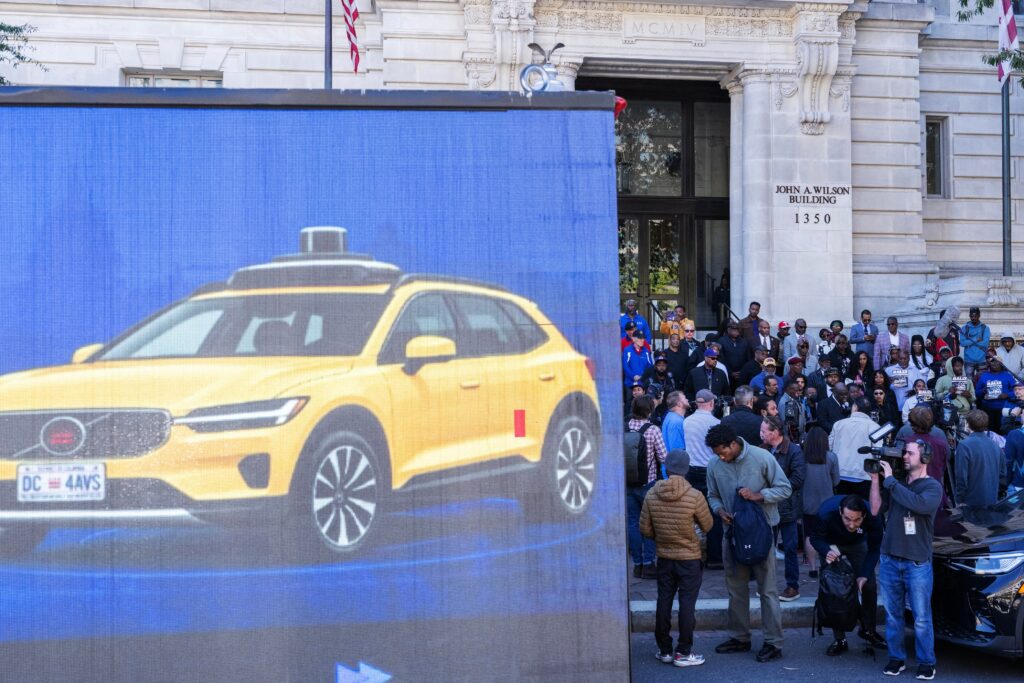
Dozens of union leaders, ride-hailing drivers and other demonstrators gathered on the steps of D.C.’s historic city hall this month to oppose a major bill allowing driverless cars.
“Robotaxis don’t vote; we vote!” some chanted. Their goal: to kill the effort to legalize commercial autonomous vehicles in the District.
The organizer was the People First Transportation Alliance, according to multiple attendees and the event’s RSVP form.
But just who is behind the group remains unclear, even as it has sought to sway the outcome of a contentious issue with vast sums of money and thousands of jobs at stake across the country.
The group operates in Philadelphia and New York, according to its website, and describes itself as a “national coalition” that opposes robotaxis because of concerns about job loss and public safety.
The Transportation Alliance lists 13 individuals and organizations as “founding members” on its website. But four of them told The Washington Post they are not.
Bishop J. Lewis Felton, president of the Black Clergy of Philadelphia and Vicinity coalition, said he had not heard of the Transportation Alliance and was not aware he was listed as a founding member until The Post asked him about it. “That’s news to me,” he said.
Felton said he supports Waymo, the autonomous vehicle company that is a major backer of the legalization effort in D.C. At a convention in Phoenix last year, he said, he rode in Waymos throughout the week. “It was a great experience,” he said.
New York consultant Amelia Adams told The Post she helps run the Transportation Alliance, but she would not say who leads the group. She didn’t respond to questions about who funds it, who created its website or who compiled its list of founding members.
“It raises a big question about transparency and disclosure,” said Edward Walker, a sociology professor at UCLA who has researched how companies and special interests shape “grassroots” political campaigns.
D.C. Council member Charles Allen (D-Ward 6), who introduced the robotaxi bill, said commercial deployment could begin in 2028. That’s years after San Francisco, Phoenix and other cities opened the door to autonomous vehicles.
On Thursday, the District’s Democratic nominee for mayor, Janeese Lewis George, came out against the bill, citing job-loss concerns. “DC must be a leader in welcoming new technology while supporting workers and prioritizing safety. Let’s get this right and not rush Waymo legislation this year,” she wrote in a social media post.
Allen said he plans to move forward with the bill sometime this fall. He said “the concerns about job losses or displacement are real” and noted that is why the bill includes support for workers.
For years, Alphabet-owned Waymo has lobbied the District — including by hiring four lobbying firms, filings show — to allow it to operate commercially in D.C., where Waymo has been testing its cars since 2024 with human drivers behind the wheel. An array of labor unions, clergy members and ride-hailing giants such as Uber and Lyft have opposed the bill, citing concerns about safety, jobs and competition.
“Washingtonians deserve an honest conversation about how to integrate fully autonomous vehicles in a responsible way. Those shaping that conversation should be transparent about who they are and whose interests they represent,” Waymo spokesman Ethan Teicher said in a statement.
The fight for the lucrative Washington market is particularly fraught given the symbolism of the nation’s capital and the chance to serve lawmakers with sway over the companies and their futures. Robotaxis threaten to upend the business model of ride-hailing companies as Waymo expands to 15 cities and counting around the United States. In 2025, the venture capital firm Bond reported that Waymo had absorbed 27 percent of San Francisco’s ride-hailing market in 20 months.
The Transportation Alliance has tapped into that threat of job loss. But much about its background remains unknown.
In response to an interview request, Andrew Bard Epstein, a New York consultant who said he works with the Transportation Alliance, wrote in a text message: “If it’s about untangling this coalition, I’m going to respectfully pass!”
The group appears to be newly formed, with a minimal social media presence. Its website domain was created in late April, according to the Internet Corporation for Assigned Names and Numbers. The three social media accounts linked on the group’s website — X, Facebook and YouTube — were created in May, but none of them have any posts. The X and Facebook accounts have no followers.
An analysis of metadata on the group’s website indicates that a user named “pamela.stamoulis” was involved in exporting some of the site’s components, including its icon and logo. News articles critical of Waymo, linked on the site, were created by an author named Pamela who used the display name “PS,” according to website metadata.
A digital strategist named Pamela Stamoulis has ties to New York and Washington. She did not respond to multiple requests for comment.
Several groups and individuals said statements made about them on the Transportation Alliance website were inaccurate.
The Amalgamated Transit Union Local 1181 and the Transport Workers Union Local 100 said they weren’t “founding members,” despite being listed that way on the site.
Ross V. Nicotero III, president of the Amalgamated Transit Union Local 85 in Pittsburgh, said he was “flabbergasted” when The Post told him that he was listed as a founding member. He said he had never heard of the Transportation Alliance and was not a founding member. “I don’t appreciate my name being used in all this stuff,” he said.
Adams — who previously worked as political director for former New York mayor Bill de Blasio’s reelection campaign, according to her LinkedIn profile and media reports — did not directly address questions about why several groups listed as “founding members” said they had never heard of the group. She asserted that members of some of those groups had been supportive.
Adams said she had “personally seen” the Transport Workers Union Local 100 and pastors from the Pennsylvania Baptist State Convention support the Transportation Alliance “in press statements and events.” She added that members of the Black Clergy group attended a Philadelphia rally earlier this year.
She did not comment on the claims made by Nicotero or the Amalgamated Transit Union Local 1181.
The Rev. Melvin R. Baber, president of the Pennsylvania Baptist State Convention, said last month that he had never heard of the Transportation Alliance and was not a founding member. Baber said he opposes autonomous vehicles because he is concerned about job loss. Last week, Baber said he had misspoken and now remembers the group, and that he actually is a founding member.
When reached by The Post, three other groups — the Independent Drivers Guild, Justice for App Workers and an African American clergy organization — said they were founding members of the Transportation Alliance. The International Association of Machinists, which is listed, said it is not a founding member, but one of its districts is. One group provided incomplete information, two others did not respond to questions, and one person could not be reached.
Adams was previously registered as a lobbyist for Uber in New York from 2021 to 2023, filings show. An Uber-funded lobbying group in New York called Citizens for Affordable Rates has paid more than $220,000 this year to Adams’s consulting firm Adams Advisors LLC, all for “advocacy — civic engagement/community organizing,” according to public New York lobbying records.
An Uber spokesperson said the company has worked with Adams to support insurance reform efforts in New York. Adams and the Uber spokesperson said Adams’s work with Citizens for Affordable Rates was unrelated to autonomous vehicles or the Transportation Alliance.
“That work has been publicly disclosed and extensively covered for months. Conflating it with PFTA simply because I have worked on both efforts is incorrect,” Adams said in a statement, using the acronym for the People First Transportation Alliance.
Uber said in a statement it wasn’t involved in the group’s website or D.C. protest.
In Pennsylvania, the head of a public affairs firm said the company has worked with the Transportation Alliance.
Bellevue Public Affairs “has provided limited local engagement to PFTA in Philadelphia,” President Jessica Cosmé Platt said in a statement. According to the company’s website, its “sister firm” is the lobbying group Bellevue Strategies, which has been a registered lobbyist firm for Uber in Pennsylvania since 2023, state lobbying records show.
“Uber is not, and has never been, a Bellevue Public Affairs client. Bellevue Strategies is a separate entity,” Cosmé Platt said. She declined to say who hired Bellevue Public Affairs to work with the Transportation Alliance.
The Transportation Alliance’s work has also extended to clergy members in New York.
Earlier this year, the Rev. Conrad Tillard, from the Congregational Church of South Hempstead on Long Island, emailed ministers with an offer of a $250 stipend to go from New York City to Albany the next day to advocate for legislation requiring human drivers in every vehicle, according to screenshots of the email reviewed by The Post. The email did not say where that money would come from. Transportation to Albany would be “fully provided by The People First Transportation Alliance,” the email said.
Tillard did not respond to multiple requests for comment. According to his LinkedIn, Tillard is the executive director of a group called Black Clergy for Economic Empowerment, which the Transportation Alliance lists as a founding member.
Adams said she had “no knowledge of stipends or payments to anyone associated with that campaign.”
At the anti-Waymo protest in Washington this month, Ali Alahmadi, culture director of a group he called the Yemeni American Community, said he had never heard of the Transportation Alliance before Adams reached out asking for his support.
Standing amid the protesters gathered at the Wilson Building, Alahmadi said Adams didn’t give many details. “I don’t know too much about the alliance,” he said.
The post Group fighting to block Waymo in D.C. has mysterious origin, backers appeared first on Washington Post.