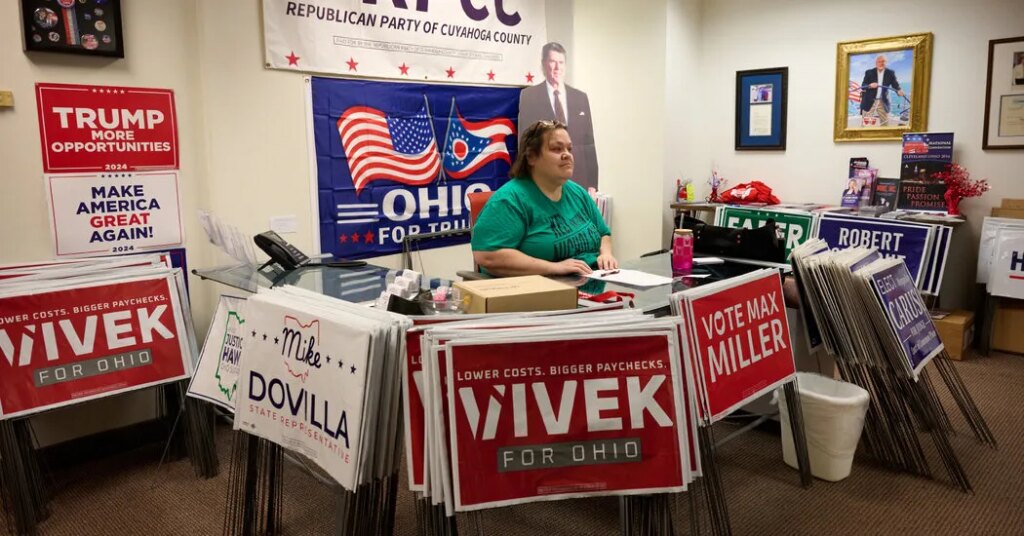
Just two volunteers showed up on a recent weekday at a Republican Party campaign office near Cleveland that in 2024 was brimming with activity every night.
One of the two, Tanya Karabanovs, 54, sat among stacks of untouched yard signs and brainstormed new ways to convince her neighbors to vote for Republican candidates such as Senator Jon Husted, who was appointed in 2025 to finish the term of Vice President JD Vance. Her most recent idea: stuffing chocolate bars into goodie bags with leftover campaign literature.
“This is really a weird cycle,” said Ms. Karabanovs, who recalled at least 30 volunteers packing into the office each day in 2024. “There’s no way to feel confident about any of the races, honestly.”
Many of the Republican volunteers trying to keep Ohio’s Senate seat red started the summer making the case that, despite rising prices, Mr. Husted was better suited to fix the economy than his Democratic challenger, the former senator Sherrod Brown. But when it became clear that the message wasn’t landing, they began to pivot.
Some, like Ms. Karabanovs, got creative. The political PAC for Americans for Prosperity, a prominent conservative advocacy group that deploys thousands of door-knockers across the state, switched its script to the threat of socialism — and organizers quickly noticed a difference.
“I wouldn’t like that,” said Nikki Cvetkovic, 77, after opening her door in a working-class suburb of Youngstown and inspecting a pamphlet with a picture of Brown next to the words, “SOCIALISM THREATENS YOUR FREEDOM.” She said she would cast her ballot for Mr. Husted.
Polls have shown Mr. Brown running ahead of Mr. Husted in one of the most closely watched races of this cycle. But many conservatives across the state believe they can pull off in the final two weeks what Republicans have done better than Democrats for the last 10 years: defy expectations on Election Day.
The modern-day Republican Party is built on upsets. Twice, polls showed Mr. Trump losing the presidential election only for him to triumph, cementing the MAGA movement’s staying power and underdog status. The question now is whether the G.O.P. can do it again, at a time when Mr. Trump is not on the ballot and his popularity is historically low.
The answer lies on the ground in unexpected battlegrounds, including Iowa and Ohio, which have swung to the right over the last decade but this year have shown signs of shifting back. In these states, as the Republican Party has struggled to defend Mr. Trump’s handling of inflation, the war with Iran and tariff policies, local campaigns and committees have leaned into depicting Democrats as dangerously far to the left — a last-ditch gambit to persuade their voters not to stay home or break the other way.
In a historically expensive midterm cycle, the Republican Party apparatus has poured more money into Ohio’s Senate race than all but one other contest, spending more than $277 million as of Saturday, according to AdImpact. At least a third of that spending has gone toward negative advertisements about Mr. Brown, many of which depict him as part of the far-left wing of the Democratic Party.
At Mr. Trump’s rally in Youngstown on Monday, he called Mr. Brown the “candidate of the Marxists, the communists, the anti-American radicals who want to tear down America’s heritage.”
It may not be enough. Representative Max Miller, one of President Trump’s closest allies in the House who has been besieged by allegations of domestic violence against his young daughter and ex-wife, came out against the war in Iran on Wednesday night during a meet-and-greet at a pub in Parma, a union town south of Cleveland.
National Republicans have withdrawn campaign funds from Ohio’s First Congressional District, where they had hoped to unseat a Democrat.
And a Republican National Committee operative circulated an email this week with data from Ohio showing Democrats outperforming Republicans in early vote, absentee votes and ballot requests compared with 2022 and 2018, according to an email reviewed by The Times.
Democrats in Ohio remain optimistic about returning Mr. Brown to the Senate, mostly because of Mr. Trump’s low approval rating and the deteriorating economy. But they also have benefited from Mr. Husted’s struggle to introduce himself to voters since he took office 21 months ago.
A former lieutenant governor and member of the House known for his outward reserve, Mr. Husted has tethered himself for much of the year to Mr. Trump, but he has also spent significant time describing his biography, including his time as a college football player and his upbringing as the son of a local factory worker focused on bringing jobs to the state.
Republicans, including Mr. Husted, are bracing for narrow margins on Election Day.
“We have a tough race, there is no doubt about that,” Mr. Husted said at an event last week at a G.O.P. field office in Mahoning County, which sprawls across three units of a strip mall in a region that once powered the country’s steel industry. “Midterm elections are tough.”
Mr. Husted had drawn a full house to the outpost in the Youngstown area, with supporters crammed between a plaque celebrating the Second Amendment and boxes of pizza. The crowd cheered when he took the lectern. As he spoke, rows of people nodded along and held up their phones to snap pictures.
“Find someone you haven’t talked to in a while, call them,” Mr. Husted continued. “You tell them I told you to call and ask them to vote, tell them that you spent time with me.”
Sitting in a plastic chair and listening along was Doris Layfield, who works at the board of elections in Mahoning County. She said she had knocked on doors for Mr. Husted and that she had liked what he said in person.
“Honestly, it’s really kind of scary,” she said. “If he doesn’t win, I really do feel like we will be living under communist rule.”
Mr. Brown, who was defeated in 2024 after three terms in the Senate, lost Mahoning County for the first time that year. The margin was just 220 votes.
He is aware that his victory is far from assured in a state that Mr. Trump won by 11 percentage points the same year he was unseated. He also seems to know that Republican claims that he’s a radical could resonate among Ohio’s increasingly conservative voters. He cut one ad, for instance, that responded to attacks from his opponent and an Elon Musk-backed PAC regarding transgender issues.
Mostly, though, Mr. Brown is running on the same progressive populism that has defined his political career since the 1970s.
In speeches at union halls, Mr. Brown talks about how the economy is “rigged,” says Congress is controlled by insider trading and describes Mr. Husted as a “special interest guy in Washington” who is detached from working-class people. He has also targeted Mr. Husted for his support for investments in data centers while he served in state government.
Aware of the resonance of the issue in Ohio, Mr. Husted sponsored a bill that passed in the House last month that encourages states to make data centers pay for higher energy costs, though it would not compel them to do so.
Back in the Youngstown area, Donovan O’Neil, a senior adviser in Ohio for Americans for Prosperity’s political PAC, walked up to a house with an American flag hanging from its porch. Barb Delaney, 65, a part-time bookkeeper, answered.
“Are you planning to vote?” Mr. O’Neil asked.
“Oh hell yes,” said Ms. Delaney, who was wearing a Detroit Lions T-shirt. “For Sherrod.”
Mr. O’Neil was not ready to walk away. He said he’d like to ask Ms. Delaney, a self-identified Democrat, a follow-up question: “Are there concerns for you with the rise of socialism, the Democrat Socialists of America?”
There were some, she said. But Ms. Delaney was far more incensed this year about data centers, and she blamed Mr. Husted. Because of a nearby development, she said, her energy bill, which includes heat for her pool, had surged from $200 a month to almost $500 — by far the highest it had been in the 28 years she had lived in her current home.
“My electric bill is skyrocketing,” she said. “Nobody wants data centers around.”
Then, referring to Mr. Husted, she added: “I will not vote for that man. I would never.”
Mr. O’Neil listened, and after a few more attempts to engage her, he continued down the block.
The post Republicans in Ohio Are Worried About Turnout. Here’s What They’re Doing About it. appeared first on New York Times.