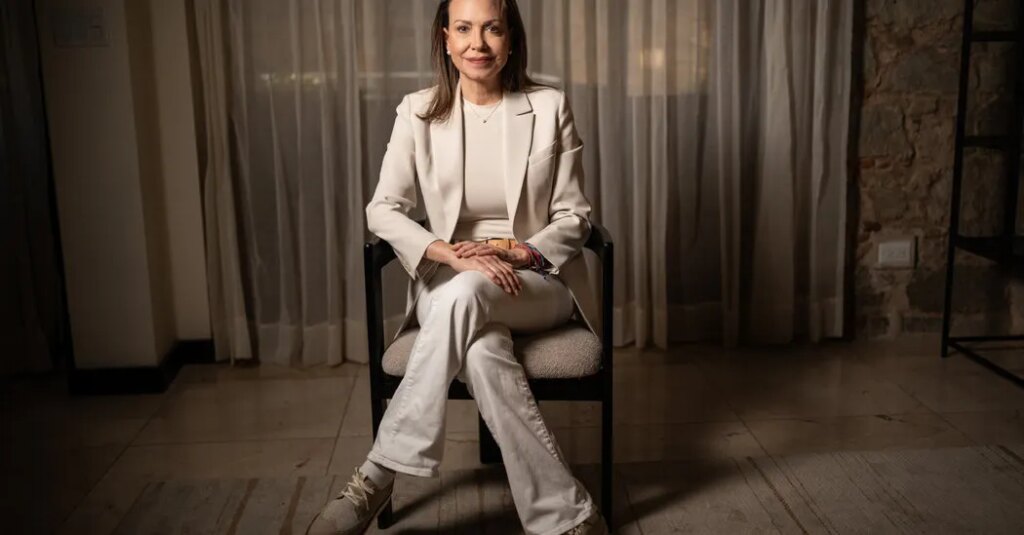
María Corina Machado is Venezuela’s most popular opposition leader. But she has not been able to return to her country since last year, when she left to receive the Nobel Peace Prize. Since then, the Trump administration captured Venezuela’s autocratic leader, Nicolás Maduro, on Jan. 3, 2026, and installed his vice president, Delcy Rodríguez, passing over Ms. Machado for the leadership spot.
Ms. Machado’s political movement won Venezuela’s 2024 presidential vote, even as the state arrested, beat and imprisoned her supporters. But the ruling party refused to give up power, and it continues to govern under President Trump.
Ms. Machado wants to return to Venezuela and run for president in another election. She spoke this week with Julie Turkewitz, the Andes bureau chief for The New York Times. They met in Panama, where Ms. Machado is staying.
Here are excerpts from the wide-ranging interview, in which Ms. Machado criticized the Trump administration’s handpicked partner in Venezuela and spoke about her country’s future.
I want to start by talking about where we are now. Have you been sidelined politically by the United States?
This is a really transformational moment. I believe that Venezuela has had a cultural change for the good, even though it went through this ordeal of 27 years, and so much devastation.
What we have done in these last years is something that is unstoppable and irreversible.
So probably we have different time frames with the United States government, but I have no doubt that we have the same vision in terms of a democratic transition. And in that sense, you cannot sideline the will of a people that have decided to be free and that have organized themselves to achieve it.
Do you agree with the decision by the U.S. to keep Delcy Rodríguez in power?
That was a possibility. She’s certainly doing whatever she’s been told. And that can be comfortable for certain interests in terms of moving smoothly.
I believe it could have been done, certainly, without her because she’s part of the criminal system. But it is what it is, and here’s where we are, and as I said before, it’s in the interest of the Venezuelan people that this works.
If you become the next leader of the country, what is your specific plan for what happens to the high-level leaders of the current government? You have talked about the idea of justice. Specifically what does that process look like?
We want Venezuela to change, so something that we certainly will not do is act as the regime has done, violating human rights and violating the Constitution. So certainly, we’re determined to offer justice and respect for the rights of even those people that violated our own rights.
Because this has to be the foundation of an institutional framework that will last for generations to come. So we’re not moved by revenge or hate.
We are moved by the truth and the fact that we have to assure that those crimes will never be repeated in Venezuela.
Our proposal is to create a truth commission that’s integrated by individuals that have respect and credibility in all of Venezuelan society and can address, case by case, how to move forward, taking into account not only the severity, the seriousness of the crimes committed, but also the disposition of every individual to ask for forgiveness, to facilitate the process, to facilitate justice.
Would some of the highest figures — for example Delcy Rodriguez, Interior Minister Diosdado Cabello — face possible prison charges in a new government?
[As vice president under Mr. Maduro, Ms. Rodríguez helped lead a government in which human rights abuses were common. The Trump administration imposed sanctions on her in 2018, calling her a key figure in solidifying Mr. Maduro’s authoritarian rule; it lifted the sanctions this year after choosing her as Venezuela’s leader.
As interior minister in charge of the police and prisons, Mr. Cabello has overseen widespread repression in Venezuela, the U.N. says. The Trump administration imposed sanctions on him as well, and named him as a defendant in a Jan. 3 drug trafficking indictment against Maduro, but he remains in Ms. Rodríguez’s government.]
In our Constitution and international treaties, there are crimes that are not subject to amnesty or forgiveness. You know, human rights violations and crimes against humanity or terrorism.
I believe it should be an independent commission that addresses this issue, and I believe no one should beforehand state what is going to be the punishment for those who have committed crimes.
But prison would be on the table?
In a country so hurt by systematic, massive crime, the notion of impunity could be very, very dangerous because that could turn sectors of the population against the process, because people demand justice, and that’s absolutely legitimate.
What happens to lower-ranking individuals, like the guard in El Rodeo prison, who maybe engaged in torture but says they were responding to an order from above? Does that person face justice? Does that person go to prison?
You’re mentioning just one case, but this extends to practically every sector. So yes, Venezuelan society will have to make compromises so that we can move forward.
And that’s why the truth commission is so important, because we are not ignoring it. We are addressing it. Things should be known first of all, and recognition to the victims and reparations to the victims is absolutely a priority.
Do you think that the U.S. would have to enforce the results of an election? And how would it do that?
No, I don’t think so. Not today. It should have been done two years ago.
What should have happened specifically two years ago?
Well, the Venezuelan people organized, voted and proved a landslide victory on July 28, 2024. I believe the international community as a whole should have enforced that result.
Are you angry at the Biden administration for not doing more after July 2024?
I think the international community as a whole never decided to act decisively. And I think it was a horrible precedent because the message you send to societies is that at the end they are on their own.
Would you have welcomed military action by the U.S.?
Such as what happened Jan. 3, yes.
Why has the U.S. not facilitated your return to Venezuela?
There is no one other person in Venezuela that wants this three-stage process to succeed. [The United States has said its involvement in Venezuela will have three phases: stabilization, economic recovery and transition to democracy.]
I believe that my presence in Venezuela is a significant factor to help and to strengthen the success of the process.
So the fact that I go back will help channel all this growing anxiety that we’re seeing in so many demonstrations and protests.
I would say that whoever opposes my presence in Venezuela does not want the process to be successful.
Are there people in the Trump administration who also do not want you to return?
I think there are, in the United States, in different sectors, people that truly support my return, and people that have doubts that it could be done in a safe way.
The U.S. has enormous power in Venezuela. Why has Marco Rubio, for example, not facilitated your return?
I don’t know the answer in terms of his decision, but I can tell you what he has told me. And he has been very clear in terms of my right to go back to my country — and that the president had told Delcy Rodríguez that I should not be harmed when I go back. And I believe in his word.
I know you have a relationship that goes back years with Marco Rubio. What is you relationship like now? How often do you communicate?
I will keep that private because I’ve learned that in order to build long-lasting relationships you have to act with prudence.
What happened when you tried to go back to Venezuela after the June earthquakes?
Well, the first time I tried to go through Curaçao, and my plane was ordered to turn around, I was on the plane in the air. And the second time I came to Panama, I bought tickets on a commercial flight and the regime closed the air zone in Venezuela.
I just want to confirm, were there seven attempts in total to return?
Yes.
You don’t know or won’t say who was it specifically that stopped you?
I don’t know, and I prefer not to speculate, but I certainly believe that the government of Venezuela, the regime in Venezuela, was involved.
Are you concerned that coming back to Venezuela you will encounter lack of energy, fear, people becoming comfortable-ish with the situation? Are you concerned that people might not go into the streets?
Look what is happening already, and I’m not there. One the one hand, you are seeing the expressions of former political prisoners, union leaders, teachers.
They are already expressing themselves for the first time in many, many years in this way. And that’s one of the positive results of Jan. 3.
We want to turn this into a massive discussion in small assemblies, tiny assemblies, thousands of them all around the country and using technology and A.I. — we already have a platform — in order to gather all that and truly listen to what Venezuelan people are saying.
Would you keep the Chevron deal as is?
I wouldn’t be surprised if representatives of this company and others that have signed contracts right now would like to improve the terms of their contracts once we’re done.
The fact that we will have a transparent and attractive fiscal system that can be stable for the long term, and the fact we will offer international arbitration, all of this impacts directly on your rate of return and make all these investments much more profitable.
How do you get the government of Delcy Rodríguez to hand over power?
Delcy Rodríguez today follows instructions that come from the U.S. government. President Trump and Secretary of State Marco Rubio have stated a three-phase plan that includes a transition.
There are options, but certainly the fact that the U.S. has currently top members of the regime facing justice in the United States makes very clear what’s the alternative.
But a very real dilemma that you face is that by all signs Delcy Rodríguez is doing whatever the U.S. asks. The Trump administration really has enormous control to do whatever it wants in Venezuela. In a new government under María Corina Machado, the Trump administration might not be able to have so much control. Why should the Trump administration want to give up its current situation?
I do not see a dilemma there, because if you have to choose between fear and conviction in terms of your ally, your partner, you would certainly go for the second.
This Trump administration is very focused on striking deals and getting benefits as opposed to larger ideals or convictions of democracy.
I think that from every perspective you address the Venezuelan situation right now, it is a win-win situation to move ahead into the transition.
From the migration perspective, you have over a million Venezuelans in the U.S. Sixty-five percent of them say they want to go back if there is a democratic transition.
And you need to have a partner that truly is committed to dismantling the terror regime, not to try to accommodate until a later moment in which they could bring it back to the previous state.
And third, from an economic and energy perspective, yes, some deals are being made now, but it’s a fraction of what will be made once we have security, stability and legitimacy in Venezuela.
And I think the greatest legacy President Trump will have in this hemisphere is being able to have a nation that rebuilds its institutions and that turns into the strongest ally of the U.S. in the region.
When you saw President Trump come out on Jan. 3 and say, “María Corina doesn’t have the support inside the country” — after you did all of the things that we know that you did in your country — what was your response in that moment?
My assessment was that he was referring to the security forces. And I believe that certainly in the top brass, there are individuals that have persecuted me and our team for years — for years. And in that very small group certainly I do not have support.
But they [Trump officials] know better than anybody what the rest of the armed forces and the police forces in Venezuela feel and believe. Their support for our movement is huge.
Were you angry in that moment?
I was surprised.
Do you need the U.S. on your side for there to be a free and fair election?
Certainly we do. And I trust we will — we do have them. We do have the U.S. government. And I believe we have the U.S. Congress, in both parties.
But even further, I believe the American people support our cause.
This is going to work, this is going to prove to the world that even the most cruel, corrupt tyranny can be dismantled because of the will of a people and the support of democratic leaders.
And this is why this movement is so powerful, because it’s driven by values and virtues and it has to do with the truth, it has do with transparency. And it has to do with good.
And I should ask, to have it on the record, When are you going back to Venezuela?
Sooner than you would expect.
After the interview, Ms. Machado clarified some details in a phone call, and Ms. Turkewitz asked about negotiations happening between Venezuelan officials and a different faction of the opposition, which have the goal of setting an election framework.
Did you choose not to participate in these talks, or did the U.S. not invite you?
I think it is clear to everyone by now that the United States government was the one that decided how to assemble this team from both sides. And I have been very clear. I am not part of the commission; I am also not going to stand in the way. Rather — for the sake of Venezuela and for our own well-being — we all hope that what was promised is fulfilled.
The post Our Interview With María Corina Machado appeared first on New York Times.