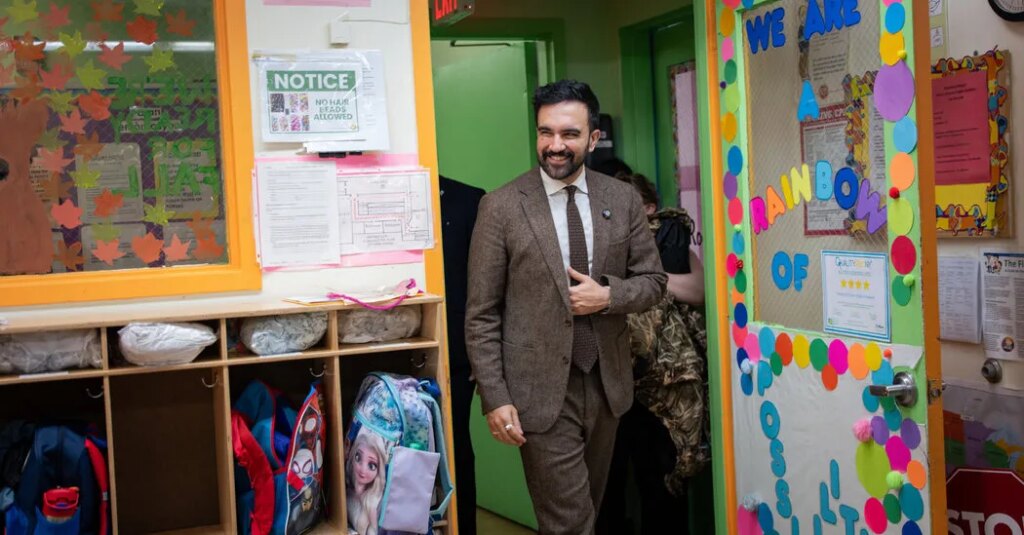
Mayor Zohran Mamdani plans to announce on Monday that New York City will expand free child care for 2-year-olds to Staten Island and across the Bronx as the city moves to add 10,000 seats next school year.
The 2-K program started this school year with 2,000 seats in four largely working class areas of the city. A major expansion could test the managerial competence of Mr. Mamdani’s administration, which has struggled to address payment delays for child care providers.
Mr. Mamdani will visit a trampoline park in the Bronx with Gov. Kathy Hochul to highlight the neighborhoods where the new seats will be offered. More than half of the city’s 32 school districts are represented in the expansion, which includes all of Staten Island and the Bronx.
“From Co-op City in the Bronx to Staten Island’s South Shore, we’re bringing 2-K to every borough and making New York City more affordable for working people,” Mr. Mamdani said in a statement.
Wealthier neighborhoods in Manhattan and Brooklyn will not add 2-K seats next year. Mr. Mamdani has said that every 2-year-old in the city will have a spot by 2029.
Ms. Hochul has said that the state will pay for the first two years of the program. But it is not clear how the city will pay for future years when the program could eventually cost $9 billion annually. Mr. Mamdani wants to raise personal income taxes on millionaires to pay for the program; Ms. Hochul has resisted the idea.
Ahead of the first day of school this year, many early childhood centers were alarmed that they had not received funding. The administration rushed to register contracts, extend loans and deliver basic school supplies.
Beyond the 2-K program, child care providers have also raised concerns that more than 25,000 low-income families have been stuck on wait lists to receive vouchers to help pay for child care. Mr. Mamdani recently announced that officials would move more than 10,000 children off the wait list.
Many families were excited to receive 2-K offers that would help them save more than $20,000 per year on child care. Other families were disappointed that they did not receive offers or declined them over concerns about quality or convenience.
Since the city began offering free preschool for 4-year-olds and then 3-year-olds, officials have tried to place the right number of seats in neighborhoods to match the demand. But that forecasting can be challenging. Some families prefer a preschool near work, while others are skeptical of enrolling in a city-run program at all.
The 2-K expansion mirrors the phased rollout of the 3-K program, which added additional school districts each year until it covered the entire city. That approach — rather than targeting smaller neighborhoods citywide with high economic hardship or high demand — helped create a surplus of vacant seats in some areas.
The neighborhoods targeted to receive 2-K seats next year have had mixed demand for 3-K and pre-K seats, according to a new report by the city’s Independent Budget Office. In a swath of the Bronx and Staten Island, demand for 3-K spots exceeded the supply during the 2024-25 school year, the report found. Yet there were unfilled pre-K seats that year in large areas of those boroughs.
The additional 10,000 seats could be filled regardless of local demand because some parents are willing to travel longer distances for a free spot. But when the program eventually expands citywide, some of the initial seats could be left empty if parents opt for more convenient sites.
The success of the 2-K expansion could depend on whether the city can sign up new child care providers. The pre-K and 3-K programs relied heavily on public schools and early childhood centers. The 2-K system is using centers and home day cares, which are popular in working-class communities.
Child care providers have long complained about inadequate funding and payment delays. Mr. Mamdani has said that the city would hire 200 workers to stabilize the system.
Lori Cangiolose, the owner of the Playgroup Experience, an early childhood center on Staten Island, said that she will have no choice but to join the city-funded 2-K program. If she opted out, she said, parents would most likely leave for free care elsewhere.
Playgroup currently has 12 students enrolled in a private 2-K program paid for by parents, a vital revenue stream that has helped keep the center afloat when city reimbursements for its 3-K and pre-K programs have been late. But Ms. Cangiolose said she would lose that cushion if her business were almost entirely dependent on the city for revenue.
“We are giving up our businesses to the city,” Ms. Cangiolose said.
Lauren Melodia, the director of economic and fiscal policy at the Center for New York City Affairs at the New School, said that as the city expands its 2-K program, it should raise pay for child care workers, who often make near the minimum wage, and make it easier for home day cares to join.
“We want to make sure there are clear pathways for family care providers to participate,” she said.
The post Mamdani to Expand 2-K Program on Staten Island and in the Bronx appeared first on New York Times.